 English
 中文简体
Content
- 1 The Material Shortlist: Six Options Behind Most Takeout Cutlery Orders
- 2 Let the Menu Choose the Material, Not the Unit Price
- 3 PP Cutlery: The Default Answer for Hot Takeout
- 4 PS Cutlery: Right for Cold Desserts, Wrong Next to Hot Soup
- 5 PLA and CPLA Cutlery: The Compostable Story Only Works if the Conditions Work
- 6 Paddy Fiber Cutlery: Rigid in the Hand, Stable at Heat, Uneven in Colour
- 7 Birch and Wood Cutlery: Texture Has Value, Soaking Does Not
- 8 Coated Paperboard Cutlery: Light, Dry and Fast, Not Wet and Slow
- 9 Heat Ranges Side by Side
- 10 Bench Tests to Run Before You Approve a Cutlery Order
- 11 Food-Contact Compliance: Documents Beat Claims
- 12 Cost per Kit: The Four Variables That Actually Move the Invoice
- 13 Humidity, Storage and Shelf Life
- 14 Recurring Buying Mistakes Worth Avoiding
- 15 Frequently Asked Questions
- 15.1 Which material should a hot-food takeout kitchen choose first?
- 15.2 Is PLA cutlery suitable for hot drinks and hot food?
- 15.3 Can wood cutlery be used with soup or wet dishes?
- 15.4 Why does cutlery weight vary between shipments?
- 15.5 How many pieces should a takeout kit contain?
- 15.6 What documentation should arrive with a cutlery shipment?
- 15.7 Does individually wrapped cutlery change the food safety picture?
- 15.8 How should compostable cutlery be stored?
The Material Shortlist: Six Options Behind Most Takeout Cutlery Orders
Start with the table. It maps the materials you will realistically be offered against the three things that decide whether a cutlery order works in service: heat exposure, mechanical load, and where the used piece ends up.
| Material | Heat contact | Best-fit menu items | Most common failure | End-of-life route |
|---|---|---|---|---|
| PP (polypropylene) | Around 100 to 120°C on short contact | Hot noodles, curry, soup, rice bowls | Tines bend under heavy food, blade dulls on meat | Recyclable in PP-only streams |
| PS (polystyrene) | Around 70 to 80°C | Ice cream, cold desserts, sushi, salads | Warps under hot sauce, cracks when stacked under load | Limited recycling access |
| PLA (amorphous) | Around 40 to 50°C | Cold drinks, parfaits, ambient salads | Deforms inside a warm delivery bag | Industrial composting |
| CPLA (crystallised PLA) | Around 80 to 90°C on short contact | Warm dishes, light hot food | Softens after long contact with hot soup | Industrial composting |
| Paddy fiber | Around 100 to 120°C depending on grade | Coffee, rice, hot sides | Moisture pickup, batch-to-batch colour variation | Varies by grade and binder |
| Birch or wood | Dry heat only, no soaking | Catering platters, events, premium takeout | Splinters, sauce absorption, odour transfer | Home and industrial composting |
| Coated paperboard | Around 90°C where a coating is present | Bakery, dry goods, light salads | Fails in wet sauces and noodle broth | Compostable or recyclable depending on coating |
Read the heat column as a working limit, not a laboratory limit. A fork that lifts a 60°C chicken breast from the pass to the table is doing very different work from a fork sitting in a 95°C curry cup for thirty minutes. Heat exposure in takeout is measured in minutes of contact with a wet, fatty, hot mass, not in the seconds a laboratory migration test uses.
Read the failure column as the thing your customers will photograph. Cutlery rarely fails loudly. It bends, dulls, splinters or takes on the smell of the sauce, and the guest blames the food before they blame the fork.
Read the last column as a purchasing question, not a marketing one. A compostable claim is only useful if your market has a collection route for it and your packaging carries the right statement. If the used fork goes into a general waste bin, the material story collapses at the point of disposal.
Let the Menu Choose the Material, Not the Unit Price
Conclusion first: shortlist the material from the menu, then compare price per order. Doing it the other way round is how kitchens end up with a five-piece set that snaps on grilled chicken and an expensive compostable fork that softens in a hot bag.
Three questions settle most of it before any quotation is requested.
What temperature does the food hold?
Not the plating temperature. The temperature of the sauce that keeps cooking the fork after the lid goes on. A curry ladled at 85°C sits against the fork wall for the whole delivery window.
How much fat is in the sauce?
Fat carries heat into the polymer surface and lubricates the contact point between fork and food. Rich sauces are harder on tines than broth, even at the same temperature.
How long until the first bite?
Fifteen seconds in a dining room and forty minutes on a scooter are two different spec sheets. Contact time, not menu description, is what the cutlery actually experiences.
A kitchen running three hot rice bowls and one cold salad bar is not served well by a single cutlery line. Splitting the order by temperature band usually costs less than upgrading everything to a heat-resistant grade, because the cold side rarely needs it.
Rule of thumb used by many takeout operators: if the sauce is above 80°C and the delivery window is over twenty minutes, test the cutlery in the actual container with the actual food before approving the shipment. Nothing on a spec sheet replaces that test.
PP Cutlery: The Default Answer for Hot Takeout
Polypropylene is the workhorse of hot-food cutlery for a reason. It holds shape near 100°C on short contact, resists grease, does not shatter on impact, and tolerates the sort of rough handling that a delivery bag delivers every night.
What matters in practice is not the raw material data but the geometry built from it. Wall thickness at the handle, the radius where the tine meets the fork head, and the taper on the blade edge decide whether the piece survives the meal.
Where PP orders fail in the field
- Tine bend on dense protein. A 1.2 mm tine lifting 200 g of grilled chicken will flex and stay flexed.
- Blade skate on meat. A blade with no serration and a shallow taper slides across the surface instead of cutting.
- Handle cracking at the box rim. Thin handles loaded against a container edge fracture at the weakest mould line.
- Weight drift between batches. A supplier shaving 0.3 g per piece to hit a price target shows up as breakage three months later.
Specifications to put into the quotation
- Nominal weight per piece for each component, in grams, with a stated tolerance.
- Handle thickness at the narrowest point, in millimetres.
- Kit configuration: five-piece, four-piece, three-piece or single item.
- Wrapping method: bulk, napkin wrap, or individually wrapped.
- Filler content, if any. Starch or mineral fillers reduce cost and reduce impact strength at the same time.
- Colour and finish: natural, white, black, or opaque with a matte surface.
For operations that need the heavier end of the range, heavy-duty plastic cutlery sets are the usual starting point because the weight and the blade geometry are already built around dense food rather than around salads.
Order samples across at least two production batches. Colour and weight stability between batches tells you more about a factory than a single perfect pre-production sample ever will.
 5-Piece Individually Wrapped PP Cutlery KitsIndividually wrapped five-piece PP sets suit grab-and-go service; order across batches to check colour and weight consistency before committing.View Product →
PS Cutlery: Right for Cold Desserts, Wrong Next to Hot Soup
Polystyrene gives you clarity, stiffness and a very low unit cost. It also gives you a narrow temperature window. Above roughly 70 to 80°C the material starts to relax, and a relaxed fork stays relaxed.
The failure is easy to describe and easy to avoid. A PS spoon resting in a hot dessert sauce curls at the bowl. A PS knife pressed against a takeaway lid cracks along the spine. A PS fork left in a warm delivery bag for half an hour arrives with a bend that the guest notices immediately.
Where PS earns its place
- Ice cream and gelato service, where the product is below freezing.
- Cold dessert spoons and cake forks for bakery counters.
- Sushi and chilled seafood trays.
- Salad bars and deli counters with ambient or chilled product.
- Event service where a clear, glass-like appearance matters more than heat resistance.
PS is also brittle. Stacked under a heavy container it cracks rather than bends, which is a different problem from PP. If your fulfilment process stacks loaded bags three high, check the crush performance before you commit to PS.
One practical note for anyone mixing materials: keep PS and PP visually distinct in the kitchen. Once the two are loose in the same dispenser, staff will use whichever comes to hand, and the hot line will find the PS.
PLA and CPLA Cutlery: The Compostable Story Only Works if the Conditions Work
Polylactic acid is made from plant starch, usually corn or sugarcane. It is genuinely compostable in an industrial facility. It is also genuinely heat sensitive, and that gap between the marketing claim and the service reality is where most disappointing orders come from.
Amorphous PLA and crystallised PLA are not the same product
Standard PLA softens somewhere around 45 to 55°C. That is below the temperature of a hot coffee lid, let alone a curry. CPLA, the crystallised form, pushes the working temperature up to roughly 80 to 90°C on short contact, which is enough for warm food but not for a forty-minute bath in hot broth.
When a buyer compares quotations and one looks dramatically cheaper, check whether amorphous PLA is being quoted against CPLA. The two behave differently and the price difference is real.
Storage is part of the specification
- PLA absorbs moisture and loses dimensional stability when stored warm and humid.
- A pallet left in a warehouse above 35°C for a summer will arrive warped at the tine tips.
- Shelf life is finite. Order to the season, not to the annual budget.
- Do not store PLA next to hot equipment, skylights or roller doors that bake in direct sun.
If the compostable message is central to your brand, the fork is only half the job. The claim on the packaging, the local collection route and the disposal instruction all have to line up, or the guest reads it as green wording rather than as a material decision.
For a side-by-side view of how the two most common options behave in service, this PP vs PLA cutlery comparison covers the mechanical and environmental trade-offs in more depth than a quotation sheet will.
Paddy Fiber Cutlery: Rigid in the Hand, Stable at Heat, Uneven in Colour
Paddy fiber tableware is built from rice husk powder bound with a food-contact resin. The result sits closer to a moulded fiber product than to a plastic one: it feels dense, has a matte surface, and holds heat far better than amorphous PLA.
In service, paddy fiber handles coffee stirrers, rice spoons and hot side dishes without the softening curve you get from PLA. The material also takes a printed or embossed logo cleanly, which is why it turns up in branded catering programmes.
What to check before you commit
- Colour consistency. Natural fiber means batch variation. Ask for a colour range, not a single reference chip.
- Moisture uptake. Prolonged contact with wet food softens the surface and can transfer a faint cereal note.
- Binder declaration. The fiber is natural; the binder is not always. Get the food-contact statement for the finished article.
- Edge finish. Moulded fiber can leave a slight seam. Run a finger along the handle before approving.
Paddy fiber is a strong choice where the guest sees the cutlery on the table and the food is warm rather than scalding. It is a weaker choice for a soup that will sit for half an hour.
 4-Piece PF Paddy Fiber Cutlery SetFor catered events and warm dishes, this BPA-free PF set offers heat resistance and a comfortable grip in knife, fork and two spoon sizes.View Product →
Birch and Wood Cutlery: Texture Has Value, Soaking Does Not
Wood is the material guests describe as premium without being told to. A birch fork on a catering platter reads differently from a plastic one, and for event work, hotel breakfast and premium takeout that perception is worth paying for.
The limits are equally clear. Wood is not built for long contact with wet sauce. A birch spoon left in a hot curry takes on the colour and the smell of the curry, and the handle softens along the grain.
Practical selection points for wood
- Species and grade. Birch is the common choice for its tight grain and low splinter risk.
- Surface treatment. Untreated wood is the safest food-contact option; any oil or coating needs a documented food-contact statement.
- Splinter control. Check the tine tips and the blade edge under a light. Rough sanding shows up there first.
- Moisture content at delivery. Wood that arrives damp will warp and grow odour in storage.
- Odour transfer. Store wood away from strong-smelling goods, because it will pick them up.
Wood works best in dry or short-contact applications: catering forks for sliced meats, dessert spoons, stirrers, and cheese or charcuterie service. It works worst in soup, in wet noodles, and in anything that goes into a sealed bag for forty minutes.
Pair a wooden front-of-house set with a heat-stable fiber or CPLA option for the hot line rather than forcing one material to do both jobs.
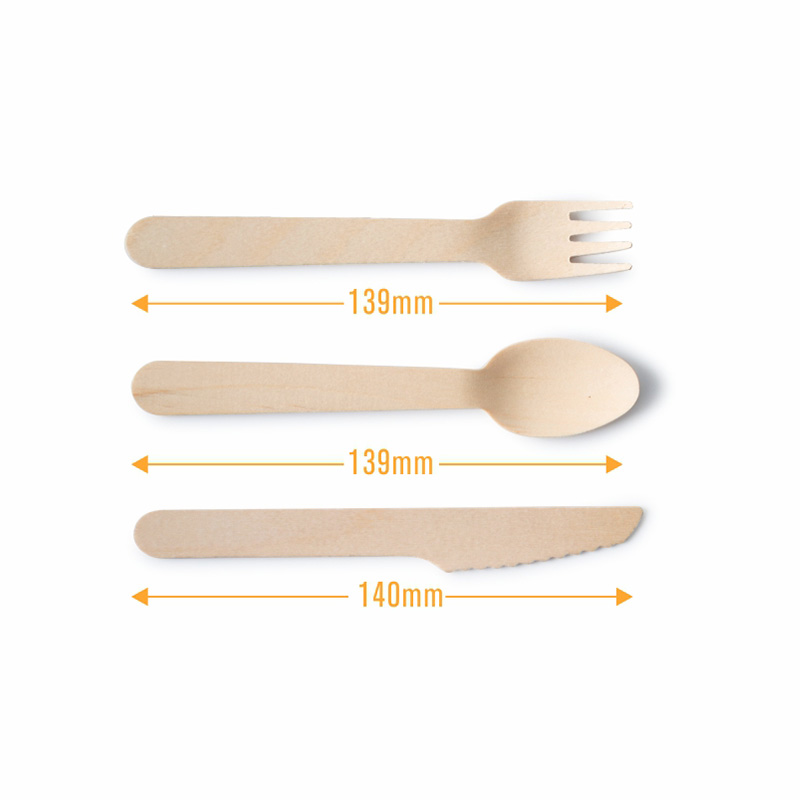 3-Piece Disposable Birch Wood Cutlery SetA light, natural birch set for everyday front-of-house service, better paired with a heat-stable option for hot lines.View Product →
Coated Paperboard Cutlery: Light, Dry and Fast, Not Wet and Slow
Paperboard cutlery occupies a narrow but useful slot. It is light, low cost, and reads as a natural material. It suits bakery counters, dry desserts, light salads and short-contact service where the food is not going to sit against the surface.
The limitation is water. Coated board resists moisture for minutes, not for a delivery window. In a wet noodle dish or a sauce-heavy bowl, the tine tips soften and the piece loses the stiffness that made it work in the first place.
If paperboard is on the shortlist, ask two questions. What coating is used, and is that coating declared for food contact in the destination market? The second question decides whether the material is acceptable at all, regardless of how well it performs.
Heat Ranges Side by Side
The chart below puts the short-contact working ranges on one scale so the gap between materials is visible at a glance. Treat it as a shortlist tool, then confirm with the supplier's measured data for the exact item.
The visual gap between PLA and CPLA is the single most useful thing on that chart. Two products that share a material name sit nearly 35°C apart in service, and that difference is what decides whether a warm grain bowl arrives intact.
Wood is deliberately absent. Wood does not have a meaningful softening point in this range, but it fails by soaking and by odour transfer instead, which a temperature scale cannot express.
Bench Tests to Run Before You Approve a Cutlery Order
You do not need a laboratory to catch most failures. A kitchen bench, a timer, a scale and one box of samples will surface the problems that a specification sheet hides.
- Load test the fork. Spear 200 g of cooked chicken or dense protein and hold it for ten seconds. Repeat twenty times with fresh pieces and count the bends.
- Test the blade on a realistic substrate. Cut through a 1.5 mm takeout lid membrane and count how many strokes it takes before the edge stops biting.
- Heat-soak the spoon. Submerge the bowl in 85°C liquid for thirty seconds and check the handle for droop.
- Run the real delivery simulation. Load the actual container with the actual food, seal it, and leave it in an insulated bag for the full delivery window. Open it and inspect the cutlery before you inspect anything else.
- Crush test the pack. Stack loaded bags three high for twenty-four hours and check for cracked or deformed pieces.
- Weigh and count. Verify grams per piece and piece count per kit against the approved sample, on every incoming lot.
- Snap test the weak point. Bend the tine and the blade joint to failure and note where the break starts. A clean break is a moulding problem; a stringy break is a material problem.
Record the results. A one-page test log with photos and lot numbers settles supplier disputes far faster than a conversation about "normal variation".
Food-Contact Compliance: Documents Beat Claims
Cutlery touches food directly, so the paperwork matters as much as the polymer. Ask for the documents below as a complete set, not as a sample of one.
- Declaration of compliance for the finished article, naming the food contact conditions it is approved for.
- Migration test reports from a recognised third-party laboratory, covering the intended use: hot, fatty, acidic or aqueous.
- Material safety data for each component, including any coating, oil, ink or adhesive.
- Current certificates for the factory system, such as ISO 22000, BRCGS or GMP, with a valid expiry date.
- Social compliance membership evidence where your buyers require it.
- Batch-level certificate of analysis for incoming shipments, traceable to the production date.
Two traps catch buyers repeatedly. The first is a certificate that expired quietly two years ago and is still circulating in the quotation pack. The second is a compliance statement written for one market being used to support a shipment into another market with different rules.
Confirm the destination requirement per order. European and North American food-contact frameworks differ in both the tests required and the declarations that must accompany the goods, and a supplier that treats them as interchangeable is telling you something about how the factory is run.
Cost per Kit: The Four Variables That Actually Move the Invoice
The headline price on a quotation is rarely the number that decides your cost per order. Four variables do most of the work.
| Variable | What changes | Commercial effect |
|---|---|---|
| Pieces per kit | Five-piece, four-piece, three-piece or single item | Perceived value rises with count; breakage and waste rise with count as well |
| Wrapping | Bulk, napkin wrap, individually wrapped | Adds pack cost and pack time per kit, and changes hygiene handling at the pass |
| Breakage allowance | Typically negotiated between 1% and 3% | Who absorbs losses on arrival; must be written into the order, not agreed verbally |
| Freight volume | Cubic metres per carton | Nested, compact kits cut landed cost more than a small unit price cut usually does |
Work the comparison on cost per served order, not cost per carton. Divide the landed carton cost by the usable pieces after breakage, then multiply by the pieces actually handed to a guest. A cheaper carton with 5% breakage and a 15% higher freight volume can lose to a more expensive one that arrives intact.
Also price the second material separately. Using a heat-stable grade only on the hot line and a lighter grade on the cold line usually beats a single premium line used everywhere.
Humidity, Storage and Shelf Life
More cutlery orders are damaged in the warehouse than in the delivery bag. The materials on this list do not all behave the same way after they leave the factory.
- PLA and paperboard absorb moisture. Store below 30°C and away from direct sunlight, on pallets, not on concrete.
- Wood needs air movement. Sealed, damp cartons grow odour and warp within weeks.
- PP and PS tolerate more abuse but deform under sustained load. Do not stack heavy cartons on light kits for months.
- FIFO rotation matters more with compostable grades, which have shorter useful windows than conventional plastic.
Write a storage clause into the supply agreement. A supplier that specifies maximum storage temperature and shelf life is signalling that it understands the material it is selling.
Recurring Buying Mistakes Worth Avoiding
- Approving from a single sample. Batch two is where the weight drifts.
- Comparing quotations without normalising piece weight and piece count.
- Assuming all compostable cutlery shares one temperature limit.
- Ignoring the container. A good fork in an oversized box still arrives swimming in sauce.
- Forgetting the napkin. A kit that absorbs sauce before the guest reaches the food turns a small saving into a large complaint.
- Ordering a year of compostable stock in a warehouse without climate control.
- Skipping the delivery simulation, then discovering the issue in reviews instead of on the bench.
Frequently Asked Questions
Which material should a hot-food takeout kitchen choose first?
PP is the practical default for hot noodles, rice bowls, curry and soup. It holds shape near 100°C on short contact, resists grease and survives impact in the delivery bag. Confirm weight per piece and tine thickness before ordering, because those two numbers decide whether the fork survives dense protein.
Is PLA cutlery suitable for hot drinks and hot food?
Standard amorphous PLA is not. It softens around 45 to 55°C. CPLA, the crystallised grade, tolerates roughly 80 to 90°C on short contact and is the version to specify if you need a compostable option on a warm line. Always confirm which grade is being quoted.
Can wood cutlery be used with soup or wet dishes?
Not well. Wood absorbs liquid, softens along the grain, and takes on the smell and colour of the food. Use wood where the contact is short and dry, such as catering platters, dessert service and charcuterie boards.
Why does cutlery weight vary between shipments?
Usually because a supplier is managing material cost against a fixed price. Weight drift of a few tenths of a gram per piece shows up as tine bend and handle cracking weeks later. Put a grams-per-piece tolerance in the purchase order and check it on arrival.
How many pieces should a takeout kit contain?
Match it to the dish. A rice bowl needs a fork or spoon, not a five-piece set. A family meal or a grilled item benefits from a knife and fork pair. Extra pieces increase cost and waste, and they rarely improve the guest experience.
What documentation should arrive with a cutlery shipment?
A declaration of compliance for the finished article, third-party migration test reports covering the intended use, valid factory certificates, and a batch certificate of analysis. Check expiry dates rather than assuming they are current.
Does individually wrapped cutlery change the food safety picture?
It reduces handling exposure between packing and service, at the cost of added packaging and pack time. For delivery and third-party courier routes, the handling benefit is often worth the cost. For dine-in service, bulk dispensers are usually adequate.
How should compostable cutlery be stored?
Cool, dry and out of direct sunlight, ideally below 30°C, on pallets and away from concrete floors. Rotate stock on a first-in, first-out basis and check shelf life before placing a large seasonal order.