 English
 中文简体
Content
- 1 PP vs PS Cutlery: Core Specifications Side by Side
- 2 Heat Resistance: The Numbers That Decide Whether a Fork Bends
- 3 Strength and Rigidity: Where PS Actually Wins
- 4 Food Safety: Migration, Monomers and Compliance
- 5 Where Each Material Belongs: Application and Temperature Boundaries
- 6 Manufacturing Reality: Moulding, Tolerances and Line Defects
- 7 Cost, Weight and Landed Cost per Piece
- 8 A Six-Question Specifier for PP and PS Cutlery
- 9 Frequently Asked Questions
- 9.1 Is PP cutlery safe to put in the microwave?
- 9.2 Can PS cutlery hold hot food at all?
- 9.3 Which material is more food safe, PP or PS?
- 9.4 Why does PS feel stronger than PP when it is actually more brittle?
- 9.5 Does cutlery weight indicate quality?
- 9.6 What temperature should I specify for hot-food cutlery?
- 9.7 Can PP and PS cutlery be recycled?
- 9.8 Is PS banned in any major market?
- 9.9 How long does it take to get a sample in a different material?
PP cutlery survives temperatures close to boiling water and goes into a microwave without complaint. PS cutlery softens somewhere past 70-80°C and is effectively out of the game the moment a microwave is involved. PS wins in other places: it is stiffer, clearer and cheaper per piece, and it handles cold dessert service better than PP at almost every step. That gap is a material specification gap, not a marketing one, so the decision you actually have to make is what temperature range your cutlery will see across its whole service life.
What follows is the comparison a production floor actually uses: which numbers decide pass or fail, how the two grades behave on a test bench and on a moulding line, and which specification details turn an easy purchase into a rework claim.
PP vs PS Cutlery: Core Specifications Side by Side
The practical answer comes first. Choose PP when the cutlery will touch hot food, gravies, soups, microwave reheating or a delivery bag that sits above 60°C for half an hour. Choose PS when the cutlery serves cold food, ice cream, cake and salad, and when a rigid, glassy feel matters more than temperature headroom.
Everything else is derived from that split. The table below puts the numbers that matter into one frame of reference.
| Property | PP (polypropylene) | PS (polystyrene) |
|---|---|---|
| Continuous service temperature | Roughly -20°C to 100°C, with short excursions higher on heat-stabilised grades | Roughly -20°C to 70-80°C |
| Heat deflection temperature | About 95-110°C depending on grade and wall thickness | About 70-90°C |
| Microwave reheating | Generally acceptable on verified grades | Not recommended |
| Rigidity at room temperature | Moderate; flexes before it yields | High; feels stiff and glassy |
| Impact behaviour | Tough, survives drops and bending | Brittle, cracks under a point load |
| Clarity | Translucent to opaque | Clear to crystal clear |
| Density | About 0.90-0.91 g/cm³ | About 1.04-1.05 g/cm³ |
| Best-fit service | Hot meals, delivery, microwave containers | Desserts, cold platters, party and event service |
Read the density row carefully. PP is lighter than water; PS is roughly 15% heavier. A PP utensil delivers more volume per gram of resin, which changes the per-piece cost and changes how substantial the item feels in a customer's hand. Buyers comparing a first round of quotes without adjusting for density usually end up with a misleading ranking.
Heat Resistance: The Numbers That Decide Whether a Fork Bends
Heat resistance is a loose phrase. On a moulding floor it splits into at least four different measurements, and each one answers a different question.
Four values that get confused with one another
- Heat deflection temperature (HDT) measures how far a moulded part deflects under a defined load at a rising temperature. It is the closest single number to the question "will this fork sag in a bowl of hot soup".
- Vicat softening point measures when a sharp probe penetrates the material to a set depth. It describes softening, not load-bearing ability, so using it to predict how long a spoon survives in hot broth tends to be optimistic.
- Continuous service temperature describes the range a part can hold over repeated exposure without significant ageing. This is the figure usually quoted on product pages.
- Melting point describes when the polymer actually flows. It has almost no bearing on everyday service, yet it appears in marketing screenshots because it is the largest number available.
When a buyer says "our current supplier claims 120°C", what usually follows is a conversation about which of those four figures was quoted and under what test method. Ask for the method before you ask for the number.
How PP and PS compare in practice
PP holds a continuous service window of roughly -20°C to 100°C on standard food-contact grades. Heat-stabilised PP grades push higher for short periods. The material copes with hot liquid, steam from a lidded container, and a microwave cycle without losing shape, which is why most reusable-style takeaway containers and hot-meal cutlery sets are moulded in PP.
PS behaves differently. General-purpose PS is glassy and rigid at room temperature, and that rigidity is exactly what makes it brittle when it is hot. Above roughly 70-80°C it loses stiffness quickly. A PS fork in a hot, oily dish will bend under its own load before the food cools. Some grades show a higher softening figure on paper, but the useful ceiling for a thin-walled disposable utensil is well below that, because thin walls heat through almost instantly.
Temperature window comparison
Bars are drawn to a common -20°C to 140°C scale. Actual limits shift with wall thickness, grade and dwell time at temperature.
Two practical warnings sit behind that chart. First, a thicker wall slows heat transfer into the part, so a heavier PS fork survives slightly longer than a thin one in the same dish. Second, time matters as much as temperature. A PS spoon that briefly contacts 85°C sauce during plating is a different risk from a PS spoon that sits inside a sealed hot container for 25 minutes during delivery.
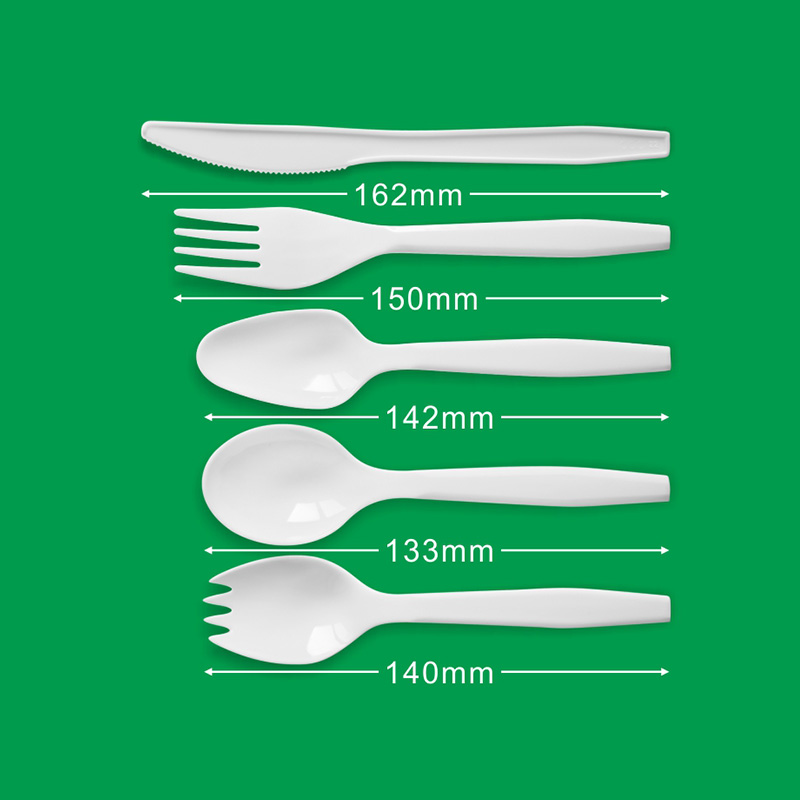 Medium-Weight Individually Sealed PP Cutlery SetsThese medium-weight polypropylene sets include knife, fork, tea spoon, soup spoon and spork, each film-sealed; flexible PP construction is relevant when comparing breakage behavior.View Product →
Strength and Rigidity: Where PS Actually Wins
Strength is not one property. A disposable fork can fail in three distinct ways, and PP and PS fail differently in each.
Point-load cracking
Press a PS tine against a firm dessert and it can snap cleanly, because the material has low impact resistance. PP bends first and recovers. For cold, dense foods such as ice cream or cheesecake, choose heavier PS or switch grades.
Torsional bending
Twist a thin PP fork and the handle bows. On long handles this becomes a usability problem rather than a breakage one. Adding a rib to the handle is usually cheaper than moving up a material thickness.
Load at temperature
This is the real divide. At 25°C, PS is stiffer than PP by a comfortable margin. At 80°C, that advantage is gone and PP remains serviceable. The same fork can be excellent for cake and hopeless for curry.
That stiffness advantage is why PS feels more premium in a cold-service context. A PS teaspoon has a crisp, almost glass-like snap to it and holds its shape on a dessert plate. PP feels slightly softer and more forgiving, which is the right feel for a hot meal but the wrong feel for a petit-four platter.
There is a related point about handle design. A PP handle can be slimmed because the material tolerates flex. A PS handle usually needs a slightly deeper section or a small reinforcing rib, because once a brittle material starts to bend it is already close to failing. Getting that geometry right at the tooling stage costs far less than fixing it after a pallet of cracked handles reaches a customer.
Impact behaviour under real handling
Shipping and serving both put point loads on cutlery. A box dropped on a corner transmits force through the pack, and PS reacts by cracking while PP deflects. For export orders that travel by sea container and then through several distribution handlings, this difference shows up as a claim rate rather than a datasheet line. If your pack configuration is loose rather than individually wrapped, PP is the safer structural choice regardless of the food it will serve.
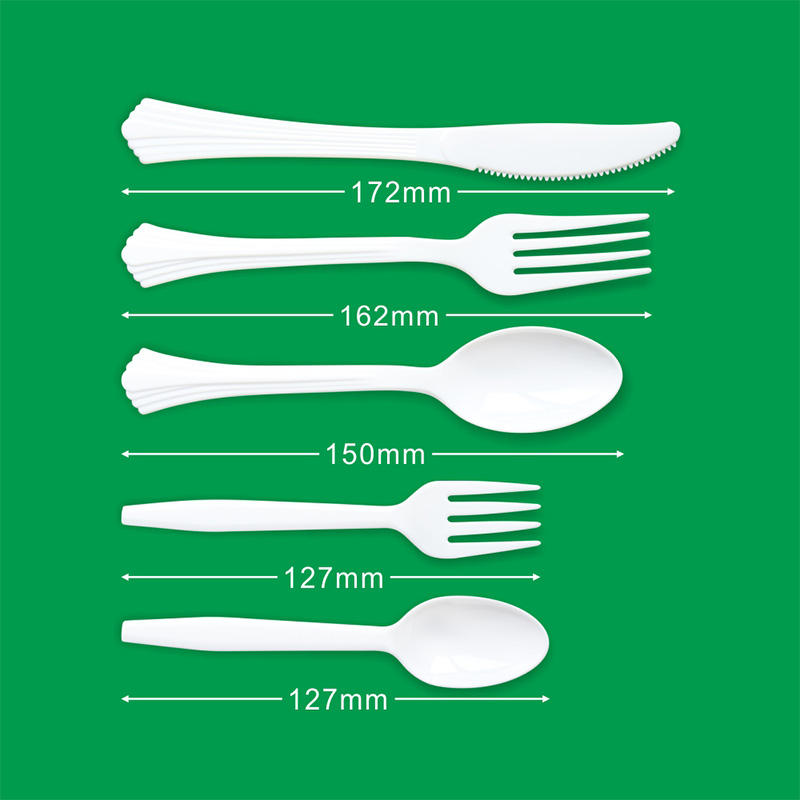 Individually Wrapped PS Dessert Cutlery SetsRigid PS dessert cutlery includes knife, fork, tea spoon, dessert fork and spoon, individually pouch-packed; high-temperature resistance suits hot dishes, while packaging affects impact risk.View Product →
Food Safety: Migration, Monomers and Compliance
Both materials are legal for food contact in major markets, and both carry clear obligations that a buyer should verify before signing off a specification. The differences are in what gets tested and how much margin exists.
What each material is regulated under
- PP is regulated as a polyolefin in the EU plastics regulation and in the US under the corresponding polypropylene food-contact regulation. It has a long history of use in hot-fill and microwave applications.
- PS is regulated under the styrene polymer provisions, with specific migration limits for residual styrene monomer and for certain oligomers. Compliance depends on the resin grade, the conversion process and the residual monomer level in the finished article.
The practical consequence is that PS demands more documentation. A compliant PS article is perfectly safe under its intended conditions of use; the risk is not the material category but the grade and the process control behind it. A supplier who cannot produce a migration test report for the finished article, as opposed to a resin certificate alone, leaves a gap.
Conditions of use are part of the specification
Food-contact approval is granted for stated conditions: which food types, which temperatures, which contact duration. A PS cutlery set approved for cold and room-temperature contact is not thereby approved for hot, fatty food. If a buyer uses it that way, the compliance claim does not travel with the product.
Three questions cut through most of the noise:
- Which specific food simulants were tested, and at which temperature and duration?
- Is the report for the finished article or only for the incoming resin?
- Does the declaration of compliance list the intended conditions of use in plain language?
For PP, the answer to those questions is usually straightforward because the material is designed for the hot end of the range. For PS, the answer depends heavily on whether the supplier has scoped the approval narrowly and communicated that scope honestly.
Odour and taste transfer
This is underrated as a selection criterion. PS has a neutral sensory profile at room temperature, which suits desserts and dairy. PP is also low-odour, but certain PP grades used for hot food can carry a faint note if the resin has not been adequately deodorised. Where a product is delicate, such as a plain cheesecake or a citrus dessert, run a taste panel against the actual grade rather than the category.
Where Each Material Belongs: Application and Temperature Boundaries
Matching material to scenario is the fastest way to avoid both under-specification and unnecessary cost. The pattern below reflects how orders are usually split in practice.
| Scenario | Temperature exposure | Usual choice |
|---|---|---|
| Hot meal delivery with sauces | 60-90°C sustained in a closed bag | PP |
| Microwave reheating of a packed lunch | Up to 100°C, repeated | PP |
| Ice cream and frozen dessert | -18°C to 5°C | PS |
| Cake and pastry service | Room temperature | PS |
| Chilled salad and cold platters | 2-8°C | PS or PP |
| Event and catered buffet service | Mixed, often room temperature | PS for presentation, PP for hot dishes |
| Transport through hot climates | Container and warehouse heat | PP preferred for structural stability |
The last row deserves attention. A PS order shipped through a summer corridor can sit inside a container at 55-65°C for days. That is below the softening point, but close enough that stacking pressure plus heat can produce warped items by the time the pallet is opened. Buyers who have been caught by this once tend to add a transit temperature clause to the next purchase order.
There is a third path worth mentioning. Where the application is hot but the buyer also needs a renewable feedstock, heat-resistant PLA compounds and fibre-based cutlery occupy a similar service window to PP for short contact times. They behave differently on cost and on end-of-life, and they are not a drop-in substitution in every pack format, but they are a legitimate specification option rather than a compromise.
Manufacturing Reality: Moulding, Tolerances and Line Defects
Two suppliers can quote the same material and deliver very different parts. The difference is process control, and it shows up in specific, predictable failure modes.
What goes wrong with PP
- Warping from uneven cooling, especially on long, flat geometry such as knife blades. Shrinkage in PP is significant, and cooling channels that are not balanced will produce a curl that only appears after 24 hours.
- Short shots at thin tine tips if injection pressure is not tuned to the specific tool.
- Weld-line weakness where flow fronts meet, typically at the fork head. Under load this is where a part fails first.
What goes wrong with PS
- Internal stress and cracking when the part is ejected too hot or packed before it has relaxed.
- Sink marks on thicker sections such as the handle-to-head transition.
- Brittle failure in transit when the pack design does not isolate individual pieces.
Both materials share one rule that buyers rarely see: cutlery should be packed after it has stabilised, not straight off the mould. A pack sealed while the parts are still warm will show deformation far more often than the same product packed from a cooled lot.
What to put in your specification
- Material grade and food-contact declaration for the finished article
- Nominal weight per piece with a stated tolerance, usually plus or minus 3%
- Dimensional tolerances on length, tine spacing and handle thickness
- Pack format: bulk, individually wrapped, or kit form, with wrap material specified
- Testing requirements: load, deflection at temperature, migration, and any sensory check
- Acceptance criteria and sampling plan, referenced to a recognised standard
A specification that lists only "PS cutlery, white" is not a specification. It is an invitation for the lowest-cost interpretation to win the order.
5-Piece Individually Wrapped Medium-Weight PP Cutlery KitsThese five-piece medium-weight PP kits include knife, fork, tea spoon, soup spoon and spork, individually wrapped in white for hygienic grab-and-go service.View Product →Cost, Weight and Landed Cost per Piece
Resin price per kilogram is not the number that matters. Cost per usable piece is, and it depends on density, wall thickness, cycle time and scrap rate.
PP's density of around 0.90 g/cm³ against PS at around 1.04 g/cm³ means a PP part of identical geometry weighs roughly 13-14% less. On resin-priced quotes that advantage is real. It narrows when you account for the slightly heavier sections PP sometimes needs to hit the same stiffness, and it reverses when PS parts can be moulded thinner because the material is inherently stiffer at room temperature.
Where PP costs less
Hot-food applications where PS is simply not viable. There is no substitute cost to compare against, so PP is priced against alternative hot-service materials such as heat-resistant filled PP or fibre blends.
Where PS costs less
Cold service with high visual expectations. A thin, crystal-clear PS piece reads as a premium item, so the buyer can specify less material and still get the presentation effect they want.
Where the difference disappears
Individually wrapped kits. Film, wrapping labour and secondary packaging dominate the unit cost, and the resin delta between PP and PS becomes a rounding error.
Freight is the final layer. Because PP parts are lighter, a container of PP cutlery carries more pieces per cubic metre at the same weight limit, which improves landed cost on long sea routes. For pallet-shipped, high-volume orders this can matter more than the resin price itself.
A Six-Question Specifier for PP and PS Cutlery
Work through these in order. The answers usually make the material choice obvious before any price comparison begins.
- What is the highest sustained temperature the utensil will see? Above 80°C, the discussion is effectively over and PP is the answer.
- Will it enter a microwave? If yes, PS should be excluded rather than risk-managed.
- What is the food consistency? Dense, cold foods such as ice cream put high point loads on brittle material; hot liquids put thermal loads on everything.
- How will it be packed and shipped? Loose packing plus a long sea route argues for the tougher material.
- Does appearance carry commercial weight? Crystal clarity and glassy rigidity favour PS where the service is cold.
- What documentation will your own customer ask for? Match the compliance file to the material before the order is placed, not after.
If the application is mixed, such as a catered event with both hot and cold dishes, the sensible answer is usually a split specification rather than a single compromise material. Two correct items cost less than one item that fails half the time.
Frequently Asked Questions
Is PP cutlery safe to put in the microwave?
PP is the standard choice for microwave reheating among disposable plastics, but "PP" alone is not a guarantee. The grade must be specified for microwave use, the part must not contain metallic decoration, and reheating times should stay within the supplier's stated conditions. Check the declaration rather than assuming from the material name.
Can PS cutlery hold hot food at all?
For brief contact with warm food it is usually fine. The problem is sustained heat combined with load. A PS fork in a hot, saucy dish softens and bends under its own working load, and a PS container in a microwave can distort within a minute or two. Cold and room-temperature service is where PS is designed to operate.
Which material is more food safe, PP or PS?
Neither is inherently safer. Both are approved food-contact materials across major markets when the correct grade is used under the declared conditions. The real variable is supplier documentation. A compliant PS article with a full migration report is safe for its stated use; an unverified PP article with no traceable grade is not automatically safer.
Why does PS feel stronger than PP when it is actually more brittle?
Stiffness and toughness are different properties. PS has higher stiffness at room temperature, so it resists bending and feels solid in the hand. It has lower impact resistance, so it cracks rather than bends when overloaded. PP feels slightly more flexible and absorbs impact without breaking. Buyers often mistake stiffness for durability.
Does cutlery weight indicate quality?
Only loosely. Heavier cutlery usually means a thicker wall, which improves load capacity and slows heat transfer, and both help in hot service. But weight can also come from a lower-grade filled resin. Weight should be specified with a tolerance and paired with a deflection test at temperature, not used as a standalone quality proxy.
What temperature should I specify for hot-food cutlery?
Specify the realistic maximum the item will see in service, then add margin. For delivery bags and insulated containers, that is often 75-90°C for 20-30 minutes. Write the condition into the specification as a temperature and a duration, and ask the supplier to test against it rather than against a generic number.
Can PP and PS cutlery be recycled?
Both are technically recyclable and both carry standard resin identification codes. In practice, small soiled utensils rarely make it through sorting, so recycling rates from food service are low. Where end-of-life is a formal requirement rather than a preference, fibre or certified compostable materials are usually the more defensible choice.
Is PS banned in any major market?
Several jurisdictions have restricted expanded polystyrene food service items, and some have extended rules to certain single-use plastic items more broadly. Restrictions vary by region and change over time, so confirm current requirements for the destination market before finalising a PS specification for a new territory.
How long does it take to get a sample in a different material?
For an existing tool, a material change is usually a short trial run rather than a new development programme, and sampling can often be completed within a couple of weeks depending on mould compatibility. Where the wall thickness or shrink profile requires tooling adjustment, allow considerably longer and plan the qualification batch accordingly.