English
 中文简体
中文简体The Short Answer: Birch, Beech, and Hard Maple
Birch, beech, and hard maple are the healthiest wooden utensils for everyday cooking. All three are dense, tight-grained hardwoods with small, evenly scattered pores. They sand to a smooth surface that sheds almost no fiber into food, they tolerate repeated washing without raising fuzz, and they take a food-grade mineral oil or beeswax finish without needing a film-forming coating that can chip. Teak and olive wood follow closely behind for reusable serving pieces, because their natural oils slow down water and stain uptake. Bamboo behaves like a hardwood in the hand, but it is a grass and most bamboo tools are laminated from strips with an adhesive, which is perfectly acceptable when the adhesive is certified for food contact and a genuine question mark when nobody can name it.
Two groups sit lower on the list. Open-pored woods such as oak, ash, and black walnut absorb liquid, hold onto onion and fish odors, and stain permanently from turmeric and tomato. Softwoods such as pine and spruce dent under light pressure, and every dent becomes a place where food and moisture collect.
| Wood | Janka hardness (lbf, typical) | Why it ranks high or low | Best use |
|---|---|---|---|
| Olive wood | About 1,500 | Dense and naturally oily; very low water uptake | Serving spoons, salad servers |
| Hard maple | About 1,450 | Closed pores, minimal odor pickup, resists staining | Spoons, spatulas, rolling pins |
| Beech | About 1,300 | Tight grain that closes well after sanding; neutral taste | Reusable spoons, single-piece sets |
| Oak | About 1,290 | Hard, but ring-porous with large open vessels | Not the first choice for daily wet cooking |
| Birch (yellow) | About 1,260 | Uniform diffuse grain, no resin, no strong odor | Single-use forks, knives, spoons, stirrers |
| Bamboo (carbonized moso) | About 1,180 to 1,380 | Hard face, but usually laminated with adhesive | Light cutting and serving |
| Teak | About 1,070 to 1,150 | Natural oils slow water and stain uptake | Serving pieces, outdoor-friendly tools |
| Black walnut | About 1,010 | Pleasant to work with, but open grain | Decorative serving pieces |
| Pine, spruce | About 600 or under | Soft, resinous, dents easily | Not recommended for wet cooking |
Quick field test: press a fingernail or a blunt knife edge into the surface with light pressure. If it leaves a visible dent, the wood is too soft for daily contact with wet, hot food.
What "Healthy" Actually Means in a Kitchen Utensil
Healthy is not one property. Four separate things decide whether a wooden spoon or fork belongs in a working kitchen, and each of them can be checked with a sample and a specification sheet rather than a marketing claim.
No chemical migration
The wood itself is cellulose and lignin, which are inert. What can move into food is the finish and, in laminated products, the adhesive. Cured mineral oil and beeswax are food-contact materials. A polyurethane or varnish film is not designed to be eaten, and it chips at the edges first.
Low shedding
A properly sanded hardwood leaves no splinters and no loose fibers. If a utensil raises visible fuzz after its first hot wash, the manufacturer stopped at a coarse grit and the surface will keep breaking down in the food.
Cleanable geometry
One-piece construction, no glued joints, no decorative grooves running across the working surface. Every seam and channel is a place where food residue sits out of reach of a cloth.
No flavor carryover
Dense, tight-grained woods release garlic, onion, and fish odors slowly or not at all. Open-pored woods keep them, which is why the same spoon can taste of yesterday's curry.
These four criteria apply just as much to a reusable spoon in a home kitchen as they do to a disposable birch fork handed out with a takeaway salad. When a supplier can answer all four with documents, the material question is essentially closed.
Ranking the Woods by Hardness, Grain, and Pores
Hardness figures are reference points taken from published wood data. Actual performance depends on moisture content at the time of use.
Hardness matters less than pore structure
Hardness tells you how a utensil resists dents. Pore structure tells you how it behaves around food. Birch, beech, and maple are diffuse-porous: their pores are small and spread evenly through the growth ring, so a sanded surface has very little open volume to trap liquid. Oak, ash, and walnut are ring-porous: each growth ring carries a band of large vessels that act like a row of drinking straws. Those vessels take up colored liquid quickly, and once turmeric or beet juice is inside, sanding is the only way to remove it.
This is the reason a 1,290 lbf oak spoon can be a worse daily tool than a 1,260 lbf birch spoon, even though oak is technically harder. For buyers comparing suppliers, the useful question is not "which wood is hardest" but "which wood has the fewest open vessels on the food-contact face." A supplier who understands this will send a cross-section photograph without being asked. We keep a longer comparison in our notes on material choices for wooden cutlery, including how moisture content shifts the picture.
Woods that work against you
Softwoods fail early for a simple reason: a dented surface cannot be cleaned properly. Resinous species such as pine also release pitch near heat, which leaves a sticky film on the wood and a smell on the food. Beyond species, two sourcing problems create most of the quality complaints we see. The first is under-dried timber, which shrinks after forming and opens hairline cracks at the tines or bowl. The second is mixed species in one shipment, which is common when a factory buys whatever is available instead of specifying a single species with a moisture range.
| Wood group | Pore type | Water uptake | Odor retention | Suitable for daily wet cooking |
|---|---|---|---|---|
| Diffuse-porous hardwoods (birch, beech, maple) | Small, evenly scattered pores | Low | Low | Yes |
| Ring-porous hardwoods (oak, ash, walnut) | Large earlywood vessels | Moderate to high | Moderate to high | Only with dedicated drying and oiling |
| Softwoods (pine, spruce) | Low density with resin canals | High | High | No |
| Laminated bamboo | Adhesive lines between strips | Low on the face, higher along seams | Low | Yes, if the adhesive is certified for food contact |
Surface Finishes: The Part Most Buyers Never Check
A wooden utensil is only as clean as what has been soaked into it. An unoiled birch spoon will pull water and pigment into its outer layer within a few uses. A spoon sealed with the wrong product can put a polymer film into hot food the first time the edge chips. Between those two extremes sits a short list of finishes that are genuinely appropriate for food contact.
| Finish | Food safe | Durability | Notes for buyers |
|---|---|---|---|
| Bare sanded wood | Yes | Needs frequent oiling | The safest baseline; the user adds oil over time |
| Food-grade mineral oil | Yes | Moderate | Inert, odorless, does not go rancid; reapply monthly |
| Mineral oil and beeswax blend | Yes | Good | The standard choice for reusable spoons and spatulas |
| Raw linseed or flax oil | Yes when food grade | Good once cured | Slow curing; can turn rancid if applied too thickly |
| Boiled linseed oil | Not reliably | High | Often contains metallic driers; treat as non-food-contact unless certified |
| Tung oil, 100 percent pure | Yes | High | Many products sold as "tung oil finish" are varnish blends |
| Lacquer, varnish, polyurethane | No | High until it chips | Forms a film that flakes into food near heat and wear |
| Walnut oil | Yes | Moderate to high | Cures hard; flag nut-allergen considerations for some markets |
The boiling-water video, explained
A widely shared clip shows a wooden spoon boiled in water until a cloudy film appears, with the claim that factories glue spoons together. The honest answer is that both cases exist. A turned, single-piece birch or beech spoon contains no adhesive at all, and the cloudiness is simply natural oils, sugars, and fine wood dust released from the surface. A laminated bamboo or joined-handle product does contain adhesive, and if that adhesive is not certified for food contact, the concern is legitimate. The lesson is not "avoid wood." It is "ask whether the utensil is one piece, and if it is not, ask what the adhesive is."
Five questions to put to any supplier
Before approving a wooden utensil for food contact, request written answers to these five points:
- Exact commercial name of the finish, or confirmation that the product ships unfinished.
- Food-contact test reports under a recognized standard, such as FDA food-contact requirements or LFGB.
- Whether the product is single-piece or laminated, and if laminated, the adhesive grade.
- Target moisture content at packing, with the measured value on the certificate of analysis.
- Cure time before packing, since a product packed while the oil is still wet can develop odor in transit.
Hygiene: Does Wood Really Hold Bacteria?
The short answer is that clean, intact, dry wood compares well with plastic, and the popular assumption that wood is a bacterial sponge does not survive contact with the research. Controlled studies on cutting surfaces conducted at the University of Wisconsin in the 1990s found that bacteria such as Salmonella and Listeria did not survive as long on wooden surfaces as on plastic ones, and that knife-scarred plastic was harder to clean than wood. Wood's structure helps here: capillary action draws moisture and organisms below the surface, where they dry out and die, while plastic keeps them on the surface and inside the scratches.
The caveat is important. Those results describe smooth, unbroken, properly dried wood. They do not describe a cracked spoon that has been sitting in a sink, a board that has been soaked overnight, or a utensil with a split along the tines where food packs in and never dries. Cracks change the material from a low-risk surface into a harborage site, and no cleaning method compensates for that.
Practical rules that keep wooden tools safe
- Wash within thirty minutes of use with hot water and dish soap, using a brush along the grain.
- Never soak. Submersion is the single fastest way to open cracks in a wooden spoon.
- Dry standing upright in open air, not flat on a towel and never in a closed drawer while damp.
- Keep a dedicated wooden board or spoon for raw meat, or reserve those tasks for a non-wood surface if you prefer strict separation.
- Sanitize occasionally with distilled white vinegar, then dry completely. Do not leave vinegar standing on the surface.
- Retire any utensil with a crack, a dark soft spot, or a persistent odor. Sanding can rescue a stained but intact surface; it cannot rescue a split.
For foodservice operations, the same logic supports single-use wooden cutlery. A single-use birch fork removes the storage and drying variable entirely, which is often the weakest link in a busy kitchen rather than the wood itself.
Where Wood Loses: Heat, Soaking, and Strong Flavors
Wood is stable in the temperature range where cooking actually happens, but it has limits that matter for menu planning and product selection. In a pan, a wooden spoon can stir at frying temperatures briefly and will scorch, not melt, if left against a hot element. In a takeaway container, the relevant number is different: how long the utensil sits in hot, wet food before the customer picks it up.
Values are typical ranges used for menu planning. Confirm against the supplier's own heat-resistance test data before committing to a specification.
The comparison explains why wood still wins in hot, wet dishes. A polystyrene fork softens in a bowl of soup that a birch fork handles without deformation, and a polylactic acid fork is realistically a cold-food utensil. Where wood loses is prolonged soaking. Leave a wooden fork in a sealed container of hot curry for forty minutes and the tines will swell, soften at the tip, and pick up the color and smell of the sauce. That is not a safety failure, but it is a service failure, and it is the kind of detail that shapes a menu decision.
Staining and flavor: the quality issues nobody tests for
Turmeric, beetroot, tomato, and red wine leave permanent marks on open-pored wood and fade slowly on tight-grained species. Strong spices and fish oils linger in the surface layer. For a home cook this is cosmetic. For a restaurant plating a pale dessert with a wooden spoon that last stirred a garlic sauce, it is a guest complaint waiting to happen. The fix is discipline rather than chemistry: dedicated utensils for sweet and savory work, and a dedicated set for highly colored ingredients.
Single-Use Birch: The Healthiest Wooden Utensil in Foodservice
For takeaway and catering, the healthiest wooden utensil is a single-piece birch fork, knife, or spoon. There is no adhesive, no film coating, and no plasticizer in the product, which removes the entire migration question. Birch is taste-neutral, so it does not change the flavor of a salad dressing or a slice of cake, and it does not soften or bend in a hot container the way polystyrene does.
The manufacturing details that decide quality are unglamorous. A good disposable birch fork is formed from kiln-dried timber to a moisture content around six to eight percent, sanded to a smooth finish with no raised fibers, and packed promptly so it does not reabsorb humidity in a warehouse. Thickness usually falls between 1.6 and 1.8 millimeters for the body; below that, tines flex under load, and above it the utensil feels heavy in a disposable setting. Buyers who specify these numbers in writing get consistent shipments. Buyers who specify only "wooden fork" get whatever the mill had that week.
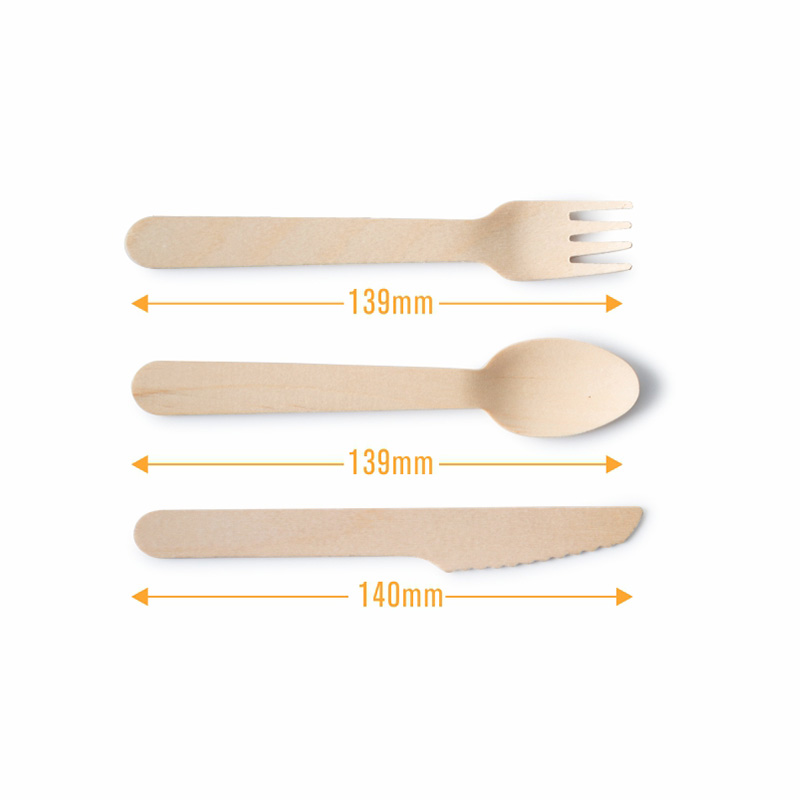 3-Piece Disposable Birch Wood Cutlery SetA light birch knife, fork, and spoon set for everyday foodservice, offering a natural material story and dependable disposable use without plastic aftertaste.View Product →
The practical benefits in service are easy to summarize. A birch set carries no plastic aftertaste, tolerates a ninety-degree container during the walk back to the office, presents well with cold salads and bakery items, and gives an operator a material story that does not require explaining a coating or a chemical additive to a customer.
When Birch Is the Wrong Choice, and What Replaces It
Wood is not the answer to every menu item. Three situations consistently push buyers toward another plant-based material. The first is long soaking: a fork left in a sealed soup container for half an hour will swell at the tip. The second is heavy load on thin tines, such as cutting a dense steak with a disposable knife. The third is repeated moisture cycling in a cold chain, where condensation forms and dries on the surface several times before the product reaches the customer, gradually roughening the finish.
In those cases a molded plant-fiber utensil is usually the better specification. A biodegradable paddy fiber cutlery set holds its shape in wet dishes far longer than wood, keeps a smooth molded surface that does not absorb sauce, and still delivers on the material story that most foodservice customers now expect. It also handles the middle temperature range, roughly up to 120 C, which covers hot noodles, rice bowls, and soup without the deformation you would see from polylactic acid.
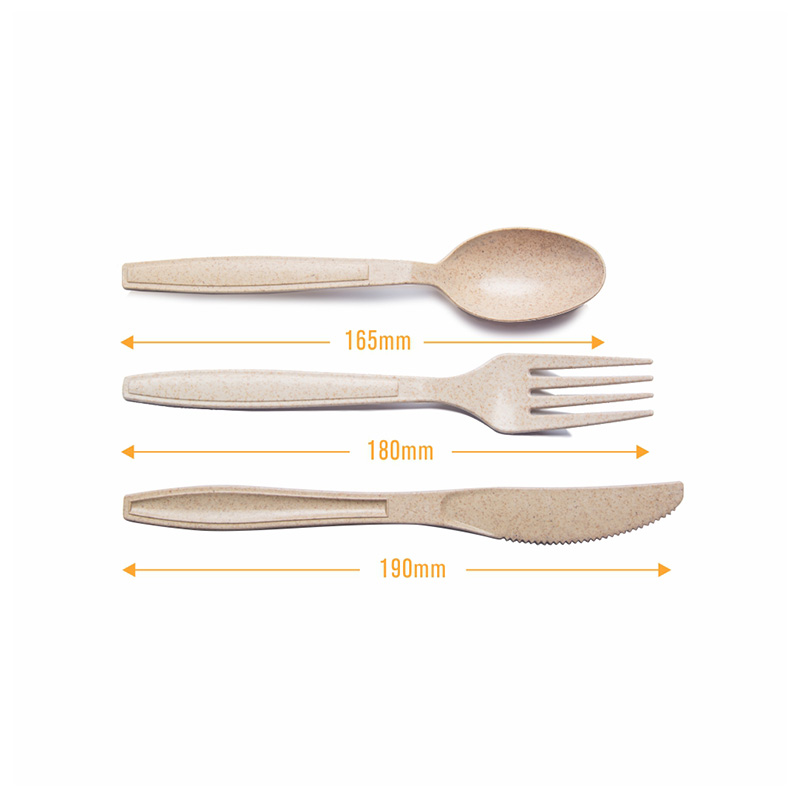 3-Piece Paddy Fiber PF Disposable Cutlery SetA molded plant-fiber knife, fork, and tea spoon set for wholesale foodservice, suited to wet dishes and hot noodles where wood may soften.View Product →
A second option is a mixed-material pack. A plant-based biodegradable cutlery combo pairs a fiber fork and knife with a compostable straw and napkin, which simplifies ordering for delivery operators who need one SKU per order rather than five. The trade-off is that mixed packs must be stored dry and used within a reasonable window, because paper components are more humidity-sensitive than molded fiber.
What does not work well is stretching a cold-food material into a hot application. If a menu regularly serves food above eighty degrees, choose wood or fiber rather than a thin bio-based plastic and accept a slightly higher unit cost in exchange for fewer customer complaints.
Buying Specs: What to Write Into a Purchase Order
Specification writing is where most quality problems are prevented or created. The table below lists the parameters that actually drive complaints about wooden utensils, along with the values we see working in volume production.
| Parameter | Working target | Typical tolerance | Failure it prevents |
|---|---|---|---|
| Species | Named single species, for example yellow birch | No substitution without approval | Mixed hardness, inconsistent flex |
| Moisture content at packing | 6 to 8 percent | Plus or minus 1 percent | Cracking when dry, mold when wet |
| Body thickness | 1.6 to 1.8 mm | Plus or minus 0.1 mm | Flexing tines or a heavy feel |
| Overall length | Per approved drawing | Plus or minus 1.5 mm | Fit problems in portion packs |
| Surface finish | Sanded smooth, no raised fibers | No visible fuzz after hot wash | Splinters in food |
| Defects on food-contact area | No knots, cracks, or dark streaks | Zero tolerance | Breakage and harborage points |
| Finish or coating | Food-grade mineral oil or none | Per approved formula | Migration and taste transfer |
| Microbiological and factory standard | Food-contact testing plus a certified plant | Report per batch | Recall risk and audit failure |
| Packing humidity control | Moisture barrier liner, dry warehouse | Storage at 45 to 60 percent relative humidity | Mold and warping in transit |
Two habits separate buyers who get consistent shipments from those who do not. First, ask for samples from the production run rather than hand-picked counter samples, because the difference between a hand sample and mass output is exactly where specifications slip. Second, request a certificate of analysis with the moisture content and a food-contact test report for each batch, not once a year. Factories that hold certifications such as BRC, ISO 22000, or GMP NSF can usually produce these documents quickly, and the response time itself tells you something about how the plant is organized.
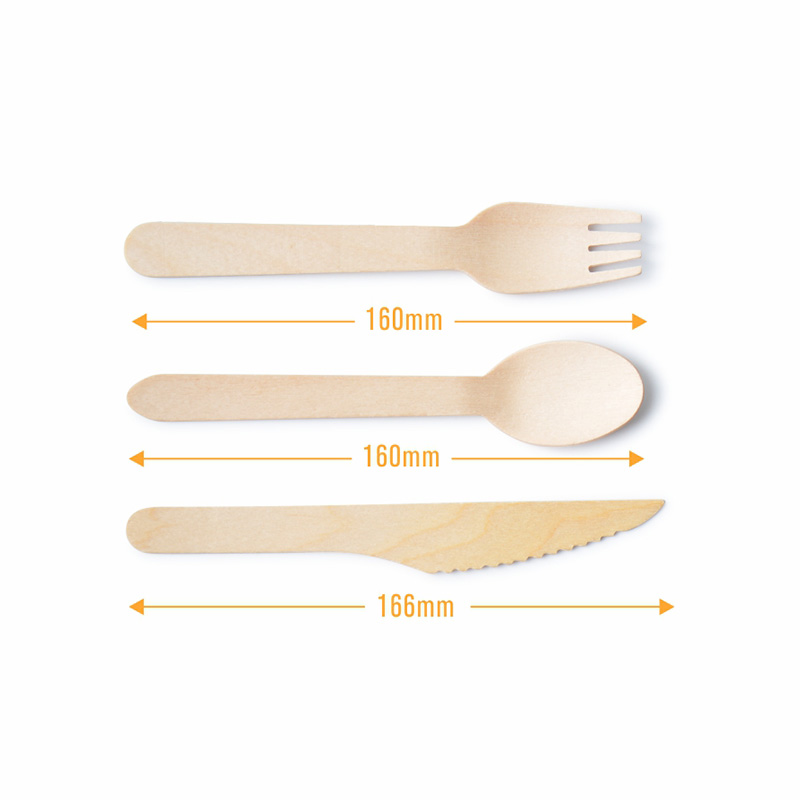 Wooden Cutlery: Disposable Birch Sets and Custom OptionsBrowse birch wooden cutlery sets, stirrers, and customizable printed options for foodservice buyers who need consistent moisture and food-contact documentation.View Product →
For reusable wooden utensils, add one more line to the purchase order: the intended finish and the cure time before packing. A spoon packed while the oil is still wet will smell rancid on arrival, and no amount of airing out in a warehouse fully fixes it.
Care, Storage, and When to Retire a Wooden Utensil
Wood is a living material in the sense that it responds to humidity. A care routine is not about preserving appearance, it is about keeping the surface closed so that food and moisture stay on top of it rather than inside it.
Step 1: Wash promptly
Hot water, mild soap, and a brush within thirty minutes. No soaking, no dishwasher, no prolonged contact with standing water.
Step 2: Dry upright
Air-dry standing so both faces see moving air. Lying flat traps moisture on one side and encourages warping.
Step 3: Oil monthly
Warm a small amount of food-grade mineral oil or a beeswax blend into the surface. Wipe off the excess after twenty minutes.
Step 4: Store dry
Keep in a ventilated drawer or open crock at roughly 45 to 60 percent relative humidity. Avoid sealed containers while damp.
Replacement timeline for daily use
- Months zero to three: the oil film wears in; re-oil after the first two or three washes, then monthly.
- Months three to six: check the working edge for raised fibers and sand lightly with fine grit if needed.
- Months six to twelve: inspect along the grain for hairline cracks, especially at the bowl and the handle joint.
- Beyond twelve months: for daily contact with hot, wet food, replace at the first sign of a crack, a soft dark spot, or a smell that survives washing.
Sanding is a reasonable rescue for a stained but structurally sound spoon. Start with fine grit, sand along the grain, rinse, dry fully, and re-oil before use. Once a crack runs across the working surface, the utensil has become a place where bacteria can sit beyond the reach of a cloth, and the correct decision is replacement rather than repair.
Frequently Asked Questions
Which wood is healthiest for cooking utensils?
Tight-grained hardwoods with small pores, specifically birch, beech, and hard maple. They absorb little liquid, release little odor, and take a food-grade oil finish without a film coating. Olive wood and teak are strong choices for serving pieces because their natural oils slow water uptake.
Are wooden utensils more hygienic than plastic?
On clean, intact, dry surfaces, wood performs at least as well as plastic in published studies, and knife-scarred plastic is often harder to clean. The advantage disappears if the wood is cracked, soaked, or stored damp, so the care routine matters as much as the material.
Is birch better than bamboo for disposable cutlery?
For single-use forks and spoons, single-piece birch avoids the adhesive question entirely, because there is no lamination. Bamboo can be an excellent material, but most bamboo products are bonded from strips, so the adhesive grade becomes the deciding factor.
Are wooden utensils safe for raw meat?
Yes, with separation and prompt washing. Use a dedicated wooden tool or board for raw meat, wash it in hot soapy water within thirty minutes, and dry it completely. If strict separation is easier for your kitchen, keep a non-wood surface for raw proteins.
Can wooden utensils go in the dishwasher?
No. Repeated dishwasher cycles drive heat, detergent, and water into the grain, raising fibers, opening cracks, and stripping the oil film. Hand washing takes less time than the damage it prevents.
What oil should I use on wooden utensils?
Food-grade mineral oil, or a mineral oil and beeswax blend. Both are inert and do not go rancid. Avoid boiled linseed oil unless it is explicitly certified for food contact, and avoid varnishes and polyurethane altogether on working utensils.
How often should wooden utensils be replaced?
With daily use and wet food, expect to replace them every twelve months or sooner. The trigger is not age but condition: a crack along the grain, a soft dark spot, or an odor that survives washing means the utensil is finished.
Do wooden disposable forks change the taste of food?
No, when the wood is a tight-grained, unscented species such as birch and the product is unfinished or lightly oiled with a food-grade product. Resinous softwoods can leave a smell near heat, which is one reason they are a poor choice for food contact.
Is a lacquered wooden spoon safe?
A lacquer or varnish film is not intended to be eaten and chips at the edges under heat and wear. For a working utensil, an oil and wax finish is the safer specification, and it can be renewed by the user.
Are wooden utensils suitable for hot soup takeaway?
For short contact, yes. Wood outperforms polystyrene and polylactic acid in hot, wet dishes. The limit is soaking time: a wooden utensil left in sealed hot soup for more than about thirty minutes will swell and soften at the tip, so molded plant-fiber cutlery is a better specification for delivery menus with longer transit times.