 English
 中文简体
The Short Answer: Biodegradable Is Broad, Compostable Is Specific
Every compostable product is biodegradable, but most biodegradable products are not compostable. That one sentence is the foundation for deciding which tableware you should put on your menu, in your delivery packaging, or in your catering kit.
A product labeled biodegradable simply means that microorganisms can eventually break it down. The label does not specify how long that takes, what environment it needs, or whether it leaves toxic residue. A product labeled compostable must meet a recognised standard such as ASTM D6400 or EN 13432, which require the item to break down within a defined period, typically 90 to 180 days, under controlled composting conditions, leaving only carbon dioxide, water, biomass, and inorganic minerals.
For a restaurant, café, or delivery business, the distinction is not academic. If you send tableware to an industrial composting facility, you need certified compostable products. If you are simply looking for a lower-impact alternative to conventional plastic, a biodegradable product may be enough, provided you understand its actual breakdown behaviour. The rest of this article explains how each category works, which materials fall into each group, and what to verify before you buy.
What Does Biodegradable Tableware Actually Mean?
The term biodegradable describes any material that can be broken down by bacteria, fungi, or other microorganisms into natural elements. In theory, almost everything organic is biodegradable. Wood, paper, food waste, and even some synthetic materials will eventually degrade if the right microorganisms are present and given enough time. The problem is that the word, when printed on tableware packaging, has no standardized meaning unless it is paired with a specific testing protocol.
Wooden cutlery is biodegradable. Plain paper plates are biodegradable. PLA, a plant-based material made from corn or sugarcane, is biodegradable too, but only under the right conditions. Even conventional plastic can technically fit the definition if you allow several hundred years and a favourable environment. That is why the term alone is nearly useless as a purchasing criterion for food service packaging.
There are three practical issues that a food service operator should understand about the biodegradable label:
- No time limit. A biodegradable claim does not tell you whether the product breaks down in 6 months or 60 years. Some bioplastics show almost no degradation in a landfill because the conditions there are too dry and lack oxygen.
- No condition requirement. The label does not indicate whether the product needs heat, moisture, or specific microbes. A coating or additive that makes paper functional for hot soup can also stop the paper from degrading quickly.
- No residue guarantee. Biodegradable plastics can fragment into small pieces instead of fully converting into biomass and carbon dioxide. The product disappears from sight but leaves microplastics behind.
In short, biodegradable is a broad category that includes everything from a single sheet of kraft paper to a petroleum-based plastic that will still exist in the environment long after the building it was used in has been demolished. The label communicates intention, not performance.
What Does Compostable Tableware Actually Mean?
Compostable tableware is held to a much stricter definition. A product can be called compostable only if it meets accepted international standards such as ASTM D6400 in North America or EN 13432 in Europe. These standards were written to protect compost quality and to make sure that certified products do not contaminate the finished compost that will later be applied to soil.
To earn a compostable certification, a product must pass laboratory tests that verify several requirements:
- Biodegradation. At least 90 percent of the material must convert into carbon dioxide, water, and biomass within 180 days when placed in a controlled composting environment.
- Disintegration. The product must break into fragments smaller than 2 millimeters within 12 weeks, so it is visually indistinguishable from other compost feedstock.
- Ecotoxicity. The final compost must support plant growth. Heavy metals and other hazardous substances must remain below defined limits.
- Chemical composition. Certain substances, including PFAS and other persistent chemicals, must not be present above trace levels.
Most commercial compostable tableware is tested under industrial composting conditions, with temperatures of 55 to 60 degrees Celsius, high humidity, and active aeration. A smaller category, home compostable tableware, is certified under standards such as OK Compost HOME or the AS 5810 standard in Australia. Home compostable products must break down at ambient temperatures between 20 and 30 degrees Celsius, which is far more demanding. In practice, you will pay more for home-certified items because the materials and formulations have to be much more reactive.
It is also important to understand that compostability is not about how a product looks or whether it is plant-based. The manufacturing process matters. A paper bowl can be certified compostable if its internal coating is PLA or a water-based dispersion. That same paper bowl, if coated with polyethylene, is no longer compostable even though the paper itself would degrade quickly. The coating is what counts.
Biodegradable vs Compostable Tableware: Side-by-Side Comparison
When you place the two categories next to each other, the difference becomes clear. The table below compares the criteria that matter most to buyers and food service operators.
| Criterion | Biodegradable Tableware | Compostable Tableware |
|---|---|---|
| Definition | A material that microorganisms can decompose, with no standardized meaning | A product certified to decompose under a recognised composting standard |
| Timeframe | Unspecified; can range from months to centuries | Disintegration within 12 weeks; biodegradation within 90 to 180 days |
| Conditions | No defined temperature, humidity, or microbial requirements | Industrial or home composting conditions set by the certification standard |
| Residue | May leave fragments, microplastics, or toxic by-products | Must leave only carbon dioxide, water, biomass, and inorganic minerals |
| Certification | None required; self-declared claims are common | ASTM D6400, EN 13432, BPI, OK Compost, or equivalent third-party certification |
| Cost | Generally lower because no testing or certification is required | Higher, due to certified materials, traceability, and laboratory testing |
| Best use | Low-risk items such as napkins, wooden stirrers, or uncoated paper wraps | Food-contact tableware destined for an organics recycling stream |
Read the table from the buyer's perspective. If your local waste contract includes a commercial composting service, the compostable column is the only one that will be accepted by the facility. If the local authority treats food waste through anaerobic digestion with a post-composting step, compostable tableware can often join that stream as well. A biodegradable product, no matter how well marketed, has no guaranteed place in any organics processing system.
Materials Used in Certified Compostable Tableware
Several materials can be made into tableware that meets official compostability standards. Each one has a different balance of strength, heat resistance, cost, and visual appearance. The following cards summarise the most common options a manufacturer can supply.
PLA (Polylactic Acid)
PLA is made from fermented plant starch, usually corn or sugarcane, and is the most common certified compostable alternative to conventional plastic for cutlery, cold cups, and clear containers. It looks and feels like traditional plastic but needs industrial composting conditions to break down. PLA has a low heat tolerance, so it is not meant for hot liquids above 60 degrees Celsius or extended microwave use. It suits cold drinks, salads, cutlery, and serve-through window service.
Paddy Fiber (Rice Husk)
Paddy fiber tableware is molded from rice husk, an agricultural by-product that would otherwise be burned or discarded. The husk is cleaned, ground, and combined with a biopolymer binder, then pressed into cutlery, plates, and trays. Paddy fiber offers better heat resistance than PLA, handling temperatures around 120 degrees Celsius, and has a natural speckled beige appearance. The material feels rigid and durable, which makes it popular for bento-style packaging and catered events.
Bagasse (Sugarcane Fiber)
Bagasse is the fibrous residue left after sugarcane stalks are crushed for juice. It has been used for years in plates, clamshells, and bowls. Bagasse tolerates oily and sugary foods without leaking or softening, withstands temperatures up to 120 degrees Celsius, and is naturally compostable. It is an excellent choice for hot takeout meals, food trucks, and catering operations that need a sturdy, heat-tolerant plate or tray.
Paper with Compostable Coating
Plain paper degrades quickly in compost but fails when it contacts moisture or grease. To make paper tableware functional, a coating is required. Compostable paper cups, containers, and bowls use a PLA lining or a water-based dispersion coating instead of polyethylene. Certified products are tested to ensure that both the paper and the coating break down within the certified timeframe. This is the most common route for hot cups, takeout boxes, and soup bowls.
Birch Wood
Birch cutlery is naturally biodegradable and can be composted in most home composting systems. Because the material is solid wood, it does not need the elaborate formulation that PLA requires. The trade-off is texture and strength. Wooden forks and spoons feel firmer than plastic, and users occasionally notice a slight woody flavour. Birch is a strong option for ice cream, fruit salads, and cafe cutlery, and it stands out visually in premium catering settings.
Each of these materials can be manufactured into compliant, food-safe tableware, but the choice depends on the food you serve and the disposal system your customers have access to. The product range below gives a real view of what certified compostable tableware looks like in production, from PLA cutlery and paddy fiber sets to kraft paper serving trays.
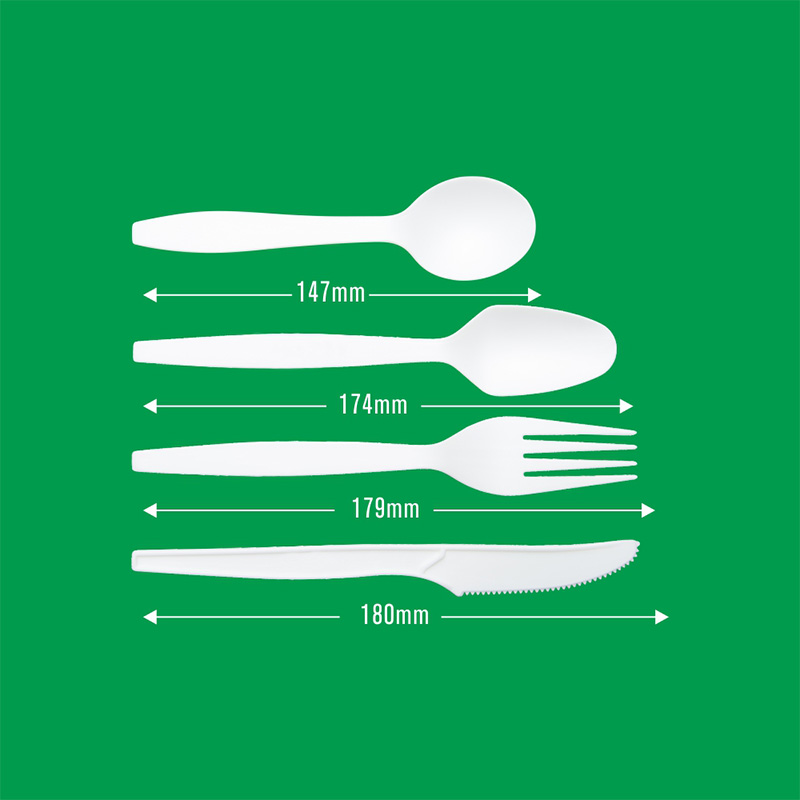 Certified PLA Cutlery Set for Compostable DiningThis plant-based cutlery set offers compostable performance comparable to plastic, making it a reliable choice when seeking third-party certified eco-friendly tableware.View Product →
 Paddy Fiber Cutlery Category with Eco-Friendly OptionsExplore plant-based fiber cutlery sets that reduce plastic use while offering heat resistance, part of a certified compostable product range.View Product →
 Grease-Resistant Kraft Paper Trays for Food ServiceThese sturdy, unbleached kraft trays handle oily foods and are suitable for high-traffic venues, providing a practical compostable serving solution.View Product →
Biodegradable Tableware That Is Not Certified Compostable
Not every tableware product that claims environmental benefits can be composted. A significant share of the biodegradable tableware on the market has no third-party certification and would fail the strict requirements of a compostability standard. Recognising these products will help you avoid misleading claims.
Paper tableware coated with polyethylene is the most common example. The paper base breaks down, but the polyethylene layer does not. What you get is a product that is technically made from renewable fibre but behaves as a composite that cannot be composted and cannot be easily recycled either. Many food service buyers discover this only after their first compost facility rejects a shipment.
There is also a category of materials referred to as oxo-degradable plastics. These are conventional plastics mixed with additives that accelerate fragmentation when exposed to heat and oxygen. They break into smaller and smaller pieces, but the pieces remain plastic. Several jurisdictions, including the European Union, have moved to restrict these products because they create microplastic pollution while giving the impression of environmental responsibility.
Some bioplastics that are not compostable-certified also appear on the market under the biodegradable label. A starch-blend or bio-based plastic can pass basic microbial screening in a laboratory yet fail to disintegrate in a real compost pile. The material may be plant-derived, but the polymer structure is not reactive enough. Without a certification mark on the package, there is no reliable way to know how the product will behave outside the laboratory.
For buyers, the safest question to ask a supplier is not whether the product is biodegradable, but whether it carries a compostability certificate and under which standard. Materials that are merely "biobased" or "oxo-biodegradable" should be treated as conventional plastics until proven otherwise.
Certification Standards and Labels
Knowing the label is the fastest way to sort compliant products from marketing claims. The certification landscape is international, and the same product line can carry multiple marks depending on the markets it is sold into. The table below summarises the standards most likely to appear on tableware packaging.
| Certification or Label | Region | What It Verifies |
|---|---|---|
| ASTM D6400 | United States | Industrial compostability of plastics and plastic-coated products |
| EN 13432 | European Union | Industrial compostability of packaging |
| BPI Certification | North America | Lets a product carry the BPI logo based on ASTM D6400 testing |
| Seedling Logo | European Union | Packaging compliance with EN 13432 |
| OK Compost INDUSTRIAL | International | Industrial composting at 55 to 60 degrees Celsius |
| OK Compost HOME | International | Home composting at ambient temperature |
| AS 5810 | Australia | Home compostability of biodegradable plastics |
When a product carries the BPI logo or the Seedling logo, you can trace the certificate number back to the testing laboratory and the material formulation. That traceability matters for claims you pass on to your own customers. If you are sourcing for a restaurant chain or a retail private label, ask for the certificate and check that the product family, including the coating, colorant, and printing inks, is covered by the same certificate. For a broader view of how these material categories compare from an environmental and cost standpoint, our comparison of biodegradable tableware materials covers the same ground in practical terms.
How Fast Does Each Type of Tableware Actually Break Down?
Timeframes are the most misunderstood part of the compostable versus biodegradable discussion. A certified compostable product is tested at elevated industrial temperatures, so the breakdown is measured in weeks, not years. A biodegradable product without certification may never complete its degradation in a realistic disposal environment. The chart below shows approximate timeframes under the conditions each product is designed for.
Two conclusions come directly from these numbers. First, certified compostable tableware is only fast and clean when it reaches a composting environment that maintains the specified temperature and moisture. Second, the gap between industrial compost and natural soil is enormous. A PLA spoon that is certified for industrial composting can sit in a marine environment for decades with minimal change. The certification describes the product's behaviour in a controlled system, not a general promise of quick disappearance.
How to Choose the Right Tableware for Each Use
The best material for a given application depends on the food temperature, the fats and liquids involved, the serving method, and how the item will be disposed of. There is no single material that works well for everything, which is why most food service operations use a mix of compostable and conventional products across different meal periods.
| Use Case | Recommended Material | Why This Choice Works |
|---|---|---|
| Hot takeout meals | Bagasse trays or paddy fiber plates | Heat resistance up to 120 degrees Celsius, sturdy enough for heavy meals |
| Cold drinks | PLA cups or paper cups with PLA lining | Certified compostable, clear or printable, suitable for cold beverages |
| Hot coffee | Double-wall paper cups with compostable lining | Insulation protects hands; lining is compostable rather than polyethylene |
| Cutlery for events | PLA or birch wood cutlery | Compiles with compostable waste streams; solid enough for moderate meals |
| Salads and deli packaging | Kraft paper containers or clear PET containers | Paper suits dry salads; PET suits high-visibility refrigerated deli items |
| High-heat microwave meals | PP or C-PET containers | Withstands reheating temperatures; recyclable but not compostable |
Notice the last row. Not every takeout item needs to be compostable. Microwaveable PP containers remain the practical answer for meal prep and frozen food that must survive high reheating temperatures, because PLA and paper cannot handle those conditions. The goal is to match the material to the job and then make sure the chosen product flows to the correct end-of-life stream.
Restaurants and catering teams should also consider how the customer will dispose of the item. Ceramic plates and metal cutlery are almost never disposed of in the same stream as compostable packaging. If your operation currently sends all waste to landfill, switching to certified compostable tableware will not create environmental benefit, because landfill conditions prevent composting. In that scenario, the most effective change is to set up a separate organics collection so that certified compostable materials and food waste are processed together. If you rely on takeout containers and bowls for your menu, our biodegradable paper food containers with lids show how a certified compostable paper line can integrate into that system.
Common Misconceptions About Compostable and Biodegradable Tableware
Misunderstandings about these materials continue to cause purchasing mistakes. The points below are the most frequent areas of confusion, with the practical reality explained.
- Biodegradable and compostable mean the same thing. They do not. Compostable is a certified subset of biodegradable, with defined timeframes and residue limits. Biodegradable is a claim without a standard.
- Compostable tableware can go into any compost pile. Most certified products need industrial conditions at 55 to 60 degrees Celsius. Home compost piles rarely reach that temperature, so the product will take far longer than the certified timeframe.
- Compostable tableware breaks down in a landfill. Landfills are designed to limit moisture and oxygen, which slows or stops the composting process. Even certified materials can persist in a landfill for years.
- PLA is always home compostable. PLA is only home compostable if the product explicitly carries a home compost certification. Standard PLA is tested for industrial composting only.
- Paper tableware is automatically compostable. The paper base is, but the coating and printing inks are part of the product. If the coating is polyethylene, the entire item is not compostable.
- Oxo-degradable plastic is a green alternative. It fragments into microplastics and does not provide the environmental benefit that certified compostable products offer.
Each of these misconceptions has a direct cost. Choosing the wrong material can result in rejected waste loads, contaminated compost, or reputational damage if customers find that a "compostable" item does not actually break down in their local facility.
Frequently Asked Questions
What is the main difference between compostable and biodegradable tableware?
The main difference is certification and time. Compostable tableware must meet a standard such as ASTM D6400 or EN 13432, which guarantees that the product breaks down within 90 to 180 days in a composting facility, leaving no toxic residue. Biodegradable tableware has no such guarantee and no defined timeframe.
Are PLA straws compostable?
PLA straws are compostable if they carry a certification such as BPI or OK Compost INDUSTRIAL. They break down in industrial composting conditions within roughly 12 to 24 weeks. They are not designed for home compost piles and will not degrade quickly at ambient temperature.
Can compostable tableware go in the regular trash?
Technically it can, but it will not compost in a landfill. The material will behave like conventional waste because landfills lack the oxygen and microbial activity needed for composting. For the environmental benefit to be real, the tableware must go to an industrial composting facility that accepts it.
How long does compostable tableware take to break down?
Certified products typically disintegrate within 12 weeks and complete biodegradation within 180 days under the conditions specified by the standard. The exact time depends on the material. Paper and bagasse degrade faster, while thicker PLA items and paddy fiber each approach the upper end of the window.
Is biodegradable tableware microwave-safe?
Not necessarily. A biodegradable label does not indicate heat tolerance. PLA tableware is not microwave-safe at high power, while bagasse, paddy fiber, and coated paper containers can tolerate moderate reheating depending on the formulation. Always check the product's temperature rating rather than relying on the eco-label.
How can I verify a compostability claim?
Look for the certification logo and then trace the certificate number. Reputable suppliers provide a certificate from an accredited laboratory such as BPI, TÜV AUSTRIA, or DIN CERTCO. The certificate should name the specific product, the coating, and the inks used. If the supplier cannot provide a certificate, the claim is unverified.
Practical Buying Checklist
Before you place your next order of disposable tableware, run the product through this checklist. It will save you from the most expensive mistakes in the eco-friendly packaging space.
- Confirm the disposal route your customers and your own kitchen will actually use. Is there an industrial composting facility available, or will the waste go to landfill?
- If composting is available, select certified compostable products that carry a recognised mark such as BPI, Seedling, OK Compost INDUSTRIAL, or OK Compost HOME.
- Match the material to the food. Use bagasse or paddy fiber for hot and heavy meals, PLA for cold drinks and cutlery, and compostable-lined paper for hot beverages and takeout boxes.
- Request a copy of the current certificate from your supplier and check that the exact item, including its coating and printing, is listed on the certificate.
- Confirm the heat rating for any product that will hold hot food or touch a microwave. Compostability does not imply heat resistance.
- Check the shelf life. Compostable materials, particularly PLA and coated paper, slowly lose performance with prolonged storage in humid or hot warehouses. Order in line with your consumption rate.
- Ask the manufacturer how the product behaves in real conditions. A supplier with production experience can tell you the actual field trial results, not just the laboratory data.
- Consider the unboxing experience. Natural materials such as paddy fiber, bagasse, and birch wood have a distinct appearance that fits well with sustainability-focused branding and can increase customer acceptance.
Compostable tableware is not the easiest option in every scenario, but when it is matched to the right food application and the right waste infrastructure, it is the only option that can be verified end-to-end. Biodegradable, used honestly, remains a useful description for materials that will naturally return to the environment over time. The difference between them should guide your decision.