 English
 中文简体
Oak, ash, pine, cedar, yew, and alder are the woods that should never be used for spoons. The reasons range from structural weakness to genuine food-contact safety concerns. Ring-porous hardwoods such as oak and ash absorb water, oils, and food debris deep into their grain, making them difficult to clean and quick to harbor bacteria. Softwoods including pine and cedar are too porous, too resinous, and too soft for repeated contact with moisture and hot food. Certain species such as yew and laburnum contain compounds that should never be present on a food-contact surface. And a few otherwise serviceable hardwoods, like alder, fail under the wet-dry cycles that every spoon experiences in normal kitchen use.
These distinctions matter for anyone making, specifying, or purchasing wooden spoons and wooden utensils. A spoon is not just a piece of shaped wood. It is a food-contact tool that must resist moisture, survive temperature swings, avoid flavor transfer, and remain structurally sound through hundreds of uses or, in the case of disposable cutlery, through one reliable use. Choosing the wrong species can produce a spoon that stains, splits, splinters, tastes bitter, or even releases substances that are not appropriate for food exposure. This guide explains exactly which woods to avoid, why they fail, and what a safer alternative looks like in both home kitchens and commercial food service.
Woods to avoid at a glance
The table below summarizes the most common woods that should not be used for spoons, along with the primary reason each one fails in food-contact applications. The sections that follow explain each issue in greater detail so you can apply the same logic to other species you may encounter.
Oak
Ring-porous structure with large open vessels. Absorbs moisture and oils deeply, stains easily, and leaves a bitter, astringent taste due to high tannin content.
Ash
Ring-porous and coarse-grained. Splits along the grain under stress, absorbs liquids readily, and develops a rough surface after contact with water.
Pine
Softwood with pronounced resin canals. Too soft for durable use, releases resin into food, picks up odors, and splinters easily.
Cedar
Softwood that is highly absorbent and aromatic. The natural oils and phenols can migrate into food, and the surface becomes fuzzy and rough with use.
Yew
Contains toxic alkaloids, including taxine compounds. Any contact with food is considered unsafe, regardless of how the wood is dried or finished.
Alder
Hardwood that is highly susceptible to cracking under repeated wet-dry cycling. It may be fine as a carving wood but fails quickly in functional kitchen use.
Ring-porous hardwoods: oak, ash, and similar species
The single most important structural distinction when selecting wood for spoons is the difference between ring-porous and diffuse-porous hardwoods. Ring-porous woods produce large vessels, called pores, in the earlywood portion of each annual growth ring. These vessels are plainly visible to the naked eye on the end grain of species like oak and ash. In a spoon, those vessels act like open channels. Liquids, oils, and tiny food particles penetrate deep into the wood and are very difficult to remove with washing. Over time, the wood darkens, develops an odor, and becomes a more favorable environment for microbial growth.
Oak is the most commonly cited example. White oak and red oak are both ring-porous, although white oak has tyloses that partially block the vessels. Red oak is especially problematic because its large, open pores are essentially exposed tubes running along the grain. A red oak spoon left in a sink for a few minutes will visibly draw water up into its structure. Even with a food-safe finish, the end grain and any exposed vessel openings remain vulnerable. Oak also contains high levels of tannins. Tannins react with iron and certain foods to create dark stains, and they impart a bitter, astringent flavor to soups, stews, and acidic dishes. When oak comes into contact with aluminum, cast iron, or high-acid ingredients such as tomato sauce, the resulting chemical interaction can discolor both the spoon and the food.
Ash presents a similar problem from a different angle. Ash is ring-porous, coarse, and open-grained. It is valued in tool handles and furniture for its shock resistance, but those same long fibers make it prone to splitting along the grain when carved into a thin spoon bowl or handle. The coarse texture also traps food residue and becomes rough and fuzzy after repeated washing. In professional kitchens, an ash spoon may look acceptable for the first few weeks, then deteriorate noticeably as the surface erodes and the grain opens up.
Hickory, elm, and mulberry share the same ring-porous family traits. Hickory is extremely hard, but its wide growth rings and open pores make it a poor choice for food contact unless it is heavily sealed, which defeats the point of a wooden spoon. Elm and mulberry are also ring-porous and should be treated with the same caution.
| Species | Grain structure | Primary failure mode | Food-contact risk |
|---|---|---|---|
| Red oak | Ring-porous, very large open vessels | Deep moisture absorption, staining | High |
| White oak | Ring-porous with some tyloses | Tannin reactions, water entry through end grain | Moderate to high |
| Ash | Ring-porous, coarse | Splitting along grain, surface roughing | High |
| Hickory | Ring-porous, heavy | Open vessels, difficult to keep clean | High |
| Elm | Ring-porous | Water absorption, cracking | Moderate to high |
If a spoon blank shows clearly visible open pores on the end grain, or if you can see a distinct ring pattern of darker and lighter bands on the side grain, you are almost certainly looking at a ring-porous species. A simple way to test any questionable blank is to place one drop of water on the end grain and observe how quickly it disappears. On an open-pored wood like red oak, the drop is absorbed almost instantly. On a closed-pore wood like birch or maple, the drop sits on the surface for a noticeable period. This test requires no special equipment and works on both dried and green wood.
Softwoods: pine, cedar, fir, and spruce
Softwoods are gymnosperm species, commonly called conifers. They include pine, cedar, fir, spruce, and hemlock. These woods are structurally different from hardwoods: they lack vessels entirely and instead rely on tracheids for water transport, which produces a much simpler and more porous cellular layout. In practical terms, that means softwoods are generally less dense, less durable, and far more absorbent than good spoon-making hardwoods.
Pine is a common offender because it is inexpensive and widely available. A pine spoon may look fine when freshly sanded, but it will not hold up to contact with liquid. The wood is soft enough to dent with a thumbnail, and the difference in hardness between the dense summerwood bands and the soft springwood bands creates an uneven wear surface. Pine also contains resin canals that can release sticky sap when the wood warms, especially when used with hot soup or coffee. That resin migrates into food and is very difficult to wash off the spoon surface. In commercial food service settings, pine is never specified for food-contact cutlery for exactly these reasons.
Cedar is often tempting because it smells pleasant and resists insects, but those same aromatic compounds are a liability in food contact. Western red cedar contains thujaplicins and other phenolic compounds that are intended by the tree as natural preservatives. Those compounds can leach into food, especially into hot liquids or acidic preparations. Cedar is also very soft and fibrous. After a few cycles in a dishwasher or even under hot running water, the surface of a cedar spoon becomes raised and fuzzy, creating places where residue collects.
Fir and spruce have similar problems. Both are lightweight, resinous, and prone to splintering along their straight grain. Douglas fir, in particular, has pronounced growth rings that separate under moisture stress. A spoon carved from fir or spruce will often develop splinters along the handle within a short period of normal use. Splinters in food are not just unpleasant. They are a potential hazard in settings where children, elderly diners, or guests are being served.
| Species | Density range (kg/m³) | Typical failure mode | Key concern |
|---|---|---|---|
| Eastern white pine | 320–400 | Denting, resin weep, staining | Resin transfer to food |
| Western red cedar | 310–370 | Surface fuzzing, phenolic leaching | Aromatic compounds in food |
| Douglas fir | 430–530 | Splintering, grain separation | Splinters in food |
| Spruce | 340–460 | Soft surface, splintering | Rapid surface degradation |
| Balsam fir | 290–380 | Compression damage, resin weep | Poor durability |
A useful rule of thumb is that any commercial softwood lumber sold for framing, decking, or general construction should not be used for spoons. Softwoods are also inappropriate for hot food service because their insulating properties work in the wrong direction: the handle heats up quickly near the bowl and remains hot, while the bowl itself does not withstand sustained heat well. The structure of softwood also means that even a high-quality mineral oil finish will not protect it for long, because the oil penetrates the tracheids and leaves the surface without the same film integrity found in closed-pore hardwoods.
Toxic and irritant woods that must be avoided
Some woods contain naturally occurring compounds that are toxic enough to make them completely unsuitable for food-contact products. The most notable example used historically for small decorative objects is yew. Yew wood contains taxine alkaloids, which are toxic if ingested. Even though the amount that might migrate from a finished spoon into food is likely small, there is no safe threshold for a known toxin in a product that will be placed in hot liquid, stirred into batter, or used to serve children. Yew is sometimes still harvested from old hedge trimmings and sold to hobby woodworkers. It should never be carved into anything that contacts food.
Laburnum is another wood with a well-documented toxic profile. Its seeds are known to be poisonous, and the wood itself contains cytisine, an alkaloid that affects the nervous system. Laburnum was historically used for small turned objects such as pipes and walking-stick handles, but the wood dust is considered hazardous and the timber should be classified as unsuitable for food use as well. Oleander, though not a common spoon-carving wood, deserves mention because it is frequently used as a landscape shrub and occasionally finds its way into woodworking projects. Every part of oleander contains cardiac glycosides, and smoke from burning oleander is also toxic. It should never be used in kitchen items.
Osage orange is a different case. The bright yellow wood is very dense and durable, and some woodworkers have made spoons from it. However, it exudes a sticky latex-like sap from fresh cuts, and the sap is known to be a skin irritant. Various sources report that compounds in osage orange may cause mild stomach upset if ingested. Given the availability of safer dense hardwoods, there is little reason to gamble on osage orange for food-contact use, regardless of how attractive the finished spoon looks.
Rosewoods, including Dalbergia species like Brazilian rosewood and cocobolo, present another type of risk. These woods contain sensitizing quinones that can cause contact dermatitis in a significant percentage of woodworkers and users. Cocobolo is especially well-known for causing allergic skin reactions and respiratory sensitivity. The risk is not necessarily that the wood is toxic to ingest; it is that repeated contact with the spoon during eating, or on the lips, can trigger an allergic response in susceptible individuals. A single spoon in one household might not cause a problem, but across a larger user population, sensitization reactions are established enough that professional food-service regulatory guidance does not recognize rosewood as an appropriate food-contact material.
| Species | Active compounds | Nature of risk | Safe for food contact? |
|---|---|---|---|
| Yew | Taxine alkaloids | Toxic if ingested | No |
| Laburnum | Cytisine | Nervous-system toxin | No |
| Oleander | Cardiac glycosides | Highly toxic | No |
| Osage orange | Sap compounds, latex-like resins | Skin irritant, possible GI upset | No |
| Cocobolo | Quinones | Allergic sensitization | No |
| Brazilian rosewood | Dalbergiones | Contact dermatitis, respiratory sensitivity | No |
If you are sourcing commercial wooden cutlery, the presence of a recognized food-contact standard such as FDA 21 CFR 175.300, LFGB, or the EU framework for food-contact materials provides a much more reliable assurance of safety than a supplier’s claim that a certain wood “has always been used.” Reputable manufacturers trace their wood species, drying method, and any finishing agents precisely because the consequences of an untested species entering the food chain are severe. A spoon that looks handcrafted and rustic is only safe if the species behind it is proven.
Woods that crack, warp, or fail structurally
Even a hardwood with a closed-pore structure can fail as a spoon if its dimensional stability is poor. Alder is the clearest example. Alder is a diffuse-porous hardwood with fine, even texture, and it carves beautifully. But alder is well known among spoon carvers and culinary woodworkers for cracking under the alternating wet and dry conditions of kitchen use. The wood shrinks and swells enough with each moisture cycle that checks and splits develop within months, particularly at the junction between the handle and the bowl, where stress concentrates. A cracked spoon is an immediate food-safety problem because the crack becomes a permanent harbor for moisture and bacteria, and it cannot be fully sanitized.
Beech is another hardwood that requires caution. Beech has good density and a fine, closed grain, and it has been used in European kitchenware for centuries. However, beech swells significantly with moisture and shows a tendency to warp in spoon shapes that have asymmetric grain orientation. Unfinished beech spoons can distort noticeably within a couple of months. Beech is also very porous to liquids on the end-grain side, even though it is technically a diffuse-porous species. If a beech spoon is not sealed with a food-safe finish, it will stain quickly and develop a rough, beard-like surface on the end grain.
Poplar and aspen are often used by beginners because they are cheap and easy to carve. Both are technically hardwood, but they are on the low end of density and hardness of any commercial hardwood. A spoon carved from poplar flexes easily, dents under normal use, and has a fuzzy surface that is unattractive and unhygienic in food service. Poplar is also prone to developing gray or brown staining when exposed to water over time, because of its high sugar content, which invites mold growth under certain storage conditions.
Silver maple and boxelder are softer maple varieties that look similar to hard maple but lack the density required for durable spoon use. They are often mixed into bundled wood sold for crafts. If you purchase a bundle of “maple” blanks from a hobby supplier, the actual species may be silver maple rather than the harder sugar maple. Janka hardness is a useful reference here. Sugar maple reaches about 1,450 pounds-force on the Janka scale, while silver maple sits around 700 pounds-force. A spoon carved from silver maple will show visible wear after just a few weeks of daily washing, whereas hard maple will keep its smooth surface for years.
| Species | Janka hardness (lbf) | Primary failure mode | Typical time to failure |
|---|---|---|---|
| Alder | 590 | Cracking from wet-dry cycles | 3–6 months |
| Beech | 1,300 | Warping and end-grain staining | 2–4 months |
| Poplar | 540 | Denting, fuzzing, water staining | 1–2 months |
| Silver maple | 700 | Surface wear, softness | 2–3 months |
| Cottonwood | 430 | Excessive flex, rapid erosion | <1 month |
For anyone buying wooden cutlery in quantity, structural stability is not only a durability issue. It is a compliance and liability issue. A spoon that cracks or warps during service can generate customer complaints, returned product, and in the worst case, a hygiene incident that damages the reputation of the brand. That is why serious suppliers subject their wood to controlled kiln drying, moisture-content verification, and species authentication before processing.
What actually makes a wood safe and suitable for spoons
Once the prohibited woods are set aside, the remaining field is made up of diffuse-porous hardwoods with good density, fine grain, low resin content, and proven dimensional stability. Birch, hard maple, cherry, and beech are all used in wooden utensils, with birch being one of the most reliable choices for both handmade and commercially produced wooden cutlery. The table below places the problematic woods against the recommended species using the Janka hardness scale to make the comparison concrete.
Janka hardness comparison of common spoon woods
The hardness chart tells only part of the story. Oak and ash score well on hardness, yet they fail because of their grain structure and tannin content. The Janka test measures force needed to embed a steel ball into the wood; it does not measure porosity, chemical reactivity, or dimensional stability. A good spoon wood needs the right combination of all four traits. Birch combines fine, diffuse porosity with a hardness around 1,260 pounds-force, low resin content, and minimal odor. It also machines cleanly and maintains a smooth surface when repeatedly washed, which is why it is the dominant species in the commercial disposable wooden cutlery market.
- Choose closed-pore diffuse-porous hardwoods: birch, maple, cherry, beech, walnut, olive wood.
- Avoid ring-porous species: oak, ash, hickory, elm, mulberry.
- Avoid softwoods: pine, cedar, fir, spruce, hemlock.
- Avoid known toxic species: yew, laburnum, oleander, osage orange.
- Avoid sensitizing species: cocobolo, rosewood, other Dalbergia species.
- Avoid low-density or unstable hardwoods: poplar, cottonwood, alder, silver maple.
- Test a sample blank: place a drop of water on the end grain and observe absorption speed.
- Source from suppliers who certify the botanical species of their wood.
Commercial food service: why wood selection matters beyond the home kitchen
Restaurants, cafeterias, catering companies, and institutional kitchens need wooden spoons that behave predictably across thousands of service events. A handmade oak spoon from a weekend craft fair might be charming in a home kitchen, but it is a liability in a food-service operation where a spoon may be used, washed, and reused dozens of times. The wood selection determines how long a spoon remains smooth, how well it resists staining, whether it splinters, and whether any unwanted flavors or colors migrate into the food.
Birch has become the default answer in the disposable wooden cutlery segment precisely because it avoids all of the failure modes described above. White birch provides a smooth, fine-grained surface, a light natural color that signals cleanliness, and one of the best strength-to-weight ratios among temperate hardwoods. It can be formed into a spoon with a bowl that holds up to hot soup and a handle that does not splinter during normal use. These properties are not incidental. They are engineered through careful drying, moisture control, and machining tolerances at the factory.
For operations that need a complete wooden cutlery program, a full set that includes a fork and knife alongside the spoon ensures visual and functional consistency across the table setting. Individual wrapped sets are also widely used in takeout, delivery, and airline catering where hygiene presentation is part of the customer experience. And for hot beverages, wooden stirrers made from the same birch species give coffee and tea service a natural, splinter-free stirring tool that does not carry the resin or odor problems found in softwood stirrers.
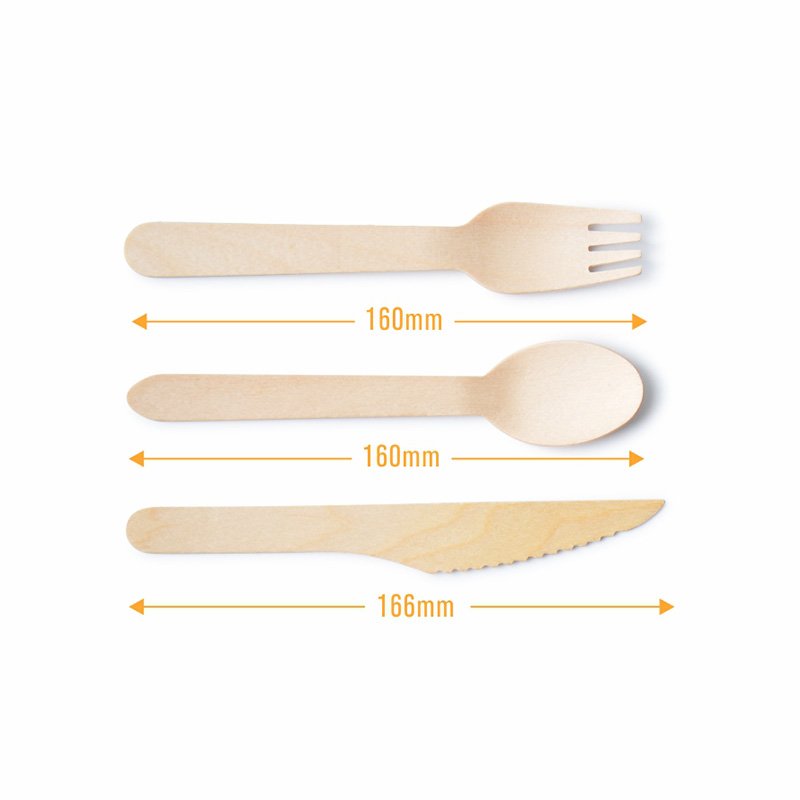 Disposable Biodegradable Birch Cutlery SetThis complete birch cutlery set includes a knife, fork, spoon, and spork, offering a sturdy, biodegradable alternative to plastic for catering and takeout operations.View Product →
Beyond durability, commercial buyers should look for documented food-contact compliance. Established international certifications such as FDA and LFGB are built on the results of migration testing, which measures whether substances from the wood move into food simulants under realistic time and temperature conditions. These tests are species-specific. A certificate that covers birch does not automatically cover oak, and a supplier who cannot name the exact species behind their “wooden spoon” should be treated carefully. The comparison between wooden and plastic utensils is worth reviewing separately because material selection interacts with menu type, price point, and sustainability goals. For an in-depth comparison of the broader category, our guide on wooden versus plastic utensils walks through the trade-offs in detail.
Wooden cutlery also pairs well with other biodegradable service items in a complete takeout or catering setup. Operators who are already using fiber-based bowls, paper boxes, or plant-based cutlery across their service line can add birch wooden spoons without introducing a separate waste stream. Some buyers prefer to diversify their disposable cutlery portfolio by combining birch spoons with paddy fiber cutlery for different menu sections, since paddy fiber has a different mouthfeel and load-bearing profile that some operators prefer for heavier dishes.
In all cases, the purchasing decision should be framed around three questions: What food will touch the spoon, at what temperature, and for how long? Room-temperature deli salads place very little stress on a spoon. Hot soups, stewed meats, and coffee, on the other hand, create the kind of sustained heat and moisture exposure that exposes the weaknesses of the wrong wood species. A birch spoon engineered for hot food service handles the full range of temperatures without cracking, leaching color, or bending.
Frequently asked questions
Can oak spoons be made safe by applying a food-safe finish?
No finish can permanently seal oak against the pressures of kitchen use. Even a high-quality food-safe oil or varnish will wear away at the edges, in the bowl, and around the handle, exposing the open vessels to moisture again. The end grain is especially difficult to seal. Once the finish fails, the oak begins absorbing liquids and the same staining, odor, and tannin problems return. A finish will not change the fundamental ring-porous structure of the wood.
Is red oak worse than white oak for spoons?
Yes. Red oak has very large, open vessels that absorb water aggressively, while white oak has tyloses that partially block its pores and make it somewhat more water-resistant. However, white oak still contains enough tannin to react with iron and acidic foods, and its grain remains relatively open compared with birch or maple. Most woodworking sources recommend avoiding both oaks for spoons, with red oak considered the least suitable.
What about bamboo spoons? Is bamboo a safe wood?
Bamboo is botanically a grass, not a wood, but it is often grouped with wooden utensils. Bamboo is hard and fast-growing, and it is generally considered food-safe when sourced from reputable suppliers. However, bamboo products are frequently joined with adhesives or coated with finishes that may contain questionable chemicals. Buyers should verify that the entire product, including any glue or surface treatment, complies with food-contact regulations. Unfinished, single-piece bamboo utensils are the safer option.
How can I quickly identify a toxic wood before carving a spoon?
The safest approach is to only use wood from a source that can provide botanical identification. When buying from a lumberyard, ask for the exact species name in both common and Latin form. If you collect or receive wood of unknown identity, do not use it for food-contact products. Toxic woods such as yew, oleander, and laburnum do not display any obvious warning signs, and the consequences of using them are serious enough that identification errors are never acceptable.
Does the drying method affect whether a wood is safe for spoons?
Not directly. Toxicity and porosity are determined by the species, not by drying. But drying quality affects durability and safety in secondary ways. Properly dried wood at 6–8 percent moisture content resists warping, cracking, and mold better than green wood or poorly dried lumber. Commercial wooden cutlery manufacturers control this precisely because unstable moisture content leads to spoons that check, split, or bend after shipment. Always ask a supplier how their wood is dried and what moisture range they guarantee.
Why is birch so common in disposable wooden cutlery?
Birch offers a rare combination of properties for disposable cutlery: it is a closed-pore hardwood, dense enough to function for a single-use meal, light in color, low in odor, free of toxic compounds, splinter-resistant when machined correctly, and available at a price point that works for mass production. It also comes from managed northern forests, giving food-service buyers a renewable source story that softwood alternatives cannot match.
Final selection checklist for safe wooden spoons
Whether you are buying one handcrafted spoon for your own kitchen or a container of wooden cutlery for a catering business, the same selection logic applies. Check the species, examine the grain, verify the finish, and ask the supplier questions about sourcing and compliance. The checklist below condenses everything covered into a practical reference.
Confirm the botanical species of the wood before purchase. A statement like “birch” or “sugar maple” should be provided, not just “hardwood.”
Examine the end grain. Large open vessels that look like tiny holes mean the wood is ring-porous and likely unsuitable.
Look at the color and pore pattern on the side grain. Oak and ash show distinct darker layers within each growth ring.
Perform the water-drop test on the end grain. Fast absorption indicates open porosity and poor moisture resistance.
Check for resin, sap, or aromatic odor. These characteristics disqualify pine, cedar, fir, spruce, and similar softwoods.
Verify food-contact compliance documentation if the spoons are being purchased commercially, including FDA or LFGB migration testing.
Confirm the moisture content is controlled in the 6–8 percent range for durable spoons and stable cutlery.
Choose finishes that are labeled food-safe and that fully cure before the spoon is put into service.
The wrong wood will make itself known through staining, cracking, bitter flavors, or splinters, often within the first few weeks of use. The right wood, by contrast, is almost invisible in daily operation: it stirs, scoops, serves, and washes without adding any color, taste, or odor to the food. That silent reliability is the real measure of whether a wood belongs in a spoon. When in doubt, choose birch, maple, or cherry from a supplier that can document the species and its food-contact credentials.