 English
 中文简体
Content
- 1 What Paddy Fiber Tableware Actually Is
- 2 How Rice Husk Cutlery Is Made, Step by Step
- 3 Paddy Fiber Compared With PP, Crystallized PLA and Birch
- 4 Heat, Load and the Numbers Buyers Should Demand
- 5 Set Configurations and What Actually Ships
- 6 Surface Finish, Color and Branding Options
- 7 Food Contact Compliance: What the Paperwork Should Show
- 8 Degradability Claims That Hold Up and Claims That Do Not
- 9 Where Paddy Fiber Cutlery Works and Where It Fails
- 10 A Practical Checklist Before the First Order
- 11 Cost Structure: Where the Money Actually Goes
- 12 Storage, Shelf Life and the Humidity Problem
- 13 Frequently Asked Questions
- 13.1 Is paddy fiber tableware the same as rice husk tableware?
- 13.2 Can paddy fiber cutlery go in the microwave?
- 13.3 Does it taste or smell of rice?
- 13.4 How much husk is actually in a fork?
- 13.5 Is it compostable at home?
- 13.6 What is the realistic minimum order for a custom color?
- 13.7 How do I compare two suppliers quoting different husk percentages?
A paddy fiber fork leaves the mold at around 60 °C, still soft enough to flex a few degrees before it sets. That single moment explains most of what buyers need to know about this material. It is not plastic and it is not paper. It is a rice husk composite that has been dried below 5% moisture, compounded with a food-grade carrier resin, and injected into hardened steel at 180–210 °C. The husk content gives the part its matte, faintly fibrous surface that diners read as natural. The resin gives it the dimensional stability that lets a 4.8 mm thick handle survive a shipping carton, a service counter and a takeaway bag without snapping at the neck.
Paddy fiber tableware covers the standard foodservice cutlery range: fork, knife, spoon, teaspoon, and the 3-piece and 4-piece sets that pair them with a napkin or a condiment sachet. Plates and small bowls molded from the same compound sit alongside them. What follows is the production route, the property numbers that come out of it, and the specific points where the material quietly stops working.
What Paddy Fiber Tableware Actually Is
Paddy means rice still inside its husk. Paddy fiber, rice husk fiber and rice hull fiber are three trade names for the same thing: the lignocellulosic shell that is separated from the grain during milling. Globally, roughly 20% of the paddy weight is husk, and almost all of it is burned, landfilled or used as boiler fuel. Turning it into a molded article is a materials engineering problem, not a recycling gesture.
The compound behind a commercial paddy fiber spoon is usually built on a fixed ratio. Husk powder accounts for 40–60% by weight. A food-grade carrier resin, most often polypropylene but sometimes a bio-based polyester, accounts for 35–55%. The remaining 2–5% is process chemistry: a coupling agent to bond the hydrophilic husk to the hydrophobic resin, a lubricant for mold release, an antioxidant, and a colorant if the part is not left in its natural tan shade.
That ratio is the single most important number a buyer can ask for, because it drives everything downstream. Push husk content toward 60% and the fossil-based share drops, but impact strength falls with it, water absorption climbs, and the surface becomes harder to keep smooth. Pull husk content back toward 40% and the part performs closer to plain PP, which is easier to sell on durability but weaker on the environmental story. Most production lines settle near 50% because that is where the appearance, the strength and the molding window overlap.
Finished cutlery is small and light. Typical production gauges look like this:
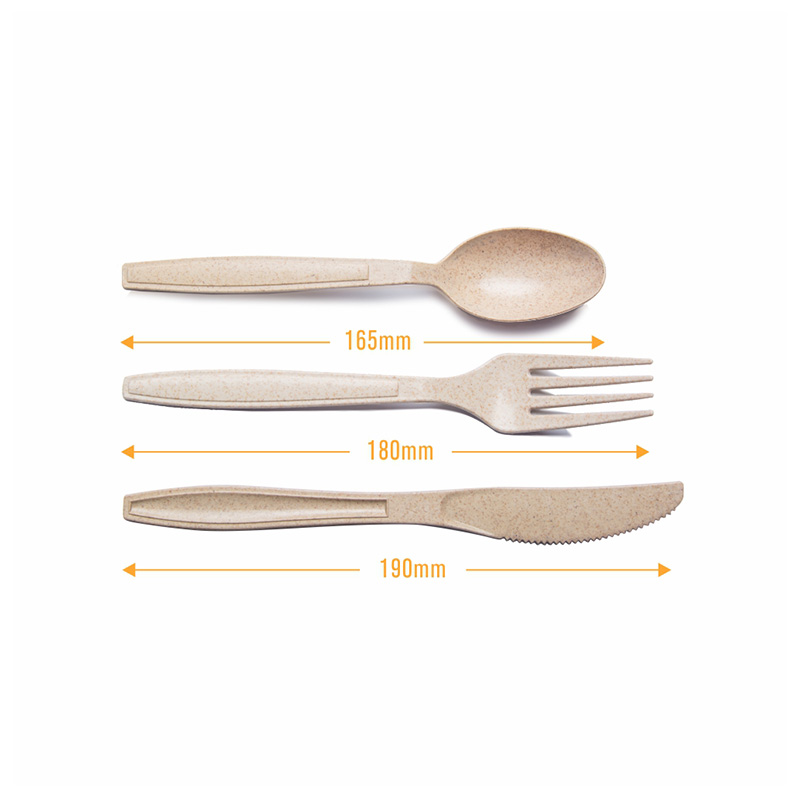
- Fork: 150–160 mm long, 4.5–5.5 g, four tines, tine gap 3.0–3.5 mm
- Knife: 160–170 mm long, 4.8–6.0 g, serrated or plain edge, blade thickness 1.2–1.6 mm
- Spoon: 155–165 mm long, 5.0–6.5 g, bowl capacity 4–6 ml
- Teaspoon: 105–115 mm long, 2.5–3.5 g, bowl capacity 2–3 ml
- Handle thickness: 2.8–4.0 mm, with a ribbed or textured grip zone on heavier models
These dimensions matter because they determine whether the cutlery works in an existing dispenser, a wrapped kit, or a takeaway bag that already carries a container and a cup. A fork that is 5 mm longer than the specification can jam a dispenser on a busy counter, and no amount of material improvement will fix that.
How Rice Husk Cutlery Is Made, Step by Step
The production route is short on paper and unforgiving in practice. Nine stages separate a truckload of husk from a sealed carton of forks.
- Husk intake and cleaning. Husk arrives from rice mills carrying sand, stones, straw and occasional metal fragments. Pneumatic separation removes the light straw, a magnetic trap catches ferrous pieces, and a vibrating screen takes out grit. Feedstock moisture is checked at the gate, because a wet load will cost more to dry than it saves on price.
- Drying. A rotary or fluid-bed dryer brings the husk down to 3–5% moisture. This is not optional. Residual water flashes into steam inside the injection barrel and shows up as bubbles, silver streaks and short shots on the finished part. A dryer running 20 °C too low produces a defect rate that only appears two processes later.
- Grinding and classification. A hammer mill followed by an air classifier reduces the husk to 80–200 mesh, roughly 75–180 µm. Coarser powder leaves a rough, notch-sensitive surface and weakens the part at the gate. Finer powder raises bulk volume, cuts feeding consistency and drives dust control costs up. Most lines run a 120–150 mesh cut as a compromise.
- Surface modification. The powder is treated with 1–2% silane coupling agent or stearic acid in a high-speed mixer at 80–100 °C for 8–12 minutes. This is the step that separates a brittle part from a part that survives a 1.2 m drop onto concrete. Untreated husk has a polar surface that the non-polar resin will not wet, so the interface becomes a row of voids waiting to crack.
- Compounding and pelletizing. Treated powder and resin pellets are metered into a twin-screw extruder with zones set around 160, 180, 190 and 200 °C. The melt is strand-pelletized to about 3 mm. Screw configuration and residence time decide whether the husk disperses evenly or forms clumps that later appear as pale specks on a dark-colored fork.
- Injection molding. Barrel temperatures run 180–210 °C, mold temperature 40–70 °C, injection pressure 40–70 MPa, hold pressure over 3–6 seconds, and total cycle 20–40 seconds depending on cavitation. The gate is normally placed at the handle end so the weld line falls in the least stressed area of the part.
- Deflashing and trimming. Any flash at the parting line is cut by hand or by a trimming fixture. A knife edge or a fork tine with a burr is a return, not a cosmetic issue.
- Polishing. A tumble deburr or a short flame pass smooths sharp corners and evens out the matte surface. Over-polishing removes the fiber texture that makes the product look natural in the first place.
- Inspection and packing. Weight checks, dimensional gauges, an appearance sample against a master, and periodic flexural and migration testing. Cartons are sealed with a batch code that ties back to the compound lot.
Two process details deserve extra attention during a factory visit. The first is moisture control at the hopper. Even a well-dried compound picks up humidity in a coastal warehouse, so a hopper dryer running at 80–100 °C for 2–3 hours before molding is standard practice on a line that cares about yield. The second is mold temperature uniformity. A cavity running 15 °C cooler than its neighbors produces parts that look identical on the line and crack differently three weeks later in a shipping container.
Paddy Fiber Compared With PP, Crystallized PLA and Birch
Buyers rarely choose a material in isolation. They choose it against the three alternatives already on the shelf, and the comparison usually turns on heat, stiffness, water and end-of-life rather than on price alone.
| Property | Paddy fiber (50% husk) | Food-grade PP | Crystallized PLA | Birch wood |
|---|---|---|---|---|
| Density | 1.05–1.15 g/cm³ | 0.90–0.91 g/cm³ | 1.24–1.26 g/cm³ | 0.60–0.75 g/cm³ |
| Heat deflection (0.45 MPa) | 95–115 °C | 95–105 °C | 120–140 °C | Not applicable |
| Flexural modulus | 2,800–3,800 MPa | 1,300–1,700 MPa | 3,500–4,500 MPa | 8,000–12,000 MPa along grain |
| Notched impact strength | 3–6 kJ/m² | 4–8 kJ/m² | 2–3 kJ/m² | Splits rather than breaks |
| Water absorption, 24 h | 0.3–0.8% | Below 0.1% | 0.2–0.6% | 15–25% |
| End-of-life options | Industrial composting, energy recovery | Mechanical recycling, energy recovery | Industrial composting | Composting, energy recovery |
| Relative unit cost index | 1.25–1.45 | 1.00 | 1.60–2.00 | 1.15–1.35 |
The table explains a pattern that shows up in real orders. Paddy fiber beats PP on stiffness and on the story a customer reads on the wrapper, but it loses on weight and on impact strength at high husk loading. Against crystallized PLA it wins comfortably on impact and price, and loses on the upper end of the heat range. Against birch it wins on water absorption and on the absence of splinters, which is why it turns up in schools, hospitals and airline catering where a wooden splinter is a genuine complaint category.
Heat, Load and the Numbers Buyers Should Demand
A rice husk fork will not melt in a bowl of hot soup. It will also not survive a microwave oven at full power for three minutes with a film of oil on it. The useful working window sits between roughly −20 °C and 100 °C for continuous contact, with short excursions to about 120 °C tolerated in a PP-based grade. Above that the resin phase softens and the part deforms under its own load before the fiber has done anything at all.
Mechanical performance is the more common surprise. On a 50% husk grade with a well-treated interface, a spoon bowl supports a static load of 4–6 kg before permanent set. Fork tines bend rather than snap, and the measured force at 10 mm deflection typically falls between 25 and 40 N. A finished piece should survive a 1.2 m drop onto concrete in six orientations without cracking, tested on at least three samples per mold cavity. Ask for the cavity-specific results, not a single number for the tool.
Heat ceiling
Continuous service to 100 °C. Short peaks to 120 °C. Not for oven use, not for direct flame, not for a microwave run with high-fat food in contact with the surface.
Load ceiling
4–6 kg static on a spoon bowl. 25–40 N at 10 mm fork tine deflection. Anything heavier belongs in reusable steel, and a supplier who promises otherwise is quoting a demonstrator rather than a product.
Moisture ceiling
0.3–0.8% water uptake after 24 hours of immersion. Below the threshold for a normal meal, but enough to justify a 60% RH storage limit over a multi-month shelf life.
Set Configurations and What Actually Ships
Loose cutlery and wrapped cutlery are different products with different logistics. Loose pieces ship in bulk cartons of 1,000 or 2,000 units and get wrapped by the buyer's own team or by a contract packer. Wrapped sets ship ready to hand to a diner, and the wrapping material becomes part of the compliance story: a paper napkin and a paper sleeve keep the whole kit compostable, while a polypropylene film quietly breaks that claim.
For operators who want a single reference kit that covers a hot main and a dessert, a three-piece configuration is the most common starting point, with the fork, knife and spoon nested in a paper wrap and a printed band. Set assembly tolerance is tighter than most buyers expect: if the wrap is 3 mm short, the corners tear, and if the knife is 2 mm long, it protrudes and punctures the band in transit.
 3-Piece PF Disposable Cutlery SetThree-piece PF set includes knife, fork, and tea spoon, giving wholesale buyers a compact reference kit for hot main and dessert service.View Product →
Four-piece kits add a teaspoon and suit operators whose menu includes coffee, dessert or a soup course. The extra piece raises unit cost by roughly 12–18% but removes a second dispenser from the counter, and that trade is usually worth it in a venue with limited service space.
 4-Piece PF Disposable Cutlery SetFour-piece PF set adds a soup spoon and suits catering, dinner, and party service with hard, BPA-free food-grade cutlery in a grouped wholesale format.View Product →
Where a plant-fiber cutlery program is being built from scratch, it helps to see how the cutlery and the matching plate and tray range sit together in one product family, since the visual consistency of a brown fiber fork next to a white molded plate is a design decision, not an automatic one. A biodegradable paddy fiber cutlery set gives a concrete reference point for how the pieces are grouped and packed.
Surface Finish, Color and Branding Options
Rice husk compound is a difficult substrate for a proud brand. It has a visible fiber texture, its natural shade is an inconsistent tan, and every colorant has to be checked against food contact rules before it goes anywhere near a fork.
The three finishes in normal production are matte natural, polished natural and colored. Matte natural leaves the fiber texture visible and is the cheapest to produce because it skips the polishing step. Polished natural smooths the surface to a low sheen and reads as more premium, at the cost of losing some of the "made from rice husk" visual cue. Colored parts, whether carbon black, off-white or a matched Pantone shade, require a masterbatch that is compatible with the husk compound and approved for food contact, and the masterbatch dose has to be stable batch to batch or the shade drifts between cartons.
Branding falls into three routes. Mold engraving puts a logo directly into the tool, which costs the buyer nothing per piece but bakes the brand into every order from that mold. Pad printing and silk screening put a logo on the handle at a few cents per piece, with an ink that must be checked for migration along with the base material. Printed bands, sleeves and napkins are the cheapest option and the easiest to change, and for most operators they deliver more visible branding per dollar than a logo on a 4 mm wide handle.
Dimensional tolerance is the quiet specification. Standard production holds ±0.3 mm on length and ±0.2 g on weight. Tighter than that requires a hotter mold and a slower cycle, and the buyer pays for it in unit price, not in a separate line item.
Food Contact Compliance: What the Paperwork Should Show
A paddy fiber fork is a food contact article, and it is tested as one. The relevant frameworks are FDA 21 CFR Parts 174–178 for the United States, EU Regulation 10/2011 with the associated migration testing for Europe, LFGB for Germany, and GB 4806.7 for the domestic Chinese market. A supplier claiming broad market access should be able to point to a specific test report rather than a marketing page.
The tests that matter in practice are overall migration, specific migration of the monomers and additives used in the carrier resin and the coupling agent, heavy metal content, and sensory testing for odor and taste transfer. Overall migration for a plastic food contact material is normally capped at 10 mg/dm², and the test conditions are chosen to match the intended use: repeated use at room temperature, hot fill, or fatty food contact as applicable.
Three documents belong in the buyer's file before the first shipment. The first is a material safety data sheet for the compound grade, tied to the exact composition rather than a generic category. The second is a migration test report from an accredited laboratory, with a date inside its validity window, because a five-year-old report on a different husk ratio is not evidence about the current product. The third is a batch-level certificate of analysis showing the measured weight, dimensions and appearance against the approved sample.
Injection molding adds one more variable that buyers often skip. Reworked scrap, when ground and fed back into the barrel, changes the fiber length distribution and can shift migration results. Ask whether regrind is used, at what percentage, and whether the tested formulation included regrind. A supplier who answers that question precisely is usually a supplier who controls the other variables too.
Degradability Claims That Hold Up and Claims That Do Not
A paddy fiber fork left in a field will not disappear in a season. This is the most damaging misunderstanding in the category, and it is worth being blunt about it. The husk fraction is lignocellulosic and breaks down slowly; the carrier resin, if it is polypropylene, does not biodegrade at all in a natural environment. A part made from 50% husk and 50% PP is not compostable in the EN 13432 or ASTM D6400 sense, and no certificate will say otherwise.
What is true is more modest and still useful. The husk replaces a measurable share of fossil-based polymer, which reduces the embodied carbon of the piece and diverts an agricultural residue that would otherwise be burned. The part behaves in industrial composting conditions roughly as a blend of a slowly degradable fiber and a non-degradable polymer: the fiber fraction breaks down, the resin fraction remains as fragments. If the carrier resin is a certified-compostable polyester, a genuinely compostable grade becomes possible, but the certificate has to name the whole formulation, not just the resin.
For labeling and menu language, the safe and legally defensible phrasing usually looks like "made with rice husk fiber, reducing fossil-based plastic content by around half" or "rice husk composite, suitable for industrial composting where facilities exist". Language that says "100% biodegradable", "breaks down in 90 days" or "zero waste" without a named standard behind it is exposure, not marketing. Greenwashing enforcement in Europe and North America has become specific enough that a mislabeled cutlery claim on a menu can generate a complaint that costs more than the entire cutlery order.
Where Paddy Fiber Cutlery Works and Where It Fails
The material is at its best in short-contact, moderate-load service. It is at its worst when it is asked to behave like steel or like a sealed plastic.
Good fit
- Takeaway and delivery kits where the fork travels with a container and is used once
- Salad bars, poke counters and cold bowls, where heat is not a factor
- Ice cream and dessert service, where the spoon meets 0–8 °C food
- Breakfast buffets and hotel catering with a natural-material theme
- Events, weddings and conferences where visual consistency matters
- Airline and rail catering, where weight and splinter risk both count
Poor fit
- Long soaking in hot broth, where the spoon stays submerged for 20 minutes or more
- High-fat food reheated in a microwave directly on the cutlery
- Cutting dense meat on a hard plate, which loads the knife edge laterally
- Storage in a humid kitchen without a sealed carton, over several months
- Children's cutlery where a short, thick handle and rounded tines are a safety requirement
There is a cost angle hidden in that split. An operator who uses paddy fiber for the salad bowl and a heavier PP fork for the steak plate will usually spend less than one who tries to standardise everything on the fiber product, because the specification that survives the steak plate is over-engineered for everything else.
A Practical Checklist Before the First Order
Most problems with paddy fiber cutlery show up after the second shipment, not the first. The first order gets attention. The second order gets whatever the line happens to be running. A checklist agreed before the purchase order is signed is the cheapest defect-prevention tool available.
- Approved sample. Keep a signed physical sample for appearance, weight and flex. Photos on a spec sheet are not a reference standard.
- Composition statement. Husk percentage, carrier resin type and grade, additive package. Get it in writing and tie a change to written notification.
- Mechanical data. Flexural modulus, notched impact and drop test results per cavity, not per mold.
- Migration reports. Current, accredited, and matching the actual formulation including any regrind allowance.
- Tolerance agreement. Length, weight, flash limit, and how many pieces out of a hundred may fall outside.
- Packaging specification. Units per inner bag, bags per carton, carton dimensions, liner and desiccant if the route is humid.
- Tooling ownership. Who pays for the mold, who owns it, and what happens to it if the relationship ends.
- Change control. Written notice before any change in husk source, resin grade or masterbatch supplier.
- Lead time and shipping terms. Production lead time separate from transit time, with the port pair named.
- Retained samples. One sealed carton per batch held by both parties for the duration of the shelf life.
Cost Structure: Where the Money Actually Goes
Rice husk powder is cheap. That is the only part of the cost story that is simple. The treatment, compounding and molding steps are where the price is built, and a supplier quoting far below the market is almost always cutting one of them.
Read that chart from the bottom. The husk itself is one of the smallest lines in the cost sheet, which is why a supplier cannot rescue a low price by using more husk. The real levers are resin grade, cycle time and cavitation. A 32-cavity tool running a 22-second cycle produces roughly 5,200 pieces an hour; the same tool at 30 seconds loses a quarter of that output and adds the difference straight onto the unit price.
Tooling amortization is where order size matters most. A cutlery mold with a realistic cavitation for this material carries a meaningful fixed cost, and spreading it over 200,000 pieces rather than 50,000 changes the unit price by more than any negotiation on resin. Buyers who plan a two-year program and commit volume in stages generally pay less than buyers who shop each order separately.
Where a program also needs a bagasse or fiber bowl to complete the tray, a plant-based biodegradable cutlery combo shows how a mixed-material kit is assembled without breaking the visual language of the range.
Storage, Shelf Life and the Humidity Problem
Paddy fiber cutlery is stable, but it is not inert. The fiber fraction will take up moisture from the air, and a carton that sits in a humid warehouse for four months before it reaches a distribution center will show it: parts gain a little weight, the surface dulls, and in the worst cases a faint musty odor develops that sensory panels pick up immediately.
The practical storage specification is a dry, ventilated space at 15–30 °C and below 60% relative humidity, with cartons kept off the floor on pallets and away from outside walls. Inner bags should stay sealed until the point of use. For sea freight through tropical routes, a desiccant sachet inside the carton and a liner bag are cheap insurance against the condensation cycle that happens when a container moves from a hot deck to a cold port.
Shelf life is typically declared as 24–36 months from production under those conditions, and the declaration should be backed by accelerated aging data rather than an assumption. Once a carton is opened on a service counter, the clock changes: an open bag in a steamy kitchen is a different environment from a sealed carton in a warehouse, and most quality complaints trace back to that gap rather than to the manufacturing line.
Frequently Asked Questions
Is paddy fiber tableware the same as rice husk tableware?
Yes. Paddy fiber, rice husk fiber and rice hull fiber describe the same raw material. The naming difference is commercial, not technical, and a supplier using one term is not offering a different product from a supplier using another.
Can paddy fiber cutlery go in the microwave?
Brief reheating of a low-fat item is generally acceptable. Long heating of oily food directly on the surface is not, because the resin phase softens and the part can deform under load. For microwave-heavy menus, a PP container with a fiber lid is a more reliable combination than fiber cutlery in the oven.
Does it taste or smell of rice?
A properly processed part does not. Residual husk oil and dust are the usual causes of an off-odor, and both are controlled by the drying and compounding steps. Sensory testing is part of the standard migration panel for exactly this reason, and a batch that fails it should never ship.
How much husk is actually in a fork?
Most commercial grades carry 40–60% husk by weight. Ask for the figure in writing, because it drives impact strength, water absorption and the environmental claim in equal measure. A supplier who cannot state a range is not controlling the formulation.
Is it compostable at home?
Not in any certified sense for a PP-based grade. Industrial composting of a certified-compostable formulation is a different case, but it requires a named standard and a named certificate. Home compost claims for this material family should be treated as marketing until the certificate is produced.
What is the realistic minimum order for a custom color?
Color changes carry a cleaning cost on the extruder and the injection machine, so most lines set a minimum that covers that cleaning rather than the colorant itself. Small trial quantities are usually possible from stock colors, with custom shades following once the specification is locked.
How do I compare two suppliers quoting different husk percentages?
Ask both for impact strength, water absorption and the drop test result at their quoted composition, then compare on the application rather than on the percentage. A 55% husk part that fails a 1.2 m drop is worse value than a 45% husk part that passes it, regardless of what the label says.