 English
 中文简体
中文简体
Agricultural By-Product Fiber
Rice husk and straw are collected from the milling industry and reused as the structural filler. This keeps a bulky residue out of burning pits and gives the set a story that diners can understand at once.

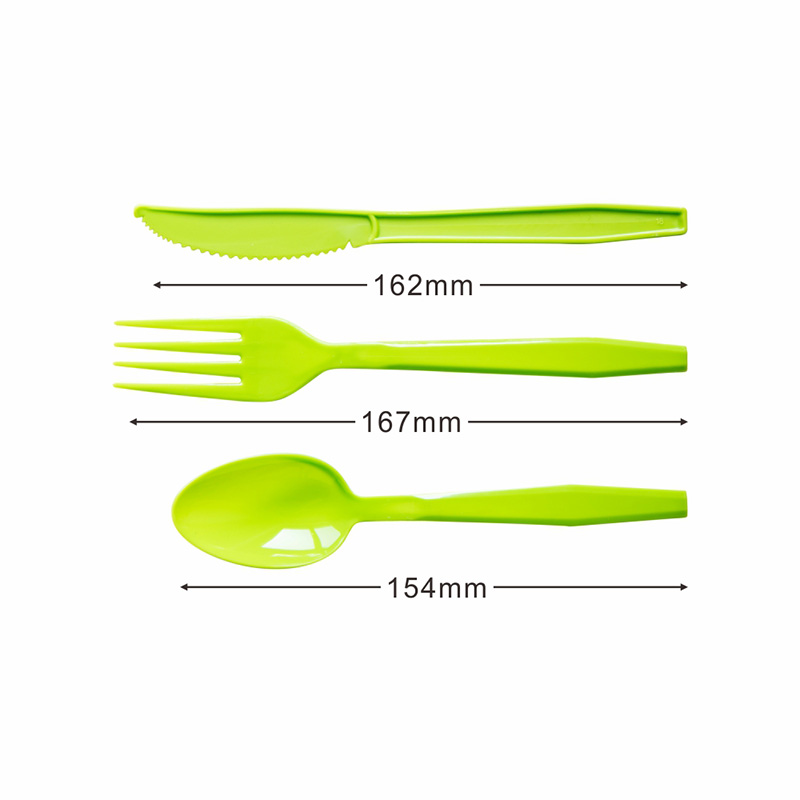
A sturdy knife, fork and spoon set made from rice husk fiber that would otherwise be burned or discarded. Warm natural texture, reliable strength at the table, and ready for your own sleeve or pouch design.
Explore more compostable and disposable food service products from the same manufacturing group.
Where the fiber comes from, how a rice-industry by-product becomes a knife, fork and spoon, and what a buyer should check before choosing it.
A biodegradable paddy fiber cutlery set is a knife, fork and spoon made largely from the husk and straw of the rice plant — the material left in the field and at the mill after the grain has been harvested and polished. Instead of sending that fibrous residue to be burned or dumped, the manufacturing process dries it, grinds it into a fine powder, blends it with a food-safe bio-based binder and presses it into cutlery shape. The finished set has a distinctive speckled, earthy surface that tells customers at a glance that this is not another white plastic fork.
For restaurants and caterers, the appeal is both practical and visual. Paddy fiber cutlery is rigid enough to cut a roast chicken thigh or spear a salad leaf, it does not bend under a heavy portion of pasta, and it tolerates hot food better than many starch-based alternatives. Because the raw material is an agricultural by-product rather than a purpose-grown crop, it also avoids the common criticism that bio-based packaging competes with food production for farmland.
The word "set" matters too. Selling the knife, fork and spoon as a coordinated kit — often with a napkin, in a paper sleeve or a printed pouch — simplifies life for takeaway counters, airline caterers, hotel room-service teams and meal-kit companies. One SKU, one carton and one price replaces three separate orders, and the customer receives a complete, hygienic eating tool in a single pick-up.
The journey starts at the rice mill. Husk is separated from the grain, screened to remove stones and dust, and dried to a controlled moisture level. It is then milled into a uniform fiber powder. Consistent particle size is the quiet secret of good paddy fiber cutlery: if the powder is too coarse, the surface becomes rough and the tines become brittle; if it is too fine, the set loses the natural texture buyers are looking for.
The powder is compounded with the binder and additives into granules, which are fed into injection moulding machines. Cooling time, mould temperature and wall thickness are tuned for each piece. A fork needs strong tines and a thicker neck; a knife needs a stiff blade and a safe, rounded cutting edge; a spoon needs a deep, smooth bowl that does not leak soup. Each tool therefore has its own mould and its own process window.
Disposal guidance deserves honesty. Depending on the binder, paddy fiber cutlery may be certified for industrial composting, while others are designed mainly as a lower-plastic alternative. The right message to customers is the one that matches the certificate, not a vague "eco" claim. A clearly stated disposal route builds trust with environmentally minded diners and keeps your brand on the right side of green-claims regulation.
In short, paddy fiber cutlery is a conversation piece that also performs. It lets a restaurant tell a story about agricultural waste turned into something useful, and it gives the diner something sturdy to eat with. For many brands that combination of narrative and function is exactly what a single-use item should deliver.
One more point deserves attention: seasonality. Rice is harvested in cycles, and the quality of husk can shift slightly from one harvest to the next in moisture, silica content and particle behaviour. A mature supplier blends and tests raw fibre ahead of each production run so that the colour, texture and strength of your cutlery remain consistent across the year, and warns you when a natural variation is likely to be visible.
Typical set configurations are listed below. Fiber ratio, finish, set composition and packaging can all be adjusted for your menu.
| Material | Paddy (rice husk) fiber blended with a food-safe bio-based binder |
|---|---|
| Set Contents | Knife, fork and spoon — optional napkin and toothpick |
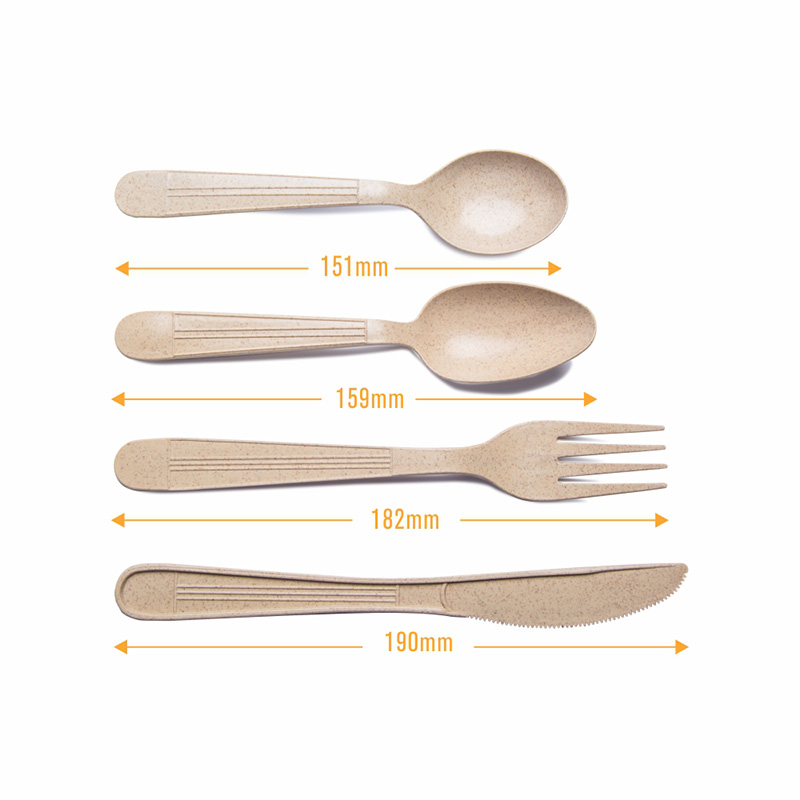
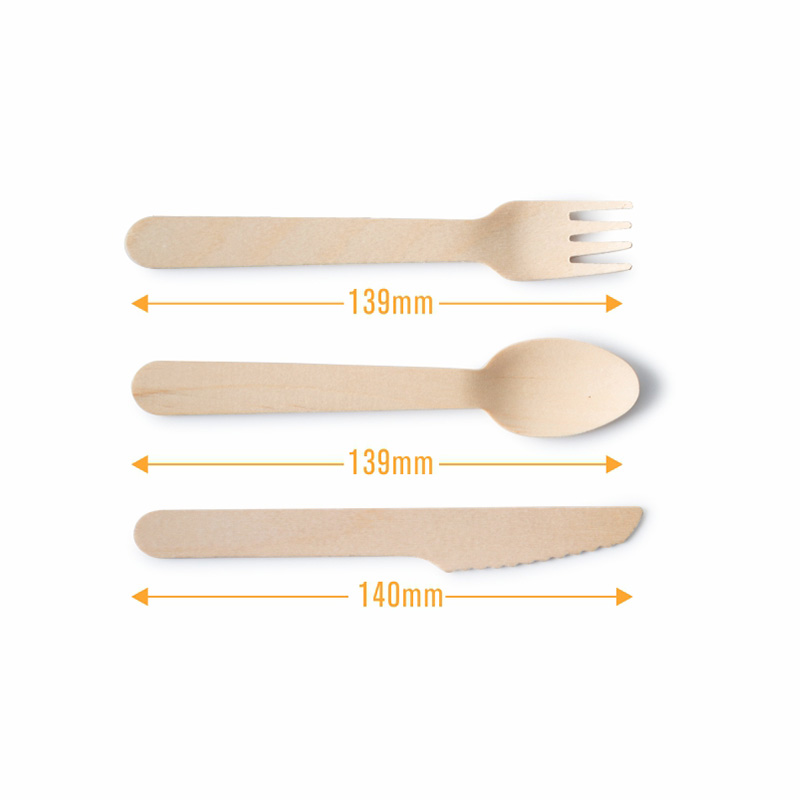
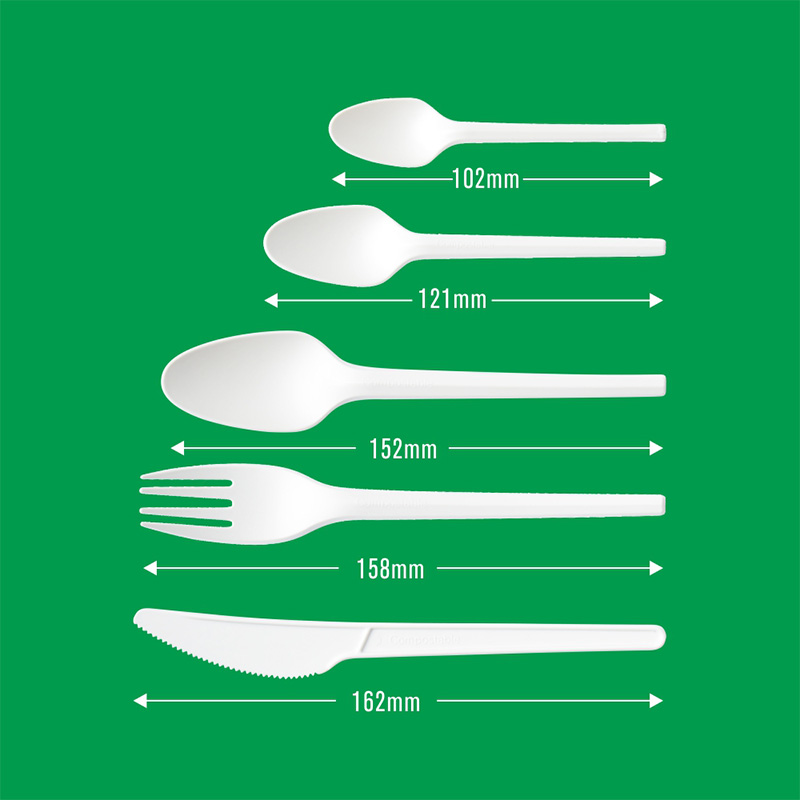
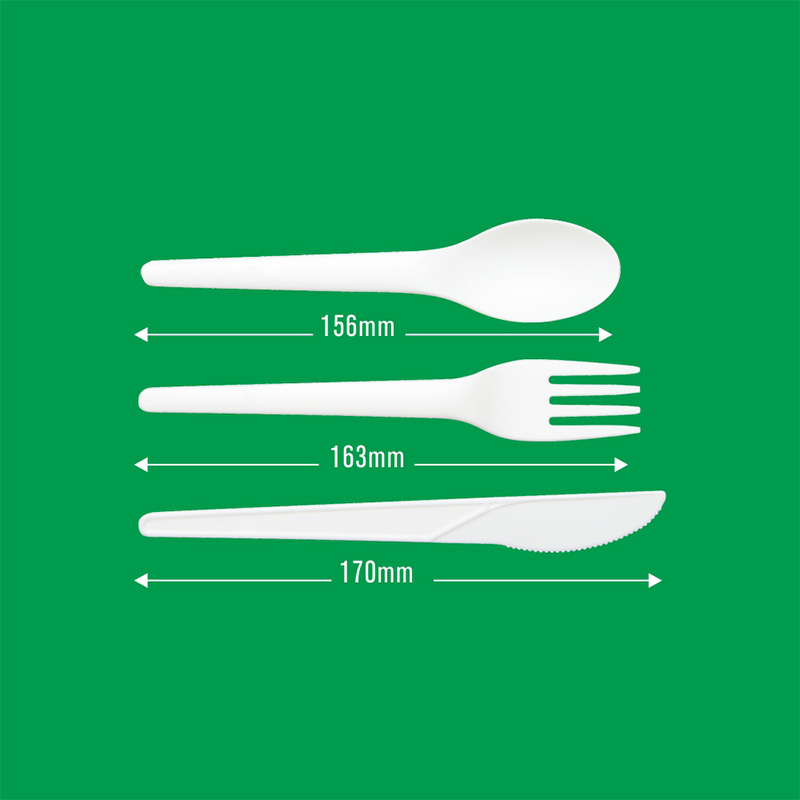
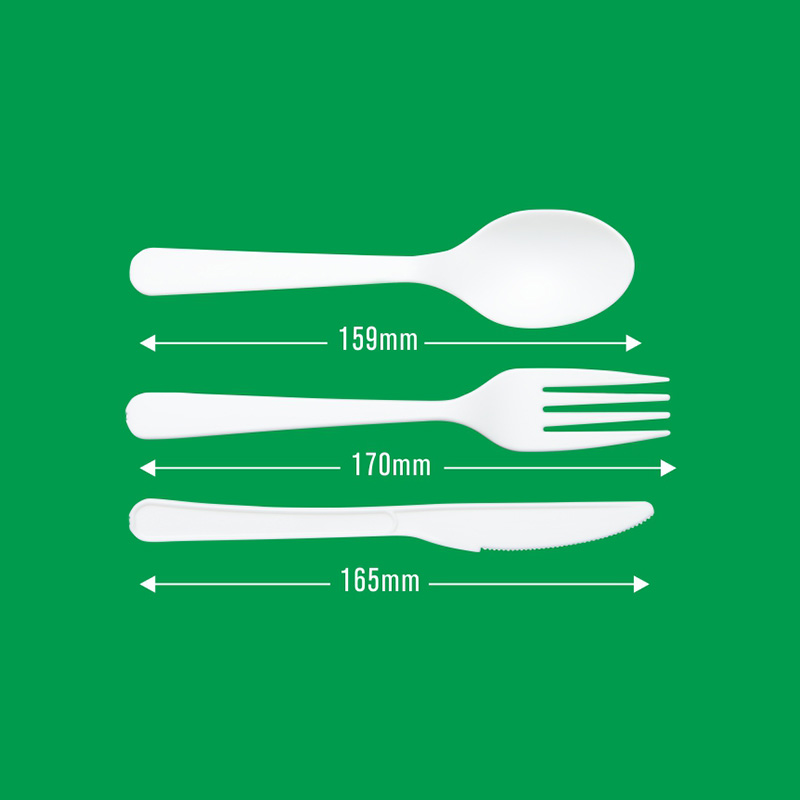
| Length | Standard 160 – 185 mm; shorter dessert and longer catering sizes available |
| Weight | Approximately 4 – 7 g per piece depending on style |
| Color | Natural tan, speckled brown or deep charcoal |
| Surface | Matte, lightly textured grip with smooth food-contact area |
| Temperature Range | Suitable for hot foods at normal serving temperature and chilled meals |
| Set Packing | Paper sleeve, kraft pouch, PLA film bag or bulk carton |
| Certification | Food contact testing; compostability depends on binder and market |
| Lead Time | Usually 20 – 35 days after sample approval and deposit |




Built for kitchens that want a natural look without a flimsy feel — strong enough for the main course and honest about its materials.
Rice husk and straw are collected from the milling industry and reused as the structural filler. This keeps a bulky residue out of burning pits and gives the set a story that diners can understand at once.
Fine fibers remain visible on the surface, producing a speckled earthy finish. No two pieces look exactly the same, which suits farm-to-table, organic and wellness food concepts.
Fork tines are moulded with reinforced roots and the knife blade is thickened along the spine. Chicken, grilled vegetables and chilled pasta salad can be cut and lifted without flexing or snapping.
Knife, fork and spoon share the same colour and finish and are packed together, so the customer receives a matched kit instead of three loose pieces from different suppliers.
The fiber-reinforced body keeps its shape in hot rice, soup and noodle dishes at normal serving temperature, which is where many starch-based cutlery ranges begin to soften.
The cutlery itself keeps its natural look, while sleeves, pouches and seal stickers carry your logo, menu message or QR code. It is an inexpensive way to extend the brand to every takeaway order.
We work with distributors, hospitality groups and retail brands across multiple markets and regions.
















Eight strengths that shape how we develop, manufacture and deliver paddy fiber and bio-based cutlery sets at scale.
A recognised voice in the sector, participating in the development of industry standards and supported by growing demand for degradable materials at home and abroad.
R&D, production, manufacturing, sales and service are integrated under one organisation, creating an efficient and sustainable operating ecosystem.
Continuous investment in new technology and production, with targeted material development supported by academic expertise in polymer and materials science.
A broad product line paired with strong design and high customisation capability, so different industries can receive products built for their specific needs.
Intelligent production workshops and automated mechanical equipment keep output consistent and lead times predictable, even at high volume.
A global outlook with service to customers worldwide. Group headquarters in Ningbo, China, and a production base in Vietnam.
More than a decade of focus on quality, with international awards and manufacturing carried out strictly to the highest industry standards.
A diversified core management team drawn from benchmark companies in different industries, forming a distinctive corporate DNA.
A recognised position in the industry with participation in the formulation of industry standards, alongside domestic and global support for the environmentally friendly degradable sector.
R&D, production, manufacturing, sales and service are integrated to create an efficient and sustainable enterprise operation ecology.
Vigorous investment in the development and production of new technologies, with targeted technology development supported by professors from the Institute of Materials of the Chinese Academy of Sciences.
An extensive product line with excellent product design and high customisation capability, producing tailored products for the different needs of various industries.
Intelligent production workshops and automated mechanical production equipment create an industry-efficient enterprise.
Positioning global and serving the world, with the group headquarters in Ningbo, China, and a base in Vietnam.
Thirteen years focused on quality, with numerous international awards and manufacturing carried out strictly in accordance with the highest industry standards.
A diversified core management team with professionals from benchmark companies in different industries and management teams in diversified fields, forming a unique corporate DNA.
Fiber-based cutlery touches food and mouths directly, so migration, heavy-metal and hygiene testing matter as much as any compostability claim.
Because paddy fiber cutlery blends a natural filler with a polymer binder, documentation has to cover both parts of the material. Each production lot is supported by food-contact tests and factory inspection before shipment.
European framework for plastic materials and articles intended to contact food, including overall and specific migration limits.
US food-contact regulations covering resins and additives used in articles that touch food.
German food and feed code, often requested for tableware sold into Germany and Switzerland.
Compostability standards applicable where the binder and formulation have been tested and certified for industrial composting.
Moisture check on raw fiber, visual inspection for black specks, tine strength sampling and drop tests on packed sets.
Selected certifications and awards that support our compostable and food-contact product range.






How a rice-fiber set compares with the two options most buyers keep on their shortlist.
Wooden cutlery has a natural image, but it can leave a dry, splintery feeling in the mouth and tends to break along the grain when pressed against dense food. Plastic cutlery is cheap and tough, yet it carries a negative image and is subject to bans in a growing number of cities.
Paddy fiber cutlery tries to deliver the useful parts of both. It is moulded rather than cut, so it has a smooth, consistent shape without splinters, and it uses a renewable agricultural filler rather than fresh timber. The look is natural, the performance is closer to plastic than to wood.
The comparison on the right covers sourcing, splinter risk, hot-food behaviour, set formats and customer perception. Use it as a practical checklist when you are comparing quotations for dine-in, takeaway and event catering.
| Attribute | Paddy Fiber | Wooden | Plastic |
|---|---|---|---|
| Raw material | Rice husk and straw fiber | Birch or poplar wood | Petroleum polymers |
| Splinter risk | None | Possible | None |
| Hot food | Good | Acceptable | Good |
| Breakage under load | Low to moderate | Higher along grain | Low |
| Mouthfeel | Smooth, slightly matte | Dry, woody | Smooth, glossy |
| Moulded set formats | Yes | Limited | Yes |
| Source story | By-product reuse | Forest resource | Fossil resource |
| Regulatory outlook | Favourable | Favourable | Increasingly restricted |
A natural-looking, sturdy alternative for food concepts that want their cutlery to match the story on the plate.


Changya New Material Technology Co., Ltd. was founded in 2013, and the group is headquartered in Ningbo, China. It is a limited liability company integrating R&D, production, and sales. As China Biodegradable Paddy Fiber Cutlery Set Manufacturers and Wholesale Biodegradable Paddy Fiber Cutlery Set Factory,, the company mainly produces paper, PLA & plastic disposable tableware, such as straws, cutlery, microwaveable box, hinged box, cup, carry-out bags, plates, dining kits, etc.
Changya New Material Technology Co., Ltd. has developed rapidly since its establishment, with constant growth each year, and has now become an enterprise in the field of high-quality disposable food and kitchen supplies in China.
Two manufacturing bases with automated production lines and strict quality control at every stage, from raw material to finished carton.

















From colour and fiber ratio to the sleeve around the set, every part of the product can be tuned to your brand and your menu.
Choose a more rustic, heavily speckled look or a smoother, more refined surface by adjusting the husk content. Matte or lightly polished finishes can be sampled side by side.
Natural tan and deep brown are always available. Charcoal, sage and cream tones can be produced to order and matched to your brand palette.
Two-piece fork and spoon kits, three-piece sets with a knife, or four-piece sets that add a napkin or toothpick are all available to suit your service style.
Kraft paper sleeves and compostable film pouches can carry your logo, menu messaging or a QR code, printed in up to four colours.
A small embossed logo on the handle gives a premium touch without adding ink or labels. Mould-based embossing suits larger, repeat orders.
Loose bulk cartons for kitchens, counter-top dispenser boxes for front-of-house, and consumer packs for supermarket shelves.
A six-dimension comparison of paddy fiber, wooden and conventional plastic cutlery. Scores are relative to the best performer in each dimension (5=best).
Strong rigidity, the best natural appearance and a favourable environmental story. Cost sits above commodity plastic because fiber compounding adds a processing step.
Excellent natural appeal and eco-credentials, but weaker under load, more prone to splintering and more limited in shape and branding options.
Still the benchmark on price and toughness, but lowest on eco-rating and increasingly restricted by regulation.
How fiber-based cutlery performs on end-of-life time and carbon footprint compared with wooden and conventional plastic sets.
Approximate breakdown time under suitable conditions for each material. Values are indicative and depend on binder and environment.
Indicative cradle-to-gate CO₂ equivalent per kilogram of material. Lower is better. *Industrial composting where certified.
From plant sugar to a wrapped straw on a café counter — five stages that define the quality of the finished product.
Plant sugars from corn starch or sugarcane are fermented by bacteria to produce lactic acid, the building block of the polymer.
Lactic acid molecules are linked into long chains to form PLA resin, which is then pelletised for easy handling and transport.
The resin is melted and pushed through precision dies to form straw tubes with a consistent wall thickness and smooth surface finish.
Tubes are cut to length, the ends are finished to remove burrs, and samples are checked for straightness, diameter and appearance.
Each straw is sealed into its own paper wrapper — plain or printed — then counted into inner boxes and master cartons.

From the rice paddy to certified disposal — the full journey of a biodegradable paddy fiber cutlery set.
Rice is harvested and milled. Husk and straw, a by-product of the grain, are collected from local mills instead of being burned.
Husk is cleaned, dried and ground to a consistent powder, then compounded with a food-safe bio-based binder.
Granules are injection moulded into knives, forks and spoons, inspected, and packed into sets with sleeves or pouches.
The set is distributed to kitchens and customers, serving hot and cold meals with a sturdy, natural feel.
Used sets are collected with food waste and sent to industrial composting where certified, or to the local recovery route.
With manufacturing bases in China and Vietnam, our fiber cutlery sets are shipped to five main regions, with rice-growing countries taking an increasing share.
Paddy fiber cutlery is a moulded composite, so it is naturally dry and stable, but it still benefits from sensible storage. Keep cartons off the floor and away from walls where humidity can build, and avoid stacking heavy loads on top of the lowest layer.
Store sets in a dry, ventilated room and keep them out of direct sun. Natural fibers can fade slightly under prolonged UV exposure, which is cosmetic rather than structural but can create uneven colour between old and new stock.
At the counter, sleeved or pouched sets are the most hygienic choice. If you dispense loose cutlery, a covered handle-first dispenser lets customers pick up each piece by the handle and prevents contact with the food surface.
Match the outer packaging to your waste stream. If your venue separates organic waste, kraft paper sleeves keep the whole set consistent from handle to carton. Where plastic film is acceptable, a thin bag may offer better protection during delivery.
Tell us the diameter, length, color and wrapping you need. Our team will reply within 24 hours with pricing, packing details and delivery time.
PLA straws have significant advantages in raw material selection, which stems from their u...
The biodegradability of PLA straws is one of its significant advantages in the field of en...
Disposable PP Cutlery is an upstart in the catering industry, and its lightweight design h...
Copyright © Changya New Material Technology Co., Ltd.All Rights Reserved.
Wholesale Biodegradable Paddy Fiber Cutlery Set Manufacturers
