 English
 中文简体
中文简体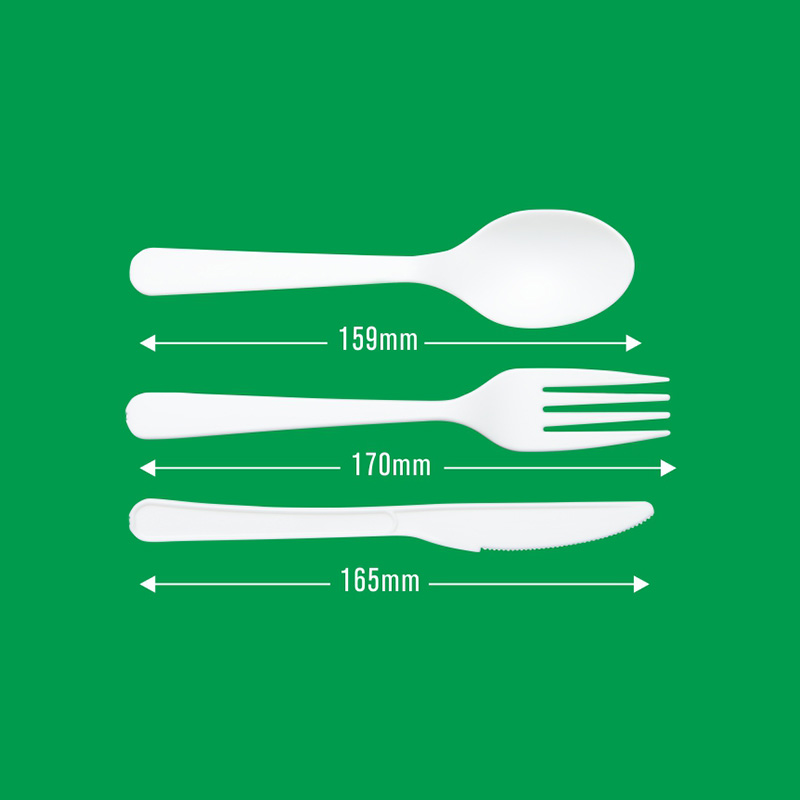
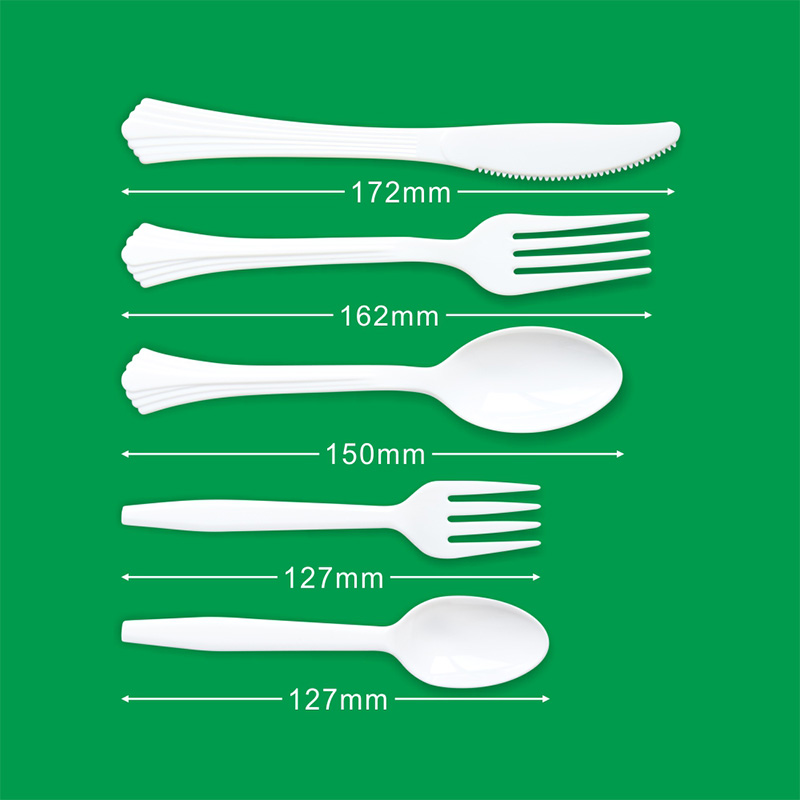
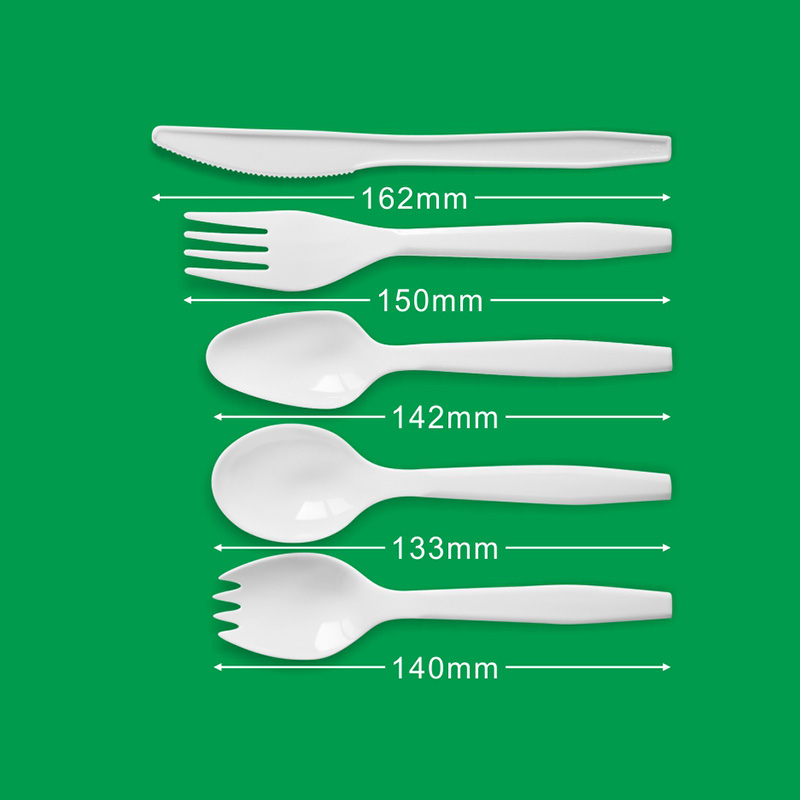
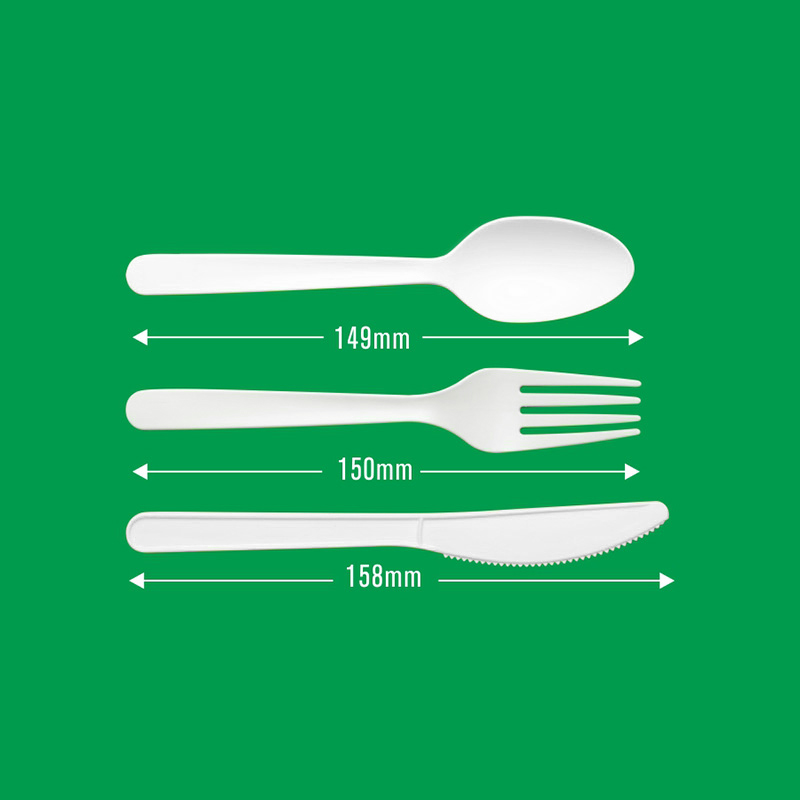
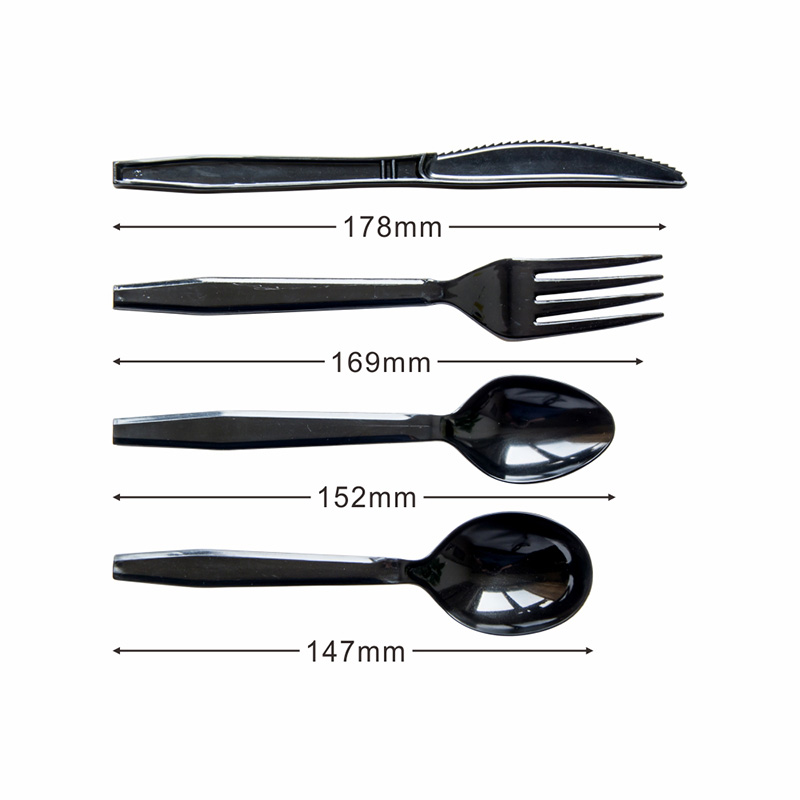
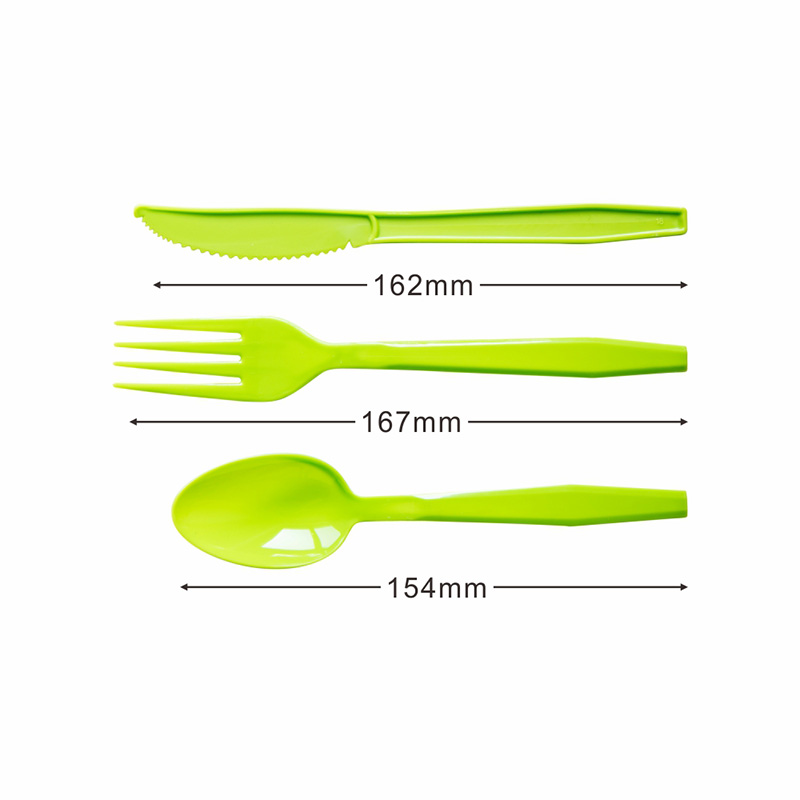
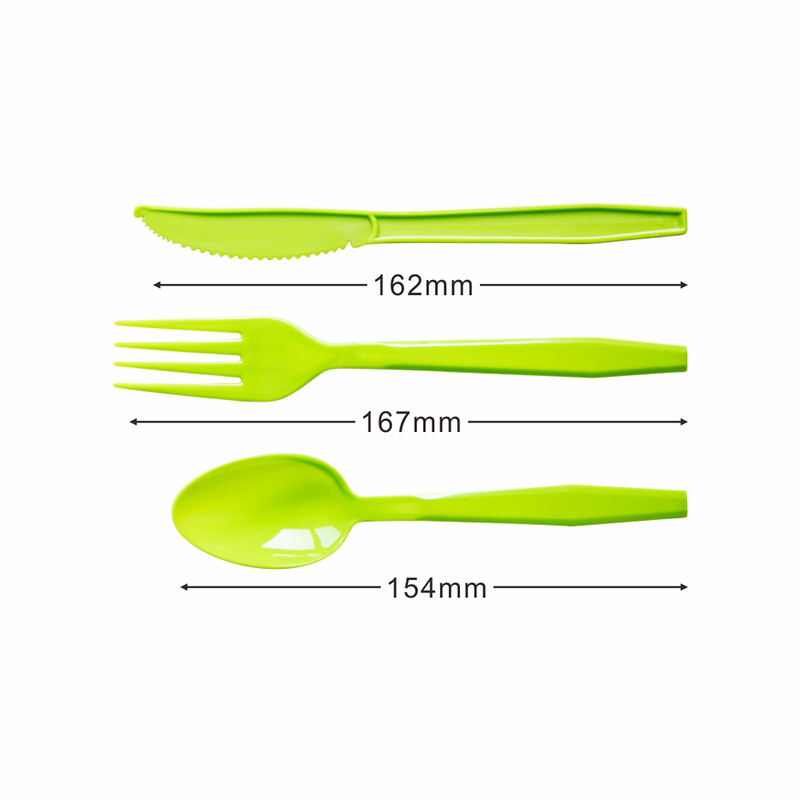
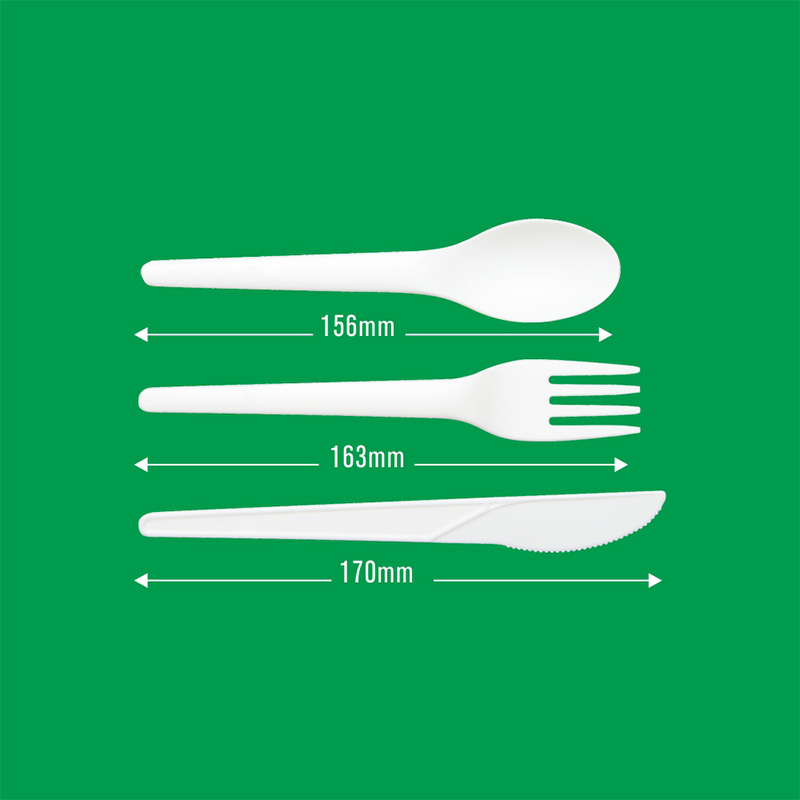
Thicker, Stiffer Pieces
Heavier gauge handles and tines resist bending, and the knife blade stays rigid through meat and bread. The set feels reassuring in the hand and avoids mid-meal replacements.

Thick, rigid knives, forks and spoons built for banquets, catering and events. Available in polystyrene or polypropylene, wrapped with a napkin, and designed to feel closer to real tableware.
Explore more compostable and disposable food service products from the same manufacturing group.
What weight classes mean, why polystyrene and polypropylene are used differently, and how a stronger set serves catering and events.
Heavy duty plastic cutlery sets are single-use knives, forks and spoons made from rigid plastic in a thicker gauge than economy or medium-weight cutlery, often packed together with a napkin and sealed in a pouch. They are sold in weight classes: light, medium, medium-heavy, heavy and extra heavy. The heavier the class, the thicker the handle, the stiffer the tines and the more the set feels like real tableware in the hand.
For caterers, hotels, wedding planners and quick-service restaurants, the class matters because cutlery is touched by every guest. A fork that bends under a piece of steak or a knife that snaps on a chicken breast creates a poor impression, and it leads to guests asking for replacements. A heavy duty set is meant to remove those moments, offering firm tines, a rigid knife blade with a serrated edge and a spoon with a deep, sturdy bowl.
The sets are produced in polystyrene (PS), polypropylene (PP) or a mix of both. PS is rigid and glossy, with a crisp, glass-like feel, while PP is slightly flexible and tolerates heat better. Many suppliers offer both, and the choice depends on the foods and the budget. Packaged sets provide a hygienic, ready-to-use kit for self-service stations and delivery orders.
Start by thinking about the heaviest dish on your menu. Steak, roast chicken, firm vegetables and large pasta portions put the most stress on cutlery. A heavy or extra heavy set will handle those foods, while a medium class may be fine for salads, rice and soft desserts. Testing a sample set with your toughest dish is the best way to decide.
Next, consider PS versus PP. PS is a stiff, glossy plastic that gives crisp edges and a refined feel, and is often chosen for wedding and banquet cutlery. PP is more flexible and tolerates hot foods and hot washing better, which makes it a better choice for hot meals and canteens. Some suppliers combine PS handles and PP bowls to balance feel and heat.
Presentation also matters. A set with a coloured handle, a silver or gold finish or a coordinated napkin elevates a buffet. A clear, wrapped set shows cleanliness for hygiene-sensitive services. Individual wraps can carry branding, while bulk boxes are more economical for high-volume use.
Responsible use also includes disposal. Rigid plastic cutlery is rarely recycled in standard municipal streams because of its small size, and some regions restrict plastic cutlery altogether. If your market has such rules, we can recommend plant-based alternatives from our PLA and fibre ranges that look similar and meet local requirements.
A note on feel: weight class is not only about strength, it is also about psychology. Guests judge a meal partly by what is in their hand, and a fork with a solid handle and sharp tines makes the food seem better. Caterers who have upgraded from light to heavy cutlery often report fewer complaints and fewer guests asking for a second set, even though the cutlery cost per guest rises only by a small amount.
Typical cutlery set configurations are listed below. Weight class, material, colour and packing can be customised.
| Material | Food-grade polystyrene (PS) or polypropylene (PP) |
|---|---|
| Weight Class | Medium-heavy, heavy and extra heavy |
| Piece Weight | Approximately 3.5 – 6.5 g per piece depending on class |
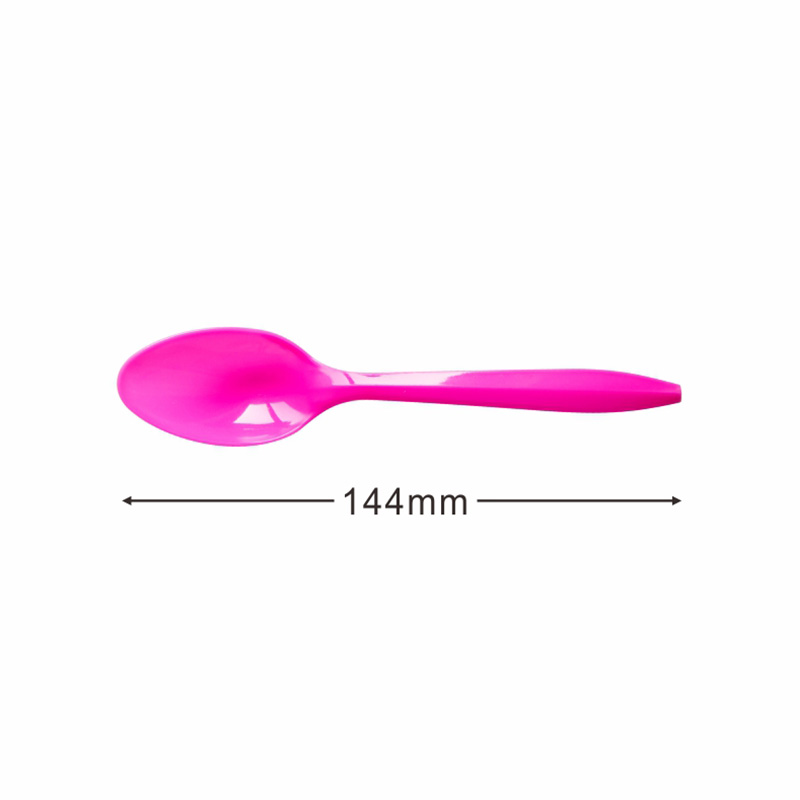
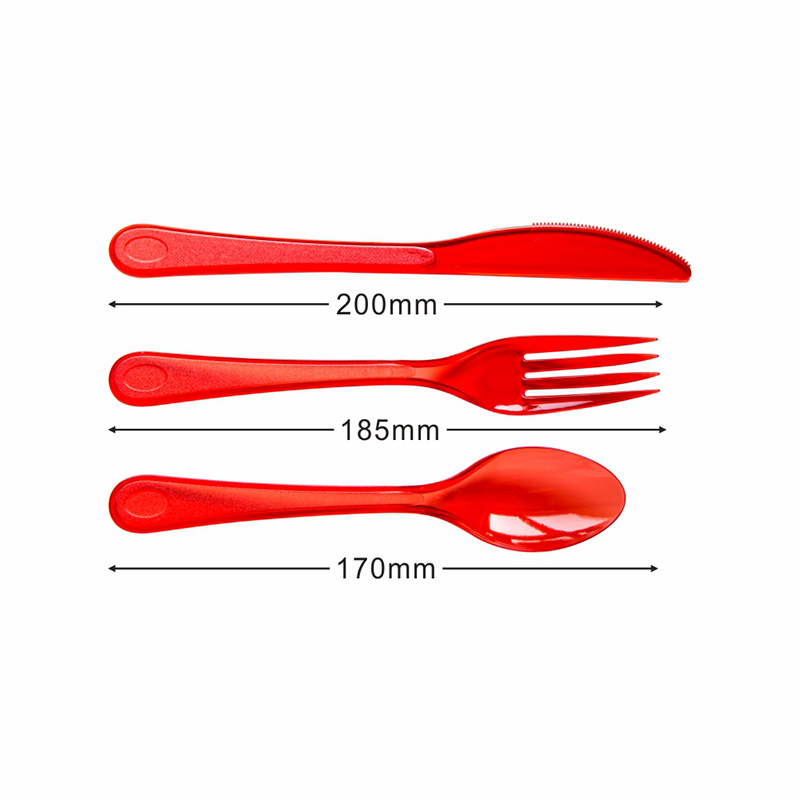
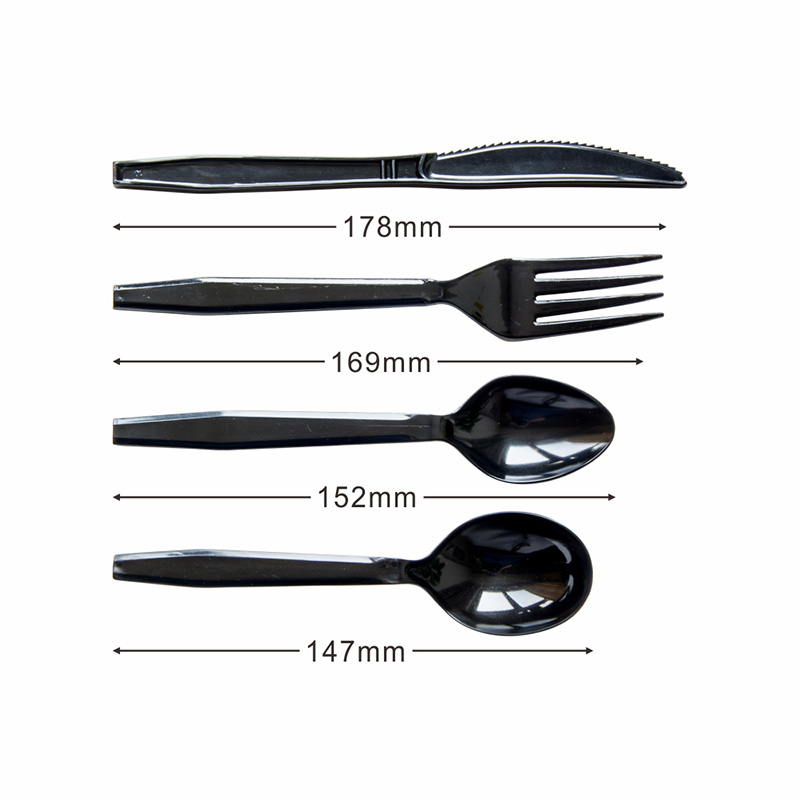
| Length | Fork, knife and spoon at 170 – 195 mm; teaspoon 140 mm |
| Set Contents | 3-piece, 4-piece (with napkin) and 5-piece (with salt and pepper) |
| Finish | Glossy or matte; clear, white, black, silver or gold tones |
| Heat Range | PP suitable for hot foods; PS best for room-temperature and cold foods |
| Packing | Individually wrapped sets, bulk boxes of 1,000 or dispenser packs |
| Compliance | FDA and EU food-contact materials |
| Lead Time | Usually 20 – 30 days for stock; longer for custom colours |




Sturdy enough for the main course, elegant enough for the buffet, and packed to keep service moving.
Heavier gauge handles and tines resist bending, and the knife blade stays rigid through meat and bread. The set feels reassuring in the hand and avoids mid-meal replacements.
A well-formed serrated edge cuts steak, chicken and cake cleanly without sawing or snapping, which is a major difference compared with light-weight knives.
Choose PS for a polished, rigid feel or PP for hotter foods and a slightly flexible handle, depending on your menu and budget.
Sealed pouches protect cutlery from dust and hands. Each set can include a napkin, salt and pepper sachet or toothpick for a complete eating kit.
Clear, white and black are staples, and silver or gold metallised finishes create a formal look for weddings and corporate banquets.
Bulk boxes for kitchen use, dispenser packs for self-service, and wrapped sets for delivery. Mixed orders are available to simplify purchasing.
We work with distributors, hospitality groups and retail brands across multiple markets and regions.
















Eight strengths that shape how we develop, manufacture and deliver heavy duty disposable cutlery and foodservice packaging at scale.
A recognised voice in the sector, participating in the development of industry standards and supported by growing demand for degradable materials at home and abroad.
R&D, production, manufacturing, sales and service are integrated under one organisation, creating an efficient and sustainable operating ecosystem.
Continuous investment in new technology and production, with targeted material development supported by academic expertise in polymer and materials science.
A broad product line paired with strong design and high customisation capability, so different industries can receive products built for their specific needs.
Intelligent production workshops and automated mechanical equipment keep output consistent and lead times predictable, even at high volume.
A global outlook with service to customers worldwide. Group headquarters in Ningbo, China, and a production base in Vietnam.
More than a decade of focus on quality, with international awards and manufacturing carried out strictly to the highest industry standards.
A diversified core management team drawn from benchmark companies in different industries, forming a distinctive corporate DNA.
A recognised position in the industry with participation in the formulation of industry standards, alongside domestic and global support for the environmentally friendly degradable sector.
R&D, production, manufacturing, sales and service are integrated to create an efficient and sustainable enterprise operation ecology.
Vigorous investment in the development and production of new technologies, with targeted technology development supported by professors from the Institute of Materials of the Chinese Academy of Sciences.
An extensive product line with excellent product design and high customisation capability, producing tailored products for the different needs of various industries.
Intelligent production workshops and automated mechanical production equipment create an industry-efficient enterprise.
Positioning global and serving the world, with the group headquarters in Ningbo, China, and a base in Vietnam.
Thirteen years focused on quality, with numerous international awards and manufacturing carried out strictly in accordance with the highest industry standards.
A diversified core management team with professionals from benchmark companies in different industries and management teams in diversified fields, forming a unique corporate DNA.
Cutlery touches food and mouths directly, so migration, odour and heavy-metal tests are part of routine documentation.
Rigid cutlery must be strong and safe. Material documents confirm food-contact compliance, and in-house tests confirm strength and finish for each production lot.
US food-contact regulations covering PS and PP resins and additives.
European plastic food-contact regulation, including overall and specific migration limits.
German food and feed code, commonly requested for tableware destined for Germany and Switzerland.
Fork tine bend test, knife snap test and spoon bowl crack check on random samples from each lot.
Piece count verification, pouch seal integrity and cleanliness inspection before cartoning.
Selected certifications and awards that support our compostable and food-contact product range.






How a heavy duty plastic set compares with economy plastic and plant-based cutlery.
Light plastic cutlery is cheap and widely available, but it bends and breaks under normal use. Plant-based PLA cutlery is positioned for sustainability, but standard PLA is less heat resistant and sometimes costs more.
A heavy duty plastic set gives a middle path: a higher-quality feel at a modest premium over light plastic, with the stiffness needed for banquet and catering service. It is a practical choice where sustainability regulations do not restrict plastic cutlery.
The comparison on the right sets out strength, heat tolerance, appearance, cost and regulatory outlook, and helps decide which type fits your event or business.
Cost per guest is a helpful way to compare. A heavy set may cost only a few cents more than a light one, yet it avoids double-use and complaints. Across a three-hundred-guest wedding, that small premium is a tiny share of the total catering budget, and it protects the impression of the whole meal.
| Attribute | Heavy Duty Plastic | Light Plastic | Plant-Based PLA |
|---|---|---|---|
| Strength | High | Low | Moderate |
| Hot food | PP good, PS limited | PP good | Standard PLA limited |
| Appearance | Premium finishes | Basic | Natural look |
| Compostable | No | No | Yes, industrial |
| Unit cost | Mid | Lowest | Mid to high |
| Wrapped set option | Yes | Yes | Yes |
| Customer perception | Neutral | Neutral | Positive |
| Regulatory outlook | Restricted in some regions | Restricted | Favourable |
Settings where cutlery will meet real food and real guests, and must not fail.


Changya New Material Technology Co., Ltd. was founded in 2013, and the group is headquartered in Ningbo, China. It is a limited liability company integrating R&D, production, and sales. As China Heavy Duty Plastic Cutlery Sets Manufacturers and Wholesale Heavy Duty Plastic Cutlery Sets Factory,, the company mainly produces paper, PLA & plastic disposable tableware, such as straws, cutlery, microwaveable box, hinged box, cup, carry-out bags, plates, dining kits, etc.
Changya New Material Technology Co., Ltd. has developed rapidly since its establishment, with constant growth each year, and has now become an enterprise in the field of high-quality disposable food and kitchen supplies in China.
Two manufacturing bases with automated production lines and strict quality control at every stage, from raw material to finished carton.

















Choose weight, material and finish for the event, then pack the sets to suit the service.
Select medium-heavy, heavy or extra heavy depending on the foods you serve and the impression you want to create.
PS for rigid, glossy looks, PP for hot foods and a slightly flexible handle. Mixed material sets can also be developed.
Clear, white and black are standard. Silver, gold and bronze metallised finishes are available for banquet and wedding sets.
Fork-knife-spoon, with napkin, with salt and pepper or with toothpick, all arranged to suit your service.
Printed wrapping film or paper napkins carrying your logo, event name or message.
Boxes sized for dispensers at self-service stations, with handle-first presentation for hygiene.
A six-dimension comparison of heavy duty plastic, light plastic and PLA cutlery. Scores are relative to the best performer in each dimension (5=best).
Highest strength and a premium feel, with good heat resistance in PP. Eco-rating is low and cost is above economy cutlery.
Lowest cost but weak strength and a basic feel, with low eco-rating.
Strong environmental profile with moderate strength and limited heat tolerance.
How heavy duty plastic cutlery compares with alternatives on material weight and carbon footprint.
Approximate weight of each fork type. Heavier cutlery uses more material but performs better and avoids double-use. Values are indicative.
Indicative cradle-to-gate CO₂ equivalent per kilogram of material. Lower is better.
From plant sugar to a wrapped straw on a café counter — five stages that define the quality of the finished product.
Plant sugars from corn starch or sugarcane are fermented by bacteria to produce lactic acid, the building block of the polymer.
Lactic acid molecules are linked into long chains to form PLA resin, which is then pelletised for easy handling and transport.
The resin is melted and pushed through precision dies to form straw tubes with a consistent wall thickness and smooth surface finish.
Tubes are cut to length, the ends are finished to remove burrs, and samples are checked for straightness, diameter and appearance.
Each straw is sealed into its own paper wrapper — plain or printed — then counted into inner boxes and master cartons.

From resin to disposal — the full journey of a heavy duty plastic cutlery set.
PS or PP resin is produced as food-grade granules and supplied to the moulding factory.
Forks, knives and spoons are injection moulded in a heavy gauge, with serrated knife edges and strong tines.
Pieces are inspected, combined into sets with a napkin if requested and sealed in pouches or boxes.
The sets are used at banquets, buffets and takeaway counters, offering rigid performance.
Cutlery enters general waste or local collection routes; recycling is rare for small items, and rules vary.
With two manufacturing bases and established export partnerships, our heavy duty cutlery sets reach customers across five main regions.
Rigid plastic cutlery is stable and does not absorb moisture, but it is sensitive to heat and impact. Keep cartons away from heaters and direct sun, and do not drop cartons from height.
Store wrapped sets in a clean, dry area. Torn pouches should be discarded, since sealed packaging is part of the hygiene benefit. Keep bulk cutlery in lidded containers to avoid dust at the buffet.
At self-service stations, use a dispenser that presents the handle first. Refill with clean hands and do not top up half-empty trays with fresh cutlery directly, to avoid mixing handled pieces with unhandled ones.
At events, estimate three sets per guest for multi-course meals, and keep spares in a covered box. A little extra stock avoids last-minute shortages and keeps service smooth.
Tell us the diameter, length, color and wrapping you need. Our team will reply within 24 hours with pricing, packing details and delivery time.
PLA straws have significant advantages in raw material selection, which stems from their u...
The biodegradability of PLA straws is one of its significant advantages in the field of en...
Disposable PP Cutlery is an upstart in the catering industry, and its lightweight design h...
Copyright © Changya New Material Technology Co., Ltd.All Rights Reserved.
Wholesale Heavy Duty Plastic Cutlery Sets Manufacturers
