 English
 中文简体
中文简体
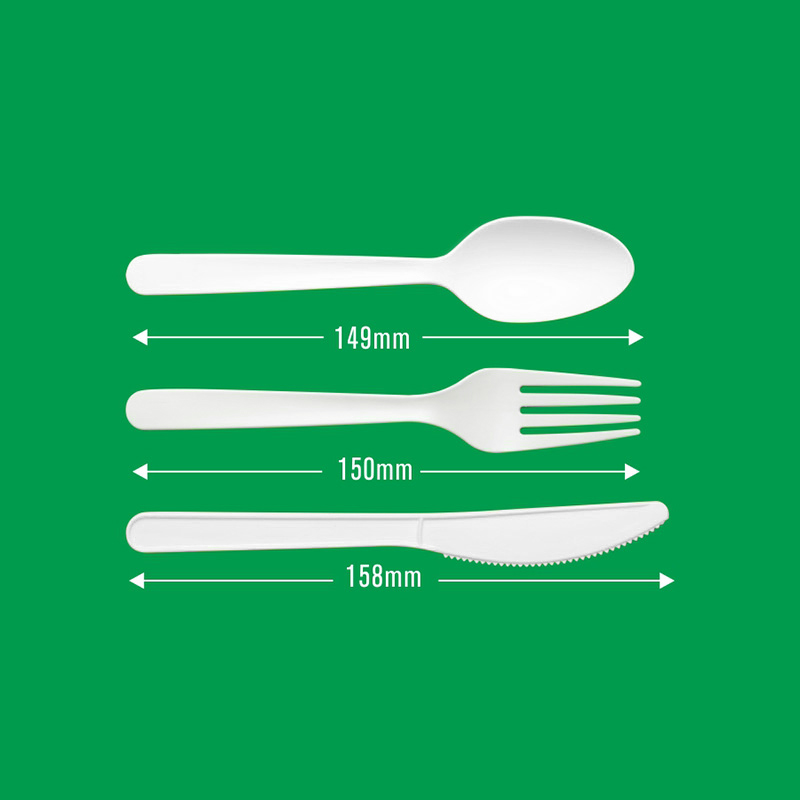
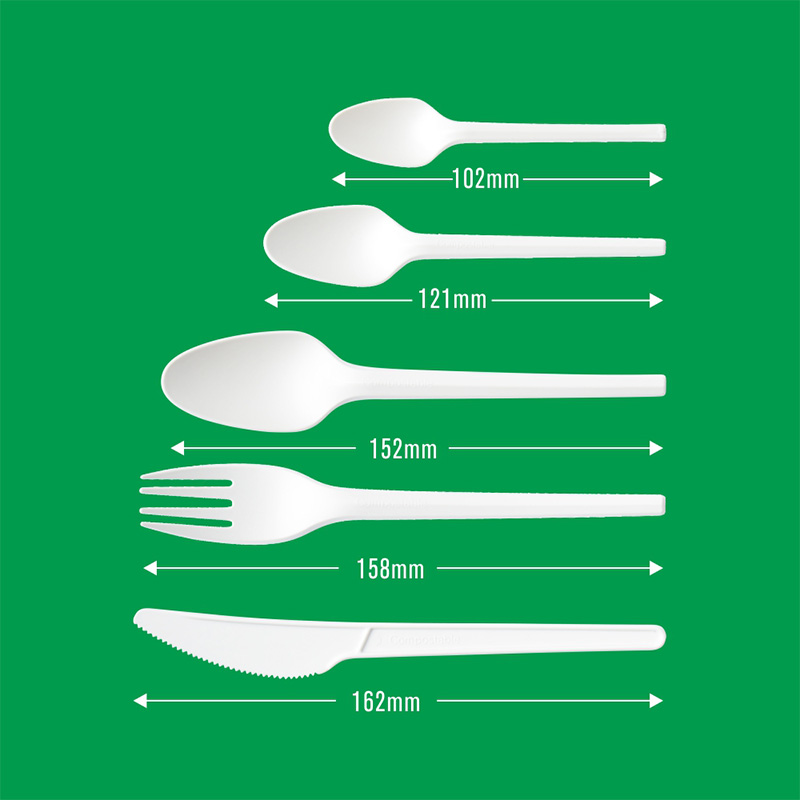
Reinforced Neck Structure
The most common failure on a disposable spoon is a crack at the neck. A thickened, filleted transition spreads the load, so the spoon survives frozen yoghurt, firm ice cream and dense rice.

A stronger, thicker plant-based spoon engineered for dense desserts, hearty grain bowls and thick smoothies. Reinforced neck, deep bowl and a comfortable grip that does not flex under load.
Explore more compostable and disposable food service products from the same manufacturing group.
What makes a spoon 'heavy duty', how PLA behaves under load, and where a stronger plant-based spoon earns its place.
Heavy duty PLA biodegradable spoons are single-use spoons made from polylactic acid, a plant-derived polymer, but designed with thicker walls, a reinforced neck and a deeper bowl than a standard lightweight spoon. They are built for jobs that make a thin spoon bend: scooping frozen yoghurt, stirring thick porridge, lifting dense rice or mixing a heavy smoothie bowl.
Many first-generation compostable spoons earned a poor reputation because they were simply made too thin to save material. Customers flexed the handle, the bowl cracked, and the restaurant received complaints. A heavy duty spoon addresses that problem directly. Material is added where stress actually concentrates — the transition between handle and bowl — and the handle has a ribbed or tapered profile that resists bending.
This makes the product especially useful for dessert shops, canteens and takeaway counters, where a spoon is a main utensil and not an afterthought. A spoon that holds its shape tells the customer the brand cares about the whole experience, and it helps the operator avoid giving out two spoons per order because the first one gave way.
PLA is naturally stiff, which is a strength for cutlery, but it is also a little brittle. Thin sections can crack suddenly rather than bending gradually. Engineering a heavy duty spoon therefore means controlling wall thickness, corner radii and cooling rate in the mould so that internal stress is kept low. A spoon that looks identical to a thinner one may perform very differently once those details have been tuned.
Production uses injection moulding with PLA grades selected for flow and impact resistance. Some formulations add small amounts of plant-based modifiers to improve toughness without compromising compostability. Each batch is sampled and flexed to confirm that handle deflection stays within a defined range before it leaves the factory.
Disposal should be communicated clearly. Certified PLA breaks down in industrial composting facilities in a matter of weeks, but not in a landfill or a home compost heap on any useful timescale. Telling customers where the spoon should go is part of responsible use, and it protects your brand against accusations of greenwashing.
For buyers, the practical question is simple: does the spoon survive the heaviest product on your menu? A sample test with your own thickest dessert or densest grain bowl will answer that more reliably than any datasheet, and we are happy to supply sample sizes to make the check easy.
A last consideration is how the spoon is stored and handed over. Heavy duty spoons are usually placed in a covered dispenser or inside a dessert cup kit, and sit for a long time in a warm kitchen. Keeping the stockroom cool, handing spoons out handle-first and avoiding pressure from heavy objects on top of loose stock all help the reinforced structure do the job it was designed for, from the first serve of the morning to the last of the night.
Standard heavy duty spoon formats are listed below. Weight, length, colour and packaging can be adjusted for your application.
| Material | Plant-based PLA (polylactic acid) derived from renewable corn starch |
|---|---|
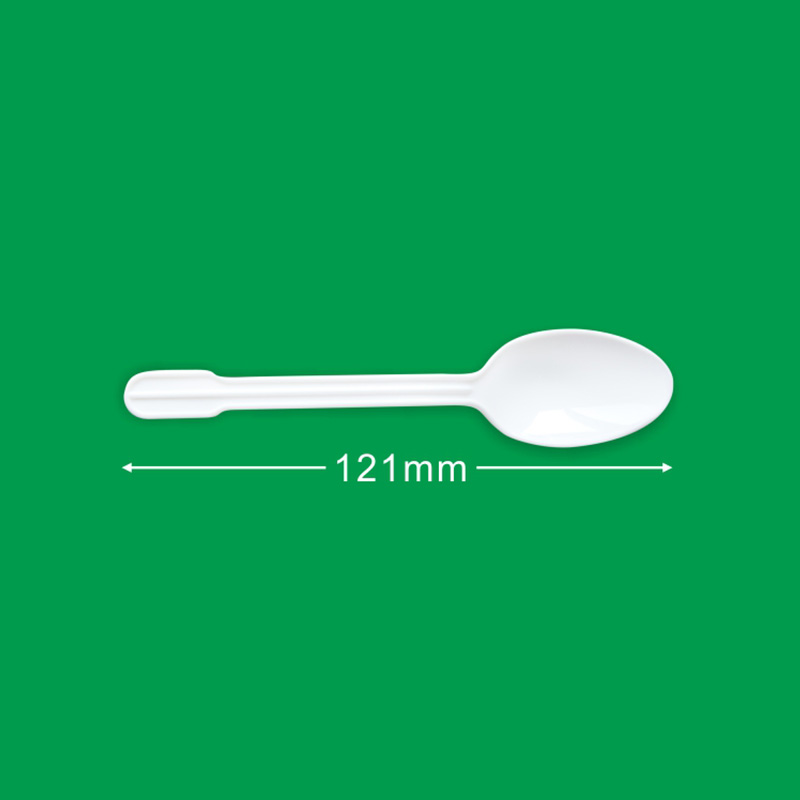
| Length | 150 mm standard, 165 mm large and 130 mm dessert sizes |
| Weight | Approximately 3.5 – 5.5 g per spoon, depending on size |
| Wall Thickness | Reinforced neck and handle; thicker than standard disposable spoons |
| Bowl Capacity | Approximately 8 – 12 ml depending on size |
| Color | Clear, white, black, kraft tone or custom matching |
| Finish | Glossy or matte surface, smooth lip edge |
| Heat Resistance | Suitable for cold and warm foods up to about 55 °C |
| Packing | Bulk carton, inner box of 50 / 100, or individually wrapped |
| Lead Time | Usually 15 – 30 days after artwork and deposit confirmation |




Engineered for the foods that defeat ordinary disposable spoons, without giving up a plant-based material.
The most common failure on a disposable spoon is a crack at the neck. A thickened, filleted transition spreads the load, so the spoon survives frozen yoghurt, firm ice cream and dense rice.
A central rib running along the handle increases stiffness without adding much material. The spoon resists flexing in the hand and feels solid rather than flimsy.
A generous bowl carries more food per scoop and has a smooth, rounded lip that is comfortable in the mouth. It works equally well for soup, pudding, cereal and cut fruit.
Produced from renewable corn starch rather than petroleum, and supported by EN 13432 and ASTM D6400 documents where certified, so your compostable claim has something behind it.
Each lot is sampled for handle flex, bowl crack resistance and surface finish. This reduces complaints and avoids the situation where one carton behaves very differently from the next.
Available in clear, white, black and custom colours, packed loose, in boxes or individually wrapped, so a single product family can serve several concepts and serving styles.
We work with distributors, hospitality groups and retail brands across multiple markets and regions.
















Eight strengths that shape how we develop, manufacture and deliver heavy duty compostable PLA cutlery at scale.
A recognised voice in the sector, participating in the development of industry standards and supported by growing demand for degradable materials at home and abroad.
R&D, production, manufacturing, sales and service are integrated under one organisation, creating an efficient and sustainable operating ecosystem.
Continuous investment in new technology and production, with targeted material development supported by academic expertise in polymer and materials science.
A broad product line paired with strong design and high customisation capability, so different industries can receive products built for their specific needs.
Intelligent production workshops and automated mechanical equipment keep output consistent and lead times predictable, even at high volume.
A global outlook with service to customers worldwide. Group headquarters in Ningbo, China, and a production base in Vietnam.
More than a decade of focus on quality, with international awards and manufacturing carried out strictly to the highest industry standards.
A diversified core management team drawn from benchmark companies in different industries, forming a distinctive corporate DNA.
A recognised position in the industry with participation in the formulation of industry standards, alongside domestic and global support for the environmentally friendly degradable sector.
R&D, production, manufacturing, sales and service are integrated to create an efficient and sustainable enterprise operation ecology.
Vigorous investment in the development and production of new technologies, with targeted technology development supported by professors from the Institute of Materials of the Chinese Academy of Sciences.
An extensive product line with excellent product design and high customisation capability, producing tailored products for the different needs of various industries.
Intelligent production workshops and automated mechanical production equipment create an industry-efficient enterprise.
Positioning global and serving the world, with the group headquarters in Ningbo, China, and a base in Vietnam.
Thirteen years focused on quality, with numerous international awards and manufacturing carried out strictly in accordance with the highest industry standards.
A diversified core management team with professionals from benchmark companies in different industries and management teams in diversified fields, forming a unique corporate DNA.
A US specification for plastics designed to compost satisfactorily in aerobic industrial facilities, covering disintegration, biodegradation and ecotoxicity.
A heavier spoon uses more material, so documentation is even more important. Our PLA spoons are supported by independent tests and routine factory checks on strength and finish.
European standard for packaging recoverable through composting and biodegradation, widely requested by distributors.
US standard specification for compostable plastics, covering biodegradation and disintegration in industrial facilities.
Third-party schemes that confirm product suitability for industrial composting, depending on the item and certificate holder.
Materials produced to meet food-contact requirements for single-use cutlery in the target market.
Handle deflection test, bowl crack inspection and drop test on random samples from every production lot.
Selected certifications and awards that support our compostable and food-contact product range.






Where a reinforced plant-based spoon fits against the lighter PLA spoon and conventional polystyrene.
Standard PLA spoons are inexpensive and light, and they perform well for tea, yoghurt cups and soft puddings. Under a heavy scoop, however, the handle can flex or the neck can crack. Many operators then double-up spoons, which wastes material and money.
Conventional polystyrene or polypropylene spoons are tougher but offer no composting pathway and are being phased out in many jurisdictions. Heavy duty PLA tries to close the gap: it adds the structural reinforcement of a thicker spoon while keeping a plant-based, certifiable material.
The table opposite sets out the differences in strength, bowl depth, cost, compostability and customer perception. It can help you decide whether the extra weight is justified for your specific menu.
| Attribute | Heavy Duty PLA | Standard PLA | Plastic PS |
|---|---|---|---|
| Raw material | Renewable plant starch | Renewable plant starch | Petroleum-based |
| Compostable | Yes, industrial | Yes, industrial | No |
| Neck strength | High | Low to moderate | High |
| Bowl depth | Deep | Shallow to medium | Medium |
| Frozen dessert use | Excellent | Acceptable | Excellent |
| Weight per piece | 4 – 5.5 g | 2 – 3 g | 2.5 – 4 g |
| Printed packaging | Sleeve or bag | Sleeve or bag | Limited |
| Regulatory outlook | Favourable | Favourable | Restricted |
Any setting where a spoon is a main utensil and has to cope with something thicker than yoghurt.


Changya New Material Technology Co., Ltd. was founded in 2013, and the group is headquartered in Ningbo, China. It is a limited liability company integrating R&D, production, and sales. As China Heavy Duty PLA Biodegradable Spoons Manufacturers and Wholesale Heavy Duty PLA Biodegradable Spoons Factory,, the company mainly produces paper, PLA & plastic disposable tableware, such as straws, cutlery, microwaveable box, hinged box, cup, carry-out bags, plates, dining kits, etc.
Changya New Material Technology Co., Ltd. has developed rapidly since its establishment, with constant growth each year, and has now become an enterprise in the field of high-quality disposable food and kitchen supplies in China.
Two manufacturing bases with automated production lines and strict quality control at every stage, from raw material to finished carton.

















Tailor spoon size, thickness and colour to your menu, then add the packaging that suits your service style.
Choose a dessert, standard or large spoon, or a tasting-spoon format for samples. Bowl depth and lip shape can be adjusted to match your food.
Select a medium or heavy gauge according to your menu. A trial with your thickest product helps decide how much reinforcement is really needed.
Clear and white are always available. Black, kraft and bespoke brand colours can be produced to order and sampled before bulk production.
Paper or compostable film wrapping keeps each spoon hygienic and can carry your logo, menu message or a QR code.
Combine a spoon with a dessert cup or bowl in a matched kit, making ordering easier for delivery and packaged dessert programmes.
Add forks and knives from the same PLA range in a single order to simplify purchasing and freight.
A six-dimension comparison of heavy duty PLA, standard PLA and conventional plastic spoons. Scores are relative to the best performer in each dimension (5=best).
Strong handle, deep bowl and excellent eco-rating. Cost is a little higher than standard PLA because of the added material, and heat resistance is the usual PLA limit.
Good eco-profile and low cost, but lighter walls limit strength with dense foods, which can push operators to hand out two spoons.
Still the cost benchmark with good toughness, but lowest eco-rating and under growing regulatory pressure.
How a heavier PLA spoon compares with the alternatives on end-of-life time and carbon footprint.
Approximate time to break down under ideal conditions for each material. Values are indicative and vary by environment.
Indicative cradle-to-gate CO₂ equivalent per kilogram of material. Lower is better.
From plant sugar to a wrapped straw on a café counter — five stages that define the quality of the finished product.
Plant sugars from corn starch or sugarcane are fermented by bacteria to produce lactic acid, the building block of the polymer.
Lactic acid molecules are linked into long chains to form PLA resin, which is then pelletised for easy handling and transport.
The resin is melted and pushed through precision dies to form straw tubes with a consistent wall thickness and smooth surface finish.
Tubes are cut to length, the ends are finished to remove burrs, and samples are checked for straightness, diameter and appearance.
Each straw is sealed into its own paper wrapper — plain or printed — then counted into inner boxes and master cartons.

From plant harvest to certified disposal — the full journey of a heavy duty compostable PLA spoon.
Corn starch or sugarcane is harvested and converted into lactic acid through fermentation, then polymerised into PLA resin.
PLA granules are injection moulded into spoons with reinforced necks and ribbed handles, then cooled in controlled cycles.
Spoons are sampled for handle flex, bowl cracks and surface quality before being counted and packed.
Spoons serve cold desserts, grains and warm foods with a solid, confident feel, then are discarded.
Collected with food waste, the spoon breaks down in industrial composting within weeks into water, CO₂ and biomass.
With two manufacturing bases and established export channels, our heavy duty PLA spoons are shipped to five main regions.
Heavy duty spoons are thicker than average and therefore pack heavier. Cartons should be stacked in manageable heights and kept on pallets to avoid crushing the lower layers, particularly in hot warehouses where PLA can soften.
Avoid storing spoons in vehicles, near ovens or against sun-heated walls. PLA begins to soften at moderate temperatures, and a spoon that has been warped before use will not perform as designed. A cool, dry stockroom is ideal.
For front-of-house service, spoons packed in wrapped or boxed units reduce handling and speed up counter service. Inner boxes of 50 or 100 pieces fit dispensers and make daily restocking quick.
If your venue composts, confirm that the PLA spoon and any wrapper both go into the same organic bin. Matching the packaging to the waste stream avoids contamination and lets staff communicate a clear, consistent message to customers.
Tell us the diameter, length, color and wrapping you need. Our team will reply within 24 hours with pricing, packing details and delivery time.
PLA straws have significant advantages in raw material selection, which stems from their u...
The biodegradability of PLA straws is one of its significant advantages in the field of en...
Disposable PP Cutlery is an upstart in the catering industry, and its lightweight design h...
Copyright © Changya New Material Technology Co., Ltd.All Rights Reserved.
Wholesale Heavy Duty PLA Biodegradable Spoons Manufacturers
