 English
 中文简体
中文简体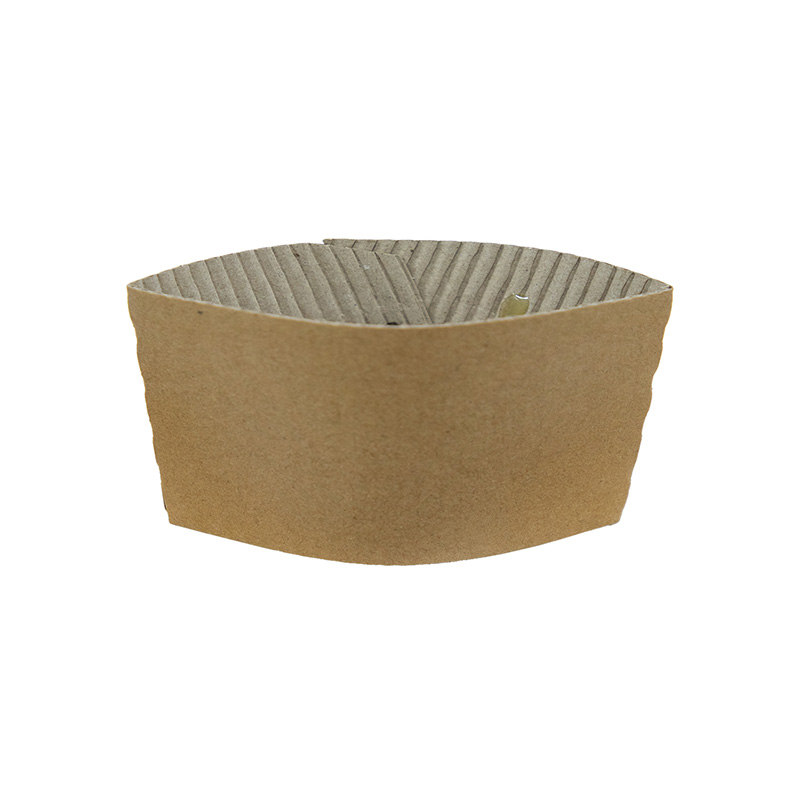
Air-Pocket Insulation
The ribbed flutes trap air against the cup, reducing heat transfer to the hand so that hot drinks are comfortable to hold.

Slim corrugated board sleeves that keep hands comfortable around hot cups. Pre-glued or flat, natural kraft or printed, in sizes for every cup.
Explore more compostable and disposable food service products from the same manufacturing group.
How a thin layer of corrugated board protects hands, why the ripple matters, and how to choose size and print for the sleeve.
Corrugated coffee cup sleeves are wraps of ribbed cardboard that slide around a paper cup to insulate the hand from the heat of the drink. The sleeve is made from a thin sheet of corrugated board, in which a fluted layer is sandwiched against a flat liner. The flutes create small pockets of trapped air that insulate, much as the air gap in a double wall cup does. The outside surface is smooth enough to print on, while the ribbed inside grips the cup.
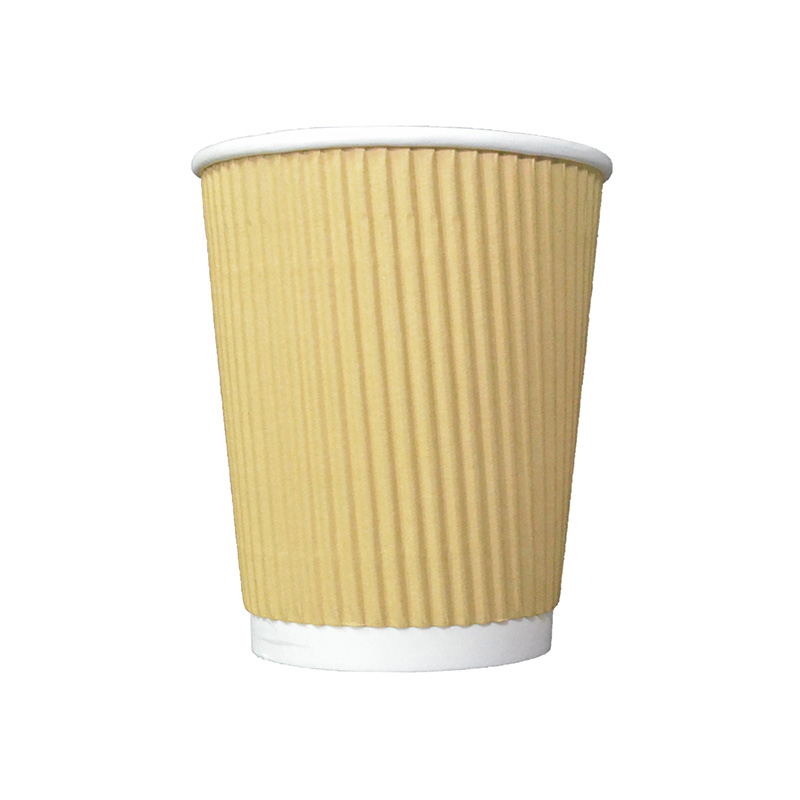
The sleeve exists because most hot cups are single wall. A single wall paper cup is cheap, light and efficient, but it passes heat quickly to the outside. Adding a sleeve for a few cents solves the heat problem without paying for a heavier cup. For high-volume coffee shops, this combination often gives the best balance of cost and comfort, and it gives a second advertising surface in the form of the sleeve itself.
Sleeves are also flexible. They can be made in different heights and diameters, to fit the cup range from small to large. They can be printed with a logo, a promotion, a loyalty message or a QR code. They can be changed with the season without changing the cup, which is attractive for brands that want fresh messaging at a small cost. They are packed flat, taking very little space.
Start with the cups. Sleeves are made for particular cup sizes and tapers. An 8 oz cup and a 12 oz cup need different circumferences and heights. If you use several sizes, order matching sleeves for each, or a universal sleeve that fits a range with a slight difference in grip.
Next, decide the style. Pre-glued sleeves are formed into rings and slide on from the top, which is fast. Flat sleeves with a tab and slot are applied by wrapping and locking, which takes slightly longer but packs flatter and costs less. For high-volume counters, pre-glued is usually best; for events and low volume, flat is fine.
Think about print. A plain kraft sleeve with a one-colour logo is economical and looks natural. A full-colour sleeve with a seasonal design gives you a changeable message. Many cafés use the sleeve as a loyalty tool, adding a QR code or a stamp area. Because the sleeve is separate from the cup, you can change it without changing the cup.
Finally, consider the end of life. Corrugated board is paper, and a clean sleeve can be recycled with cardboard or paper in most places, or composted where food contaminated paper is accepted. Water-based inks and plain kraft board make the sleeve easy to process. Ask customers to remove the sleeve and place it with paper, and the cup with its own stream.
Think about speed as well. Pre-glued sleeves can be applied in about a second, but flat sleeves need a wrap and a tuck, which adds a second or two. In a coffee shop making hundreds of drinks an hour, those seconds add up, so many busy outlets choose pre-glued sleeves, while low-volume or event settings use flat sleeves to save storage and money.
Typical cup sleeve configurations are listed below. Size, style, flute type and printing can all be customised.
| Material | Micro-flute corrugated paperboard (E or F flute), kraft or white |
|---|---|
| Board Thickness | Approximately 1.0 – 1.6 mm |
| Sizes | For 8 oz (60 – 80 mm), 12 oz (80 mm), 16 oz and 20 oz (90 mm) cups |
| Style | Pre-glued ring sleeve or flat wrap with locking tab |
| Height | Typically 55 – 85 mm depending on cup size |
| Heat Protection | Reduces heat felt by the hand with hot drinks up to about 95 °C |
| Printing | Plain or up to four colours, with matte or gloss varnish |
| Finish | Natural kraft, white, black or coloured board |
| Packing | Flat or nested bundles of 100 / 250, in master cartons |
| Lead Time | Usually 20 – 35 days for stock; 30 – 40 days for printed |




A thin, inexpensive piece of cardboard that protects hands and adds a second billboard to every drink.
The ribbed flutes trap air against the cup, reducing heat transfer to the hand so that hot drinks are comfortable to hold.
The ridged surface gives a non-slip feel, which is useful when carrying a hot drink on the move or in cold weather.
Sleeves are made for specific cup sizes and tapers, so they sit snugly without sliding down or being hard to apply.
Pre-glued ring sleeves slide on in a second, while flat sleeves pack more compactly and cost less. Choose the style that suits your counter.
A printed sleeve carries a logo, a seasonal design, a loyalty message or a QR code, and can be changed without changing the cup.
Made from corrugated board with water-based inks, a clean sleeve fits paper or cardboard recycling in most places.
We work with distributors, hospitality groups and retail brands across multiple markets and regions.
















Eight strengths that shape how we develop, manufacture and deliver corrugated cup sleeves and hot beverage packaging at scale.
A recognised voice in the sector, participating in the development of industry standards and supported by growing demand for degradable materials at home and abroad.
R&D, production, manufacturing, sales and service are integrated under one organisation, creating an efficient and sustainable operating ecosystem.
Continuous investment in new technology and production, with targeted material development supported by academic expertise in polymer and materials science.
A broad product line paired with strong design and high customisation capability, so different industries can receive products built for their specific needs.
Intelligent production workshops and automated mechanical equipment keep output consistent and lead times predictable, even at high volume.
A global outlook with service to customers worldwide. Group headquarters in Ningbo, China, and a production base in Vietnam.
More than a decade of focus on quality, with international awards and manufacturing carried out strictly to the highest industry standards.
A diversified core management team drawn from benchmark companies in different industries, forming a distinctive corporate DNA.
A recognised position in the industry with participation in the formulation of industry standards, alongside domestic and global support for the environmentally friendly degradable sector.
R&D, production, manufacturing, sales and service are integrated to create an efficient and sustainable enterprise operation ecology.
Vigorous investment in the development and production of new technologies, with targeted technology development supported by professors from the Institute of Materials of the Chinese Academy of Sciences.
An extensive product line with excellent product design and high customisation capability, producing tailored products for the different needs of various industries.
Intelligent production workshops and automated mechanical production equipment create an industry-efficient enterprise.
Positioning global and serving the world, with the group headquarters in Ningbo, China, and a base in Vietnam.
Thirteen years focused on quality, with numerous international awards and manufacturing carried out strictly in accordance with the highest industry standards.
A diversified core management team with professionals from benchmark companies in different industries and management teams in diversified fields, forming a unique corporate DNA.
Corrugated board can be supplied with chain-of-custody certification, supporting responsible sourcing claims for paper-based accessories.
A sleeve is not a food-contact item, but it is held by customers and sits near the lips and the drink. Documentation covers fibre and inks, and fit and heat checks are carried out on the line.
Chain-of-custody certified board supplied on request.
Water-based or low-migration inks used for printing, with declarations available on request.
Sleeves tested on cups filled with hot water, measuring the outside temperature.
Sleeve fit checked against cup samples for grip and ease of application.
Declarations that board and adhesives are suitable for packaging near food and drink.
Selected certifications and awards that support our compostable and food-contact product range.






How a corrugated sleeve compares with buying double wall cups or using two cups for each drink.
Double wall cups give built-in insulation, but they cost more per cup and take more storage space. Double cupping, putting one cup inside another, is quick but wasteful and doubles the cup cost.
Corrugated sleeves offer a low-cost, flexible solution. They allow a shop to use inexpensive single wall cups and add insulation only when it is needed. They also give a second printed surface and can be recycled with paper.
The comparison on the right sets out cost, waste, storage, flexibility and brand space, helping you decide which approach suits your coffee shop.
Another point is flexibility. With sleeves, you can run a promotion on a few thousand pieces without touching your cup supply, and you can change designs seasonally. With printed cups, a new design requires a new minimum run of the entire cup.
| Attribute | Corrugated Sleeve | Double Wall Cup | Double Cupping |
|---|---|---|---|
| Cost per drink | Low | Mid | High |
| Waste per drink | Cup + sleeve | One cup | Two cups |
| Storage space | Flat, compact | Bulky | Double stock |
| Flexibility | Use only when needed | Fixed | Always both |
| Brand space | Second print surface | Cup only | Cup only |
| Service speed | Add one step | No step | Add one step |
| Hand comfort | Good | Excellent | Good |
| Recycling | Paper stream | Cup route | Two cups |
Hot drink service where single wall cups are used and comfort and branding matter.


Changya New Material Technology Co., Ltd. was founded in 2013, and the group is headquartered in Ningbo, China. It is a limited liability company integrating R&D, production, and sales. As China Corrugated Coffee Cup Sleeves For Hot Drinks Manufacturers and Wholesale Corrugated Coffee Cup Sleeves For Hot Drinks Factory,, the company mainly produces paper, PLA & plastic disposable tableware, such as straws, cutlery, microwaveable box, hinged box, cup, carry-out bags, plates, dining kits, etc.
Changya New Material Technology Co., Ltd. has developed rapidly since its establishment, with constant growth each year, and has now become an enterprise in the field of high-quality disposable food and kitchen supplies in China.
Two manufacturing bases with automated production lines and strict quality control at every stage, from raw material to finished carton.

















Choose size, style and print so that the sleeve fits your cups and carries your message.
Sleeves for 8, 12, 16 and 20 oz cups, with universal sizes for mixed ranges.
Ring sleeves for fast application or flat wraps with locking tabs for compact storage.
Choose E or F flute and thickness for the balance of insulation and flexibility.
One to four colour designs in natural kraft, white or coloured board, with matte or gloss varnish.
Stamp areas, QR codes or promotions printed on the sleeve for customer engagement.
Short runs for holiday and seasonal campaigns, with quick artwork changes.
A six-dimension comparison of corrugated sleeves, double wall cups and double cupping. Scores are relative to the best performer in each dimension (5=best).
Low cost, compact storage and a second print surface, with good comfort. Adds a step to service.
Best comfort and speed, but higher cost and more storage space.
Quick but wasteful and costly, with no extra brand space.
How sleeves compare with the alternatives on packaging weight and carbon footprint.
Approximate weight added to a single wall cup for insulation. Lower weight reduces material use. Values are indicative.
Indicative cradle-to-gate CO₂ equivalent per kilogram of material. Lower is better.
From plant sugar to a wrapped straw on a café counter — five stages that define the quality of the finished product.
Plant sugars from corn starch or sugarcane are fermented by bacteria to produce lactic acid, the building block of the polymer.
Lactic acid molecules are linked into long chains to form PLA resin, which is then pelletised for easy handling and transport.
The resin is melted and pushed through precision dies to form straw tubes with a consistent wall thickness and smooth surface finish.
Tubes are cut to length, the ends are finished to remove burrs, and samples are checked for straightness, diameter and appearance.
Each straw is sealed into its own paper wrapper — plain or printed — then counted into inner boxes and master cartons.

From fibre to recycling — the full journey of a corrugated coffee cup sleeve.
Paper liners and fluting are made from wood pulp and recycled fibre.
A fluted layer is glued between flat liners to make micro-flute board, then printed and die-cut.
Sleeves are bundled flat or nested and cartoned for compact shipping.
The sleeve is slid onto a hot cup, protecting the hand and displaying the brand.
Clean sleeves go to cardboard or paper recycling, separated from the cup where required.
With two manufacturing bases and established export partnerships, our cup sleeves reach customers across five main regions.
Sleeves are packed flat or nested and take little space, but corrugated board can be crushed. Keep cartons on shelves and avoid placing heavy items on top.
Store in a dry, ventilated room, away from steam and humid walls. Moist corrugated board loses stiffness and can warp, making sleeves difficult to apply.
At the counter, keep sleeves in a dispenser near the cup station, and apply them before filling or immediately after. Slide the sleeve on from the bottom of the cup, and position it below the lid line, avoiding the seam.
Encourage customers to recycle the sleeve with paper. A small sign near the bin, showing the sleeve and cup in separate streams, helps ensure that both are recovered.
Tell us the diameter, length, color and wrapping you need. Our team will reply within 24 hours with pricing, packing details and delivery time.
PLA straws have significant advantages in raw material selection, which stems from their u...
The biodegradability of PLA straws is one of its significant advantages in the field of en...
Disposable PP Cutlery is an upstart in the catering industry, and its lightweight design h...
Copyright © Changya New Material Technology Co., Ltd.All Rights Reserved.
Wholesale Corrugated Coffee Cup Sleeves For Hot Drinks Manufacturers
