 English
 中文简体
中文简体


Strong Kraft Fibre
Long wood fibres from the kraft process resist tearing and puncture, so bags survive corners of boxes, cup bases and busy kitchen handling.

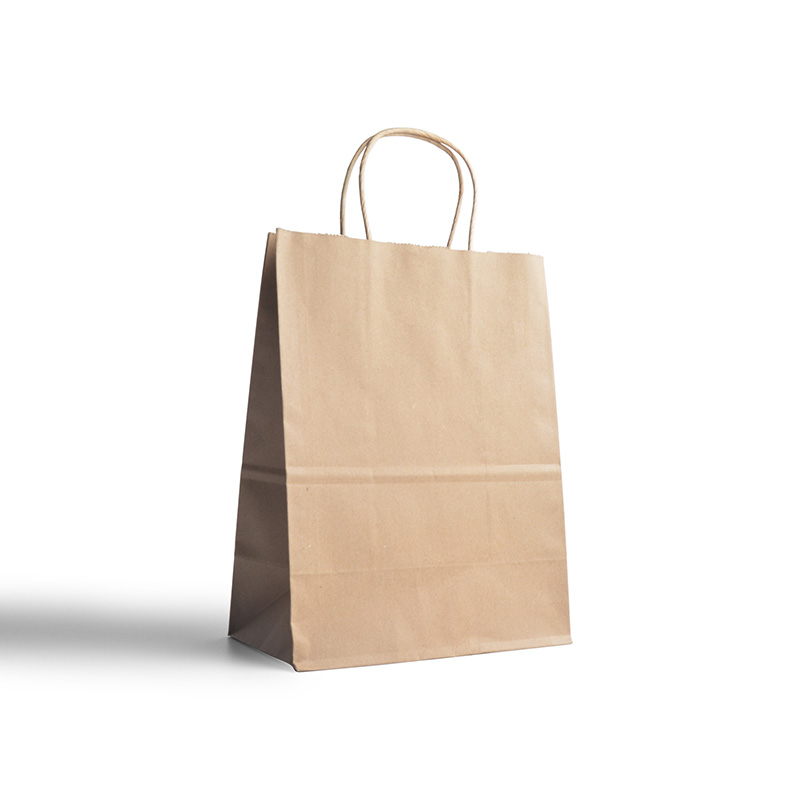
Strong, flat-bottom kraft paper bags that stand up on the counter, carry a full takeaway order and carry your brand out of the door. Handled or SOS style, plain or printed, in sizes for every menu.
Explore more compostable and disposable food service products from the same manufacturing group.
How a flat-bottom kraft bag carries a full takeaway order, which structural details decide whether it holds, and how handles, paper weight and printing change the bag.
Disposable carry out paper kraft bags are the bags that take a takeaway order from the counter to the street: brown or white paper sacks, usually with a flat bottom, folded side gussets and, in many designs, flat paper or twisted handles. They are made from kraft paper, a strong paper produced by the sulphate pulping process, which keeps long wood fibres intact and gives the sheet exceptional tear resistance for its weight. The word kraft is German for strength, and in a carry out bag that strength is the whole job.
A good carry out bag does more than hold things. It stands upright on a counter so staff can pack quickly, it keeps its shape when loaded with boxes and cups, it absorbs the occasional grease stain without failing and it can be folded flat for storage in a very small space. A restaurant that handles several hundred orders a day will pack, carry and hand over the bag every few seconds, so ease of opening and stability matter just as much as strength.
For brands, the bag is also the most mobile advertising surface in the business. It travels through offices, trains and households, and the customer carries it in plain view. A kraft bag with a clean one-colour logo reads as natural and honest, and a fully printed bag can reflect a bold brand. Either way, paper is widely seen as a more responsible choice than a plastic carrier, which is why cities that have restricted plastic bags generally treat paper as the default replacement.
Start with the contents. Sandwiches, bagels and pastries only need a small SOS bag with no handles. A family meal of three or four containers needs a large, wide-gusset bag with strong handles. A delivery order with soup cups and a drink tray may need a stronger base and more height. A simple trial with a typical order, carried around the shop, tells you more than the datasheet.
Then consider the handle. Flat paper handles are glued inside the mouth of the bag and give a comfortable carry for medium loads. SOS bags without handles are cheaper, simpler to store and ideal for grab-and-go. If you want an upscale look, twisted paper handles can be requested, although for that design we offer a dedicated range with more options.
Look at the paper. Natural brown kraft reads as eco-friendly and reduces the visibility of stains, while bleached white kraft gives a clean surface for colourful printing. Recycled-content kraft is available in many weights, with a slightly different feel and a greater share of short fibres. Strength should be verified for each paper type, because recycled paper is usually weaker at the same weight.
Finally, think about disposal. Plain paper bags are widely accepted in paper recycling and, when clean, can be composted. Bags with plastic liners, laminated surfaces or heavy ink coverage can complicate that. If your customers care, a simple, lightly printed bag with a clear message about recycling gives the strongest environmental story.
Cost per order is the number that matters. A bag that costs a fraction of a cent more but never tears saves the remake, the refund and the bad review. Operators who track complaints often find that moving from a light bag to a reinforced one pays for itself within weeks, particularly in delivery, where bags are tossed into baskets and carried by the handles for blocks.
Typical carry out bag configurations are listed below. Size, paper weight, handle type and printing can all be customised.
| Material | Virgin kraft paper, natural brown or bleached white; recycled-content option |
|---|---|
| Paper Weight | 60 – 120 gsm depending on size and load |
| Bag Sizes | From 12 × 8 × 24 cm snack bags to 32 × 17 × 34 cm family bags |
| Style | Flat-bottom SOS bags or bags with flat paper handles |
| Bottom | Glued and folded base, with optional reinforcing card |
| Load Capacity | Approximately 3 – 10 kg depending on style and paper weight |
| Printing | Plain, or up to four colours flexographic / offset |
| Liner Options | Unlined, grease-resistant or moisture-resistant liner on request |
| Packing | Bundles of 50 / 100 bags, packed flat in master cartons |
| Lead Time | Usually 20 – 35 days for stock; 30 – 45 days for printed |




Bags built for the busiest hours of the day, from first order to last, and for the walk home afterwards.
Long wood fibres from the kraft process resist tearing and puncture, so bags survive corners of boxes, cup bases and busy kitchen handling.
A glued, folded base lets the bag stand open on the counter, so staff can pack with both hands and fill quickly during a rush.
Flat paper handles are glued over reinforcing patches, spreading the load across the bag mouth and reducing the chance of tearing when carried.
A range from small snack bags to wide family bags matches the order to the bag, avoiding both overpacking and under-sized carriers.
Broad flat panels allow a logo, slogan or pattern to travel with every order, and one-colour designs keep costs low and the natural look intact.
Plain kraft bags enter paper recycling streams in many places, and are easy to explain to customers who are looking for a lower-plastic alternative.
We work with distributors, hospitality groups and retail brands across multiple markets and regions.
















Eight strengths that shape how we develop, manufacture and deliver kraft paper bags and takeaway packaging at scale.
A recognised voice in the sector, participating in the development of industry standards and supported by growing demand for degradable materials at home and abroad.
R&D, production, manufacturing, sales and service are integrated under one organisation, creating an efficient and sustainable operating ecosystem.
Continuous investment in new technology and production, with targeted material development supported by academic expertise in polymer and materials science.
A broad product line paired with strong design and high customisation capability, so different industries can receive products built for their specific needs.
Intelligent production workshops and automated mechanical equipment keep output consistent and lead times predictable, even at high volume.
A global outlook with service to customers worldwide. Group headquarters in Ningbo, China, and a production base in Vietnam.
More than a decade of focus on quality, with international awards and manufacturing carried out strictly to the highest industry standards.
A diversified core management team drawn from benchmark companies in different industries, forming a distinctive corporate DNA.
A recognised position in the industry with participation in the formulation of industry standards, alongside domestic and global support for the environmentally friendly degradable sector.
R&D, production, manufacturing, sales and service are integrated to create an efficient and sustainable enterprise operation ecology.
Vigorous investment in the development and production of new technologies, with targeted technology development supported by professors from the Institute of Materials of the Chinese Academy of Sciences.
An extensive product line with excellent product design and high customisation capability, producing tailored products for the different needs of various industries.
Intelligent production workshops and automated mechanical production equipment create an industry-efficient enterprise.
Positioning global and serving the world, with the group headquarters in Ningbo, China, and a base in Vietnam.
Thirteen years focused on quality, with numerous international awards and manufacturing carried out strictly in accordance with the highest industry standards.
A diversified core management team with professionals from benchmark companies in different industries and management teams in diversified fields, forming a unique corporate DNA.
Chain-of-custody certified kraft paper can be supplied on request, supporting claims about responsible sourcing of wood fibre.
A carry out bag touches food packaging and sometimes food directly, so documentation covers the paper, the inks and any liners. Strength is verified in the factory on every production lot.
Chain-of-custody certified paper for brands and markets that require responsible forestry sourcing.
Paper and inks produced to meet food-contact requirements where the bag touches unwrapped food.
Bags filled with a standard test weight, carried and dropped to confirm bottom and handle strength.
Water-based or low-migration inks used where printed surfaces are close to food.
Paper moisture content measured to keep strength consistent through storage and use.
Selected certifications and awards that support our compostable and food-contact product range.






How a kraft paper carry out bag compares with plastic and non-woven carriers.
Plastic bags are cheap, waterproof and strong, but they face bans or charges in many cities and carry a negative image. Non-woven bags are durable and reusable, but their unit cost is too high for a bag handed out with every meal.
Kraft paper offers a balance that suits food service. It is low in cost, recognisable as a sustainable choice, easy to print and easy to recycle. Its weakness is moisture, which can be managed with packaging inside the bag and with liners where needed.
The comparison on the right sets out cost, strength, moisture performance, branding and regulatory outlook, which helps you weigh the choice for takeaway, delivery and retail.
Consider also the way the bag is stored. Flat-packed paper bags occupy a fraction of the volume of plastic or non-woven alternatives, which matters in small kitchens and food trucks where every shelf counts.
| Attribute | Kraft Paper Bag | Plastic Bag | Non-Woven Bag |
|---|---|---|---|
| Raw material | Wood fibre (kraft pulp) | Petroleum polymers | Polypropylene fibre |
| Recyclable | Paper stream | Limited | Rarely |
| Strength dry | High | High | High |
| Wet performance | Weakens | Excellent | Good |
| Print area | Large | Moderate | Moderate |
| Unit price | Low to mid | Lowest | High |
| Reusable | Occasionally | Occasionally | Designed for reuse |
| Regulatory outlook | Favourable | Restricted | Mixed |
Any counter where food leaves the building and the bag has to be strong, stable and on brand.


Changya New Material Technology Co., Ltd. was founded in 2013, and the group is headquartered in Ningbo, China. It is a limited liability company integrating R&D, production, and sales. As China Disposable Carry Out Paper Kraft Bags Manufacturers and Wholesale Disposable Carry Out Paper Kraft Bags Factory,, the company mainly produces paper, PLA & plastic disposable tableware, such as straws, cutlery, microwaveable box, hinged box, cup, carry-out bags, plates, dining kits, etc.
Changya New Material Technology Co., Ltd. has developed rapidly since its establishment, with constant growth each year, and has now become an enterprise in the field of high-quality disposable food and kitchen supplies in China.
Two manufacturing bases with automated production lines and strict quality control at every stage, from raw material to finished carton.

















Choose size, paper and printing to suit your orders, and add liners or handles where the menu needs extra protection.
Select width, depth and height to match typical orders, from single-sandwich bags to wide family bags with deep gussets.
Choose between lighter and heavier gsm, natural brown or bleached white, and virgin or recycled-content kraft.
Flat paper handles for comfort, or handle-free SOS bags for grab-and-go. Handle patches are reinforced for heavier orders.
One-colour logos, patterns or full-colour designs on the front, back and gussets. Water-based inks keep the paper recyclable.
Optional liner for fried foods, pastries and oily meals, specified to match your disposal route.
Clear windows for baked goods or label areas for order numbers and delivery details.
A six-dimension comparison of kraft paper, plastic and non-woven bags for takeaway. Scores are relative to the best performer in each dimension (5=best).
Strong when dry, easy to print on and widely accepted as a sustainable choice. Wet strength is its main limitation.
Cheapest and fully waterproof, but low eco-rating and increasingly restricted.
Durable and reusable, but a high unit cost and bulkier storage make it a poor fit for single-order service.
How kraft bags compare with plastic and non-woven options on carrying capacity and carbon footprint.
Approximate load a bag can carry in normal use. Values are indicative and depend on size, paper weight and handling.
Indicative cradle-to-gate CO₂ equivalent per kilogram of material. Lower is better.
From plant sugar to a wrapped straw on a café counter — five stages that define the quality of the finished product.
Plant sugars from corn starch or sugarcane are fermented by bacteria to produce lactic acid, the building block of the polymer.
Lactic acid molecules are linked into long chains to form PLA resin, which is then pelletised for easy handling and transport.
The resin is melted and pushed through precision dies to form straw tubes with a consistent wall thickness and smooth surface finish.
Tubes are cut to length, the ends are finished to remove burrs, and samples are checked for straightness, diameter and appearance.
Each straw is sealed into its own paper wrapper — plain or printed — then counted into inner boxes and master cartons.

From forest fibre to recycling — the full journey of a disposable carry out paper kraft bag.
Wood chips are pulped by the kraft process, producing long, strong fibres that are pressed into paper rolls.
Paper is printed, tubed, gusseted and glued into bags, with reinforced bottoms and handles where needed.
Bags are counted, bundled flat and cartoned to reduce storage space and shipping volume.
The bag is opened at the counter, filled with food and drinks, and carried to the customer's destination.
Clean bags are collected for paper recycling or composting, depending on local systems.
With two manufacturing bases and established export partnerships, our kraft bags reach customers across five main regions.
Paper bags are shipped flat and take little space, but they are sensitive to humidity. Keep cartons sealed and stored on shelves or pallets in a dry, ventilated room, away from walls and floors where moisture can accumulate.
Avoid storing near steam, sinks and refrigeration units, where condensation can soften the paper and weaken the glue lines. In humid climates, use a dehumidifier or keep cartons in a closed cabinet.
At the counter, keep bags in a dispenser or on a shelf at a comfortable height, so staff can pick and open them with one hand. Open the bag by tapping the base on the counter, which loosens the folds and lets it stand upright.
Pack heavier items at the bottom, keep hot and cold items separate and avoid overfilling above the fold line. A few seconds of careful packing prevents most complaints about torn or collapsed bags.
Tell us the diameter, length, color and wrapping you need. Our team will reply within 24 hours with pricing, packing details and delivery time.
PLA straws have significant advantages in raw material selection, which stems from their u...
The biodegradability of PLA straws is one of its significant advantages in the field of en...
Disposable PP Cutlery is an upstart in the catering industry, and its lightweight design h...
Copyright © Changya New Material Technology Co., Ltd.All Rights Reserved.
Wholesale Disposable Carry Out Paper Kraft Bags Manufacturers
